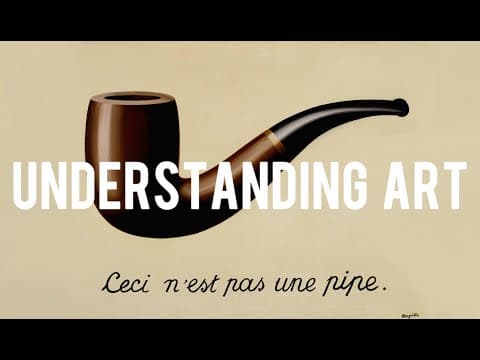
Rene Magritte's painting, The Treachery of Images, challenges our understanding of representation and language. By stating 'Ceci n'est pas une pipe,' Magritte reveals the arbitrary relationship between images and reality, prompting viewers to reconsider how they perceive art and language. This blog post delves into the philosophical implications of the painting and Magritte's unique approach to surrealism, emphasizing the complexities of visual representation and meaning.
Rene Magritte's painting, The Treachery of Images, is a profound exploration of the relationship between images and language. This blog post will delve into the philosophical implications of the painting, examining how it challenges our understanding of representation and reality.
When standing in front of a painting, many viewers often grapple with the question: What am I supposed to feel? This uncertainty can be particularly pronounced with works by artists like Kandinsky, Monet, or Seurat, where the emotional response is not immediately clear. However, Magritte's The Treachery of Images offers a different experience. It engages the viewer directly, using language to communicate its message.
Rene Magritte, a prominent figure in the surrealist movement, viewed himself not merely as a painter but as a thinker who utilized images to express complex ideas. His artistic style remained consistent throughout his career, and he drew heavily from philosophical concepts, engaging with thinkers from Plato to Foucault. Magritte's work often aimed to confuse and evoke mystery, revealing that our desires and understandings are often obscured by our perceptions.
At first glance, The Treachery of Images presents a straightforward image of a pipe, accompanied by the phrase "Ceci n'est pas une pipe" (This is not a pipe). This statement serves as a reminder that the painting is not a pipe itself but rather a representation of one. While this may seem like common sense, it raises deeper questions about the nature of representation.
Historically, many have believed in a direct relationship between language and reality, assuming that the names of things arise organically from the things themselves. This notion was famously challenged by linguist Ferdinand de Saussure, who argued that the connection between a word and its referent is arbitrary. According to Saussure, we do not know things directly; instead, we access their meanings through language, which operates within a broader system of signs.
Magritte's work critiques the traditional understanding of representation in art. Realistic paintings often rely on resemblance, suggesting a hierarchy where the image points to the object itself. However, Magritte subverts this expectation by exposing the false premises of resemblance. In The Treachery of Images, he lays bare the dependence of visual representation on language, illustrating that our understanding of images is mediated by words.
In The Treachery of Images, the image of the pipe and the accompanying text are presented together, prompting viewers to consider their relationship. Why should the image and the sentence refer to one another? This question highlights the complexities of how we interpret visual and verbal information. The inevitability of connecting the image and the text reflects our everyday experiences, where we often assume that what we see can be accurately described by language.
Magritte's assertion that "This is not a pipe" introduces a contradiction that challenges our understanding of meaning. If the painting is not a pipe, then the statement itself becomes nonsensical. This contradiction invites viewers to reconsider their assumptions about representation and the nature of reality. It suggests that our perceptions and the language we use to describe them do not always align.
Rene Magritte's The Treachery of Images serves as a powerful reminder of the complexities inherent in visual representation and language. By challenging the viewer's assumptions about what an image can convey, Magritte encourages a deeper examination of how we understand art and reality. The painting's exploration of the arbitrary relationship between language and images reveals the treachery that lies within our perceptions, prompting us to question the very nature of meaning itself.
In a world where images and words are constantly intertwined, Magritte's work remains a relevant and thought-provoking commentary on the limitations of representation and the intricacies of human understanding.