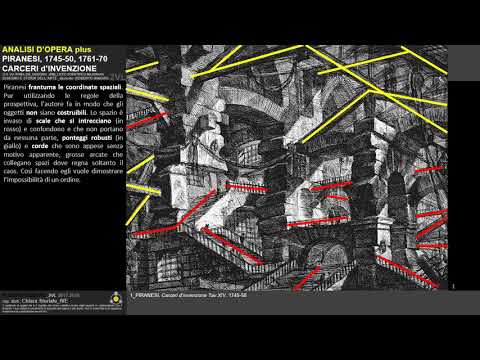
Giovanni Battista Piranesi, an 18th-century Italian artist, created the haunting series 'Carceri' which explores themes of confinement and chaos through intricate architectural engravings. His work has influenced numerous artists and writers, reflecting a deep sense of existential dread and the impossibility of escape.
Giovanni Battista Piranesi, born in 1720 and passing in 1778, was an influential engraver, architect, and theorist of Neoclassical architecture. His fascination with Rome and its ruins led him to relocate there, where he would create a body of work that primarily consisted of engravings depicting Roman ruins and imaginative architecture. Among his most significant contributions is the series known as "Carceri" (Prisons), which delves into themes of confinement and the human condition.
Piranesi produced two editions of the "Carceri" series, both published by the Buchard publisher. The first edition, titled "Invenzioni Capricci di Carceri" (Inventions of Caprice of Prisons), was released between 1745 and 1750 and contained fourteen plates. The second edition, known as "Carceri d'invenzione di Giambattista Piranesi, architetto veneziano," was published from 1761 to 1770 and included sixteen plates, with additional elements added to enhance the visual impact.
In the second edition, Piranesi revisited his earlier works with a more mature perspective, emphasizing certain strengths. He introduced machinery, staircases, and beams to amplify the sense of depth in his engravings. The original plates were brighter, but by 1770, they were reworked to be darker and more contrasted, creating a theatrical effect that heightened the feelings of discomfort and suffering.
Piranesi's "Carceri" is characterized by divergent perspectives and vanishing points that extend beyond the edges of the plates. The absence of a clear stage plane, obscured by bases and capitals, contributes to an unsettling atmosphere. The interplay of time and space is masterfully manipulated, resulting in a vast allegory that evokes a sense of vertigo. This sensation arises not from a lack of measurements, as Piranesi was a skilled draftsman, but from the multitude of precise calculations that lead to incorrect proportions.
The "Carceri" series aims to convey a profound sense of malaise that evolves into a nightmare, depicting a world devoid of a center yet perpetually expanding. Francesco Dal Co describes this experience as one where the coordinates of space are fragmented, creating an environment where order is impossible.
In his engravings, Piranesi disrupts spatial coordinates, employing perspective rules while ensuring that the depicted objects remain unbuildable. The images are filled with intertwining staircases that lead nowhere, creating a chaotic environment. Elements such as scaffolding and ropes appear without purpose, while massive arches connect to spaces dominated by disorder.
This labyrinthine structure reflects an inner sense of anxiety, with the continuous presence of human figures amplifying the grim and terrifying aspects of the scenes. As noted by the critic Juve Noir, the true horror of the "Carceri" lies in the indifference of the human figures, who wander through vast spaces without communicating or acknowledging one another, even as a condemned individual suffers in a dark corner.
Piranesi revolutionized the traditional representation of prisons, moving away from the concept of a closed iron cage. Instead, his walls feature numerous openings, and the bars serve more as decoration than as barriers. The real impossibility of escape stems from the labyrinthine essence of the structures and the intertwining staircases.
One of the most recognized plates in the series, the seventh plate, exemplifies Piranesi's intent to deceive the observer with impossible spaces. The depicted staircases lead to nowhere, colliding with walls or other staircases, creating a sense of futility.
The "Carceri" series has inspired countless artists and writers, particularly during the Romantic period. Notable figures such as Horace Walpole, author of "The Castle of Otranto" in 1764, drew from Piranesi's themes. The influence extends to modern artists like M.C. Escher, who adopted similar impossible constructions, as well as references in cinema, such as the library in "The Name of the Rose" and the staircases of Hogwarts in the "Harry Potter" films.
A contemporary homage to Piranesi's themes can be seen in Zaha Hadid's MAXXI Museum, where the use of oblique linear objects creates depth reminiscent of Piranesi's engravings.
Giovanni Battista Piranesi's "Carceri" remains a profound exploration of confinement, chaos, and the human experience. Through his intricate engravings, Piranesi invites viewers to confront the unsettling nature of existence, making his work timeless and influential across various artistic disciplines.