René Magritte, a pivotal figure in surrealism, used his art to challenge perceptions of reality and identity. His life, marked by personal trauma and a desire for anonymity, influenced his unique approach to painting, where he often obscured familiar images to provoke thought and reflection. This blog post delves into Magritte's artistic methods, personal history, and the profound themes present in his work, illustrating how he subverted expectations and explored the complexities of human experience.
René Magritte, a prominent figure in the surrealist movement, is known for his thought-provoking paintings that challenge our perceptions of reality. His work often features familiar objects presented in unfamiliar contexts, prompting viewers to question their understanding of the world. This blog post explores the life and art of Magritte, examining how his personal experiences and artistic methods shaped his unique vision.
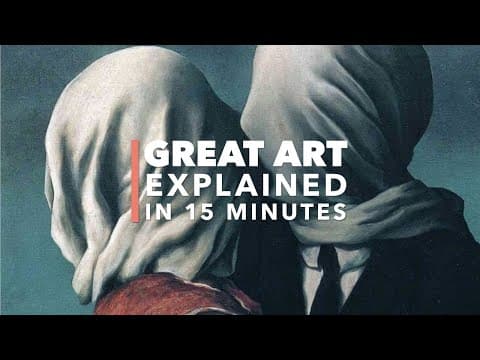
Magritte's art often reflects complex emotional themes. In one of his notable paintings, he depicts a kiss, a moment typically associated with intimacy and connection. However, he disrupts this notion by covering the faces of the lovers with cloth, transforming a moment of passion into one of isolation and sexual frustration. This juxtaposition highlights the darker aspects of intimacy, revealing how vulnerability can lead to feelings of anonymity and disconnection.
Unlike many artists who cultivate elaborate personas, Magritte chose to conceal his identity. He lived a life of quiet respectability, adopting the bowler hat associated with Belgian civil servants and maintaining a routine that included daily walks with his dog. This deliberate choice to blend into the bourgeoisie allowed him to challenge societal norms from within, much like a secret agent.
Born in 1898 in Lessines, Belgium, Magritte's childhood was marked by trauma. His mother’s tragic death, which involved drowning and a shrouded face, left a profound impact on him. Although he rarely spoke of his past, the themes of death and concealment permeate his work. His early experiences, including playing in an abandoned cemetery and witnessing a local artist at work, ignited his passion for art.
Magritte's artistic journey began with a focus on cubism, but he soon gravitated towards surrealism after being inspired by Giorgio de Chirico's work. In 1924, the surrealist manifesto was published, aiming to liberate the mind by subverting rational thought. Magritte moved to Paris in 1927, where he became a leading member of the surrealist group, although he distanced himself from Freudian interpretations of art.
One of Magritte's most famous works, "The Treachery of Images," features the phrase "Ceci n'est pas une pipe" (This is not a pipe). This statement challenges viewers to reconsider their relationship with language and representation. Magritte's word paintings question the reliability of words and the nature of art itself, emphasizing that art is an illusion rather than a functional object.
Magritte employed various techniques to create tension and provoke thought. He often combined familiar objects in unexpected ways, painted solid objects as transparent, and obscured identities with coverings. His series "The Lovers" exemplifies this approach, where the intimacy of a kiss is rendered inaccessible by fabric, evoking feelings of frustration and curiosity in the viewer.
Literature played a significant role in shaping Magritte's artistic vision. He was influenced by writers such as Edgar Allan Poe and Lewis Carroll, whose works explored the boundaries of reality and imagination. The phrase from Lautréamont's "Songs of Malador"—"As beautiful as the chance encounter of a sewing machine and an umbrella on an operating table"—captures the essence of surrealism and the unexpected juxtapositions that characterize Magritte's art.
After returning to Brussels, Magritte faced challenges in selling his paintings and even started an advertising agency to support himself. Despite his later fame, he struggled financially throughout his life and did not receive significant recognition until late in his career. His major retrospective at the Museum of Modern Art in New York in 1965 marked a turning point, although he passed away shortly after.
René Magritte's art invites us to confront the absurdities of our everyday existence. By subverting our expectations and challenging our perceptions, he reveals the complexities of human experience. His ability to transform simple images into profound reflections on reality continues to resonate, reminding us that a pipe is not merely a pipe, and that our understanding of the world is often more complicated than it appears.