Ron Resch's exploration of paper and stick structures reveals the inherent geometry of simple materials, leading to innovative designs and applications in architecture and art. Through a series of experiments with folding, cutting, and assembling, Resch demonstrates how basic shapes can create complex forms and how technology can enhance artistic expression.
In the realm of art, architecture, and design, foundational courses often introduce students to the principles of basic design and composition. These classes typically utilize simple materials such as paper, string, and sticks to help students understand spatial organization. Ron Resch, an artist and designer, embarked on a journey several years ago that began with a simple assignment: to explore the possibilities of paper.
Resch's exploration started with a focus on crumpled paper. He limited himself to studying the effects of crumpling and folding, which led to a deeper understanding of the inherent geometry of paper. Over the course of a week, he examined various wadded-up pieces of paper, noting that some wrinkles were more interesting than others. One particular wrinkle caught his attention, as it could both rotate and elevate when manipulated.
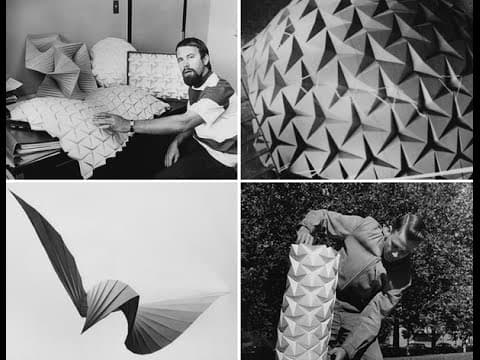
Through careful observation, Resch began to diagram the essential folds that occurred in the crumpled paper. He simplified these diagrams into straight lines and equilateral triangles, identifying the fundamental shapes that governed the behavior of the paper. This process allowed him to create modular patterns that could be folded continuously without cutting.
Resch's work involved developing triangular, square, and hexagonal modules that could be folded and integrated into complex forms. By scoring curved lines into the paper, he was able to create interesting curved surfaces. The goal was to produce a grouping of modules that maintained their integrity when unfolded into a two-dimensional pattern.
The early stages of Resch's work focused on the visual effects of light interacting with these geometric surfaces. He experimented with folding continuous sheets of paper and later transitioned to using sticks to represent the edges of these modules. This shift allowed him to visualize the relationships between the modules in three-dimensional space.
As Resch moved away from paper, he began to construct models using sticks, representing the folded edges of his paper modules. This transition provided a new perspective on the geometric relationships within the structures. He discovered that these stick assemblages could be organized into polyhedral forms, such as tetrahedrons and octahedrons, which are fundamental shapes in geometry.
Resch's experiments led him to create movable geometric structures. By linking modules together, he was able to produce dynamic forms that could open and close, revealing the intricate relationships between the components. This exploration of movement highlighted the potential for creating interactive designs.
As Resch continued his investigations, he began to seek practical applications for his geometric explorations. One of his early projects involved creating acoustical wall panels using a vacuum forming technique. This process allowed him to produce panels that were both decorative and functional, demonstrating the potential for his folded paper designs in real-world applications.
Resch's work evolved into a quest to translate his paper models into architectural structures. He recognized the importance of understanding the behavior of these forms in order to create stable buildings. By building larger models and refining his techniques, he aimed to develop a system that could be used in architectural design.
With advancements in technology, Resch began to explore the use of computers to simulate the geometry of his designs. He developed programs that allowed him to visualize and analyze the structural properties of his folded paper forms. This integration of technology into his artistic process enabled him to create more complex and refined designs.
Resch emphasizes the importance of a feedback loop in the design process, where the artist interacts with the environment and modifies their approach based on the results of their experiments. He believes that computers can enhance this loop by providing rapid simulations and visualizations, ultimately aiding creativity and innovation in design.
Ron Resch's journey through the exploration of paper and sticks reveals the profound connections between simple materials and complex geometric forms. His work not only highlights the artistic potential of these materials but also demonstrates how technology can facilitate the design process. As Resch continues to push the boundaries of art and architecture, his innovative approach serves as an inspiration for future generations of designers and artists.