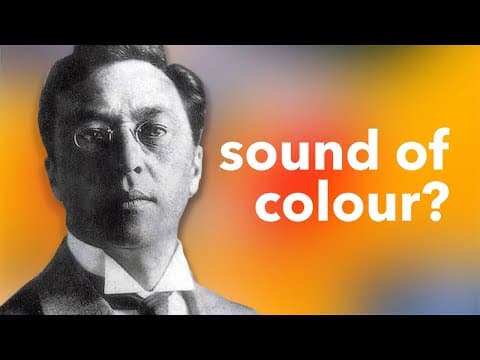
This blog post delves into Wassily Kandinsky's unique experience of synesthesia, where he perceived colors as sounds, and how this influenced his abstract art. It discusses his artistic evolution, key works, and the philosophical underpinnings of his belief that art should express the artist's soul, paralleling the abstraction found in music.
What do you hear when you see a painting? For Wassily Kandinsky, a pioneer of abstract art, the experience of color was deeply intertwined with sound. This blog post explores Kandinsky's unique perception of synesthesia, his artistic journey, and how he sought to express the essence of music through visual art.
Kandinsky experienced a condition known as synesthesia, where stimulation of one sensory pathway leads to automatic, involuntary experiences in a second sensory pathway. For him, sounds evoked colors, and colors elicited musical sensations. This phenomenon is vividly illustrated in his painting "Impression III (Konzert)", which represents his response to a concert by his friend, composer Arnold Schoenberg.
Kandinsky believed that the more abstract the form, the clearer and more direct its appeal. He viewed music as the pinnacle of abstraction, stating, "Music has been the art which is devoted itself not to the reproduction of natural phenomena, but rather to the expression of the artist's soul." This philosophy guided his artistic evolution, pushing him to create works that transcended representational forms.
Born in Moscow in 1866, Kandinsky initially pursued a career in law and economics. However, two pivotal experiences in 1896 changed his trajectory. The first was an exhibition of Claude Monet's work, where he realized that color and form, rather than the objects themselves, triggered emotional responses. The second was witnessing Wagner's opera "Lohengrin" at the Bolshoi Theatre, which inspired him to envision colors and lines in his mind.
Kandinsky moved to Munich to study art and was influenced by various movements, including Symbolism, Neo-impressionism, Fauvism, and Cubism. His early works, such as "Der Blaue Reiter" (The Blue Rider) and "The Blue Mountain", began to emphasize color over form, marking his shift towards abstraction.
In 1911, Kandinsky co-founded the artists' collective Der Blaue Reiter, named after his earlier painting. This group aimed to unite diverse artistic talents and embraced all forms of art, including music. Their 1912 almanac featured contributions from notable composers, reflecting Kandinsky's belief in the interconnectedness of art forms.
Kandinsky's 1912 essay, "Concerning the Spiritual in Art", is a cornerstone of his philosophy. He argued for the dematerialization of art and explored the emotional and sensory associations of colors. For instance, he described green as restful, white as harmonious silence, and black as the absence of harmony. He sought to create a universal language through color, stating, "Color is the keyboard, the eyes are the hammers, the soul is the piano with many strings."
Kandinsky distinguished between simple and complex compositions in painting. Simple compositions, which he termed melodic, are constructed clearly, while complex compositions are symphonic, creating intricate visual rhythms. His series "Composition I-X" represents his most ambitious works, where he aimed to achieve the level of abstraction found in music.
In his groundbreaking works, Kandinsky employed overlapping forms, rhythms, and motifs to create pure art. For example, "Composition VII" features multiple motifs that overlap, creating a rhythmically complex visual experience. This painting reflects the dissonant, chromatic music of his time, paralleling the innovations of Schoenberg.
"Composition VIII" is particularly notable for its geometric forms and harmonious color combinations, resembling musical chords. Kandinsky's use of lines and shapes creates a visual melody, allowing viewers to experience the painting as if they were listening to music.
Kandinsky's exploration of the relationship between color and sound invites us to reconsider how we perceive art. His belief that art should resonate with the soul and evoke emotional responses parallels the experience of music. As we engage with his works, we might ask ourselves, "What does this sound like?" Through this lens, Kandinsky's art becomes a profound exploration of the spiritual possibilities inherent in both visual and auditory experiences.