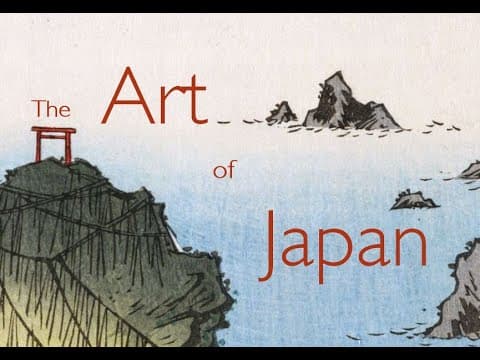
This blog post delves into the evolution of Japanese art, highlighting its native roots, the influence of Buddhism and Taoism, and the impact of historical events on artistic expression. Key concepts such as Wabi-sabi and Mono-no-aware are explored, alongside significant periods and artists that shaped Japan's artistic landscape.
The story of Japanese art is a dynamic narrative that intertwines native Japanese innovations with the influences of mainland Korea and China. This journey traverses the realms of native religion, introduced philosophies, and the contrasting themes of conflict and tranquility. Central to this narrative are two pivotal concepts in Japanese aesthetics: Wabi-sabi and Mono-no-aware.
Wabi-sabi embodies the aesthetic of simplicity and can be observed in Shinto shrines and rustic teaware used in tea ceremonies. This native aesthetic stands in stark contrast to the grandeur imported from China.
Mono-no-aware, on the other hand, reflects the beauty found in the sadness of transient things. This aesthetic is influenced by Buddhism and the tumultuous history of Japan's shogunates.
Shinto, meaning "the way of the spirits," is Japan's indigenous religion. It is animistic, believing that spirits, or kami, inhabit various elements of nature, including mountains, trees, and even the wind. Notable sacred sites include Mount Fuji and the Meoto Iwa (married couple rocks) in Ise Prefecture. Shinto shrines are often marked by a torii, a wooden arch that serves as a gateway to sacred spaces, and may contain shide, folded zigzagging paper tied to rice-straw ropes called shimenawa. One of the oldest shrines, Ise-Jingu, dates back to the fourth century.
The Mesolithic Age in Japan, known as the Jomon period, is characterized by pottery made through coiling clay and impressing patterns with thin rope. The late Jomon period saw the emergence of elaborate figurines known as dogu, which served religious purposes and displayed shamanistic features.
Beginning in 300 BC, the Yayoi period marked increased contact with Korea and China, leading to the introduction of smooth wheel-thrown pottery and metallurgy. Bronze ritual bells called dotaku were also created during this time.
The Kofun period is named after its burial mounds, which grew larger with the centralization of power. The largest of these mounds is Daisenryo, the mausoleum of Emperor Nintoku.
Buddhism was introduced to Japan during the Asoka period, merging with Shinto beliefs over the following centuries. The Horyu-ji temple complex, one of the earliest in Japan, features a pagoda and houses significant artistic treasures, including murals of Buddha.
The 12th century saw the rise of the Minamoto clan and a new militaristic culture that emphasized inner spirituality. The Unkei school pioneered Japanese portraiture, focusing on realistic portrayals of spiritual essence.
Zen Buddhism, introduced from China in the 12th century, emphasized the negation of self and communion with an eternal principle. This philosophy influenced landscape painting, as seen in works by Zen monks like Tensho Shubun.
In the early 17th century, the Tokugawa shogunate established Edo (modern-day Tokyo) as the capital. The term ukiyo, or "floating world," described the pleasure-seeking culture of the new merchant class. Artists like Ogata Korin and Kitagawa Utamaro produced works reflecting this new demographic.
Ukiyo-e, or woodblock prints, became a popular art form during this period. Hokusai and Hiroshige were two of the most renowned ukiyo-e artists, with Hokusai's Under the Wave off Kanagawa becoming an iconic representation of Japanese art.
Japan's isolation ended in the mid-19th century, leading to the rise of japonisme in Europe. Artists like Vincent van Gogh and Paul Gauguin drew inspiration from ukiyo-e prints, incorporating elements of Japanese art into their own works.
The evolution of Japanese art is a testament to the country's rich cultural heritage, shaped by both native traditions and external influences. From the spiritual aesthetics of Wabi-sabi and Mono-no-aware to the vibrant expressions of the ukiyo-e movement, Japanese art continues to captivate and inspire audiences around the world.