This blog post explores the intricate relationship between Gustav Klimt's art and Nazi ideology, examining why Klimt was excluded from the 'Degenerate Art' exhibition, the impact of his works on Vienna's cultural landscape, and the tragic fate of his paintings during and after the Nazi regime.
In 1937, the Nazis orchestrated a notorious exhibition titled "The Degenerate Art Exhibition," showcasing 650 modern artworks that had been stolen from museums and private collectors. This exhibition was part of the Nazis' broader cultural campaign aimed at inflaming public sentiment against modern art. Artists such as Paul Klee, Otto Dix, Pablo Picasso, Marc Chagall, and Piet Mondrian were labeled as degenerate. Surprisingly, one prominent artist was notably absent from this purge: Gustav Klimt.
Gustav Klimt, often described as "morally questionable," "obscene," or even "pornographic," had connections with Jewish patrons, intellectuals, and artists. His exclusion from the Nazis' list of degenerate artists raises questions about the reasons behind it. This blog post delves into Klimt's lesser-known works and their connections to Vienna, a city that played a pivotal role in his artistic journey.
For over six centuries, the Habsburg Dynasty ruled vast territories in Europe, with Vienna as its cultural and political heart. The city became a focal point for the emergence of modern art and culture. The Burgtheater, opened in 1748, became a symbol of Habsburg success, hosting premieres of operas by Mozart, Beethoven, and Strauss. It was here that Klimt achieved his artistic breakthrough at the young age of 22, receiving a prestigious commission from Emperor Franz Joseph to create decorative ceiling panels.
Klimt, along with his brother Ernst and friend Franz Matsch, produced ten monumental paintings for the Burgtheater. These works depicted the evolution of theater, starting with the Altar of Dionysus, showcasing classical nudity in a restrained manner. One notable piece, "The Cart of Thespis," illustrates the world's first actor, while Klimt cleverly included a self-portrait among the audience, marking his budding career.
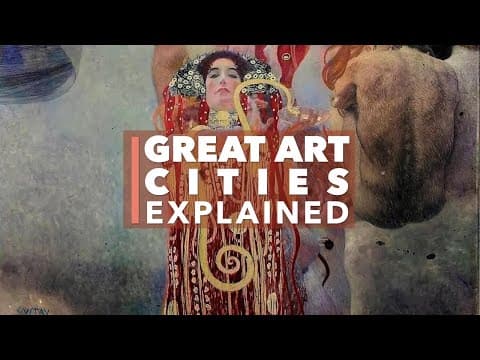
Following their success at the Burgtheater, Klimt and Matsch were commissioned to create five large works for the University of Vienna, representing the faculties of Theology, Jurisprudence, Medicine, and Philosophy. Klimt's style evolved dramatically during this period, leading him to co-found the Vienna Secession in 1897, a radical movement that broke away from conservative artistic norms.
Klimt's university paintings, however, were met with controversy. His works, particularly "Philosophy," "Medicine," and "Jurisprudence," were avant-garde and deeply pessimistic, diverging from the classical style expected by the university. The paintings depicted themes of despair and human sexuality, leading to their rejection by the university. Klimt's frustration culminated in his decision to terminate his contract and refund his fee.
Klimt's devoted patron, August Lederer, a Jewish factory owner, purchased the three completed canvases, which were later seized by the Nazis in 1938 as part of their campaign against Jewish-owned properties. Despite the Nazis' disdain for modern art, Klimt's work curiously escaped the bonfires that consumed many masterpieces. In 1943, the Nazis even sponsored a retrospective of Klimt's art, attempting to rebrand him as part of the Austrian folk tradition.
The Nazis' interpretation of Klimt's work was complex. They appreciated the Teutonic qualities in his art, aligning it with their ideology while ignoring the subversive themes present in his work. Klimt's fascination with Greek mythology resonated with Nazi aesthetics, yet his exploration of sensuality and sexuality stood in stark contrast to their ideals of racial purity.
As the war progressed, many of Klimt's paintings were relocated to hidden storage facilities. Tragically, in the final days of the war, a retreating SS unit set fire to a castle where Klimt's works were stored, destroying them, including the university paintings. This loss marked a significant blow to Klimt's legacy.
In recent years, efforts have been made to recreate Klimt's lost university works. Large-scale reproductions have been installed in the original ceiling spaces, and with the help of AI, researchers have colorized these works, allowing us to imagine their original glory.
Gustav Klimt's relationship with the Nazis is a poignant reminder of how art can be manipulated and reinterpreted to serve ideological ends. While he escaped the Nazi purge, his works were co-opted and ultimately destroyed in the chaos of war. Klimt's legacy continues to provoke thought about the intersection of art, politics, and cultural identity, highlighting the enduring power of creativity in the face of oppression.