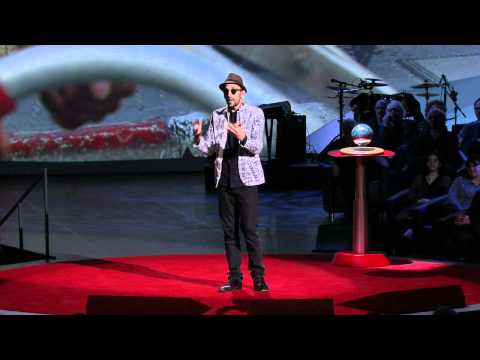
JR, a renowned artist, shares his journey from graffiti to impactful art projects that challenge perceptions and foster community engagement. Through initiatives like Face 2 Face and Women Are Heroes, he demonstrates how art can serve as a powerful tool for social change, encouraging individuals to participate in a global art movement to express their stories and values.
Two weeks ago, I received a call in my studio in Paris that would change my perspective on art and its potential impact. I was informed that I had won the TED Prize 2011 and was asked to make a wish to save the world. Initially, I felt lost; the world seemed too broken to be saved. With dictators in power, a growing population, dwindling fish stocks, and climate change, I thought, "How can I possibly make a difference?" However, I was reminded that my wish was not to save the world but to change it.
This realization led me to ponder the role of art in societal change. While technology, politics, and business can influence the world, I wondered if art could do the same. My journey began at the age of 15 when I started doing graffiti, using the city as my canvas. I documented my adventures with a cheap camera I found on the subway, creating small photocopies of my work. At 17, I held my first sidewalk gallery, framing my art in color to distinguish it from advertisements. The streets of Paris became my gallery, allowing me to connect directly with the public.
In November 2005, Paris experienced a wave of riots, and I saw my pasting on a wall illuminated by a burning car. The faces of my friends, often labeled as criminals by the media, stared back at me. This moment inspired me to take full portraits of individuals from the affected neighborhoods, showcasing their humanity. I pasted these portraits in affluent areas of Paris, reclaiming their images from media distortion.
A year later, amidst the ongoing Israeli-Palestinian conflict, I traveled to the region with my friend Marco. We sought to understand the real stories behind the headlines. We took portraits of Palestinians and Israelis doing the same jobs, asking them to express their commitment through their expressions. We launched the Face 2 Face project, pasting these portraits on both sides of the wall separating the two communities. Despite warnings of potential violence, we found that people were curious and engaged, often unable to distinguish between the two groups.
Inspired by the strength of women in communities, I initiated the Women Are Heroes project. Traveling to various countries, I documented the stories of women who are often the pillars of their communities. In Rio de Janeiro, after a tragic incident involving three students, I connected with local women who expressed a hunger for culture. We began pasting their portraits throughout the favela, creating a sense of ownership and pride in their stories.
Throughout my travels in Africa, I witnessed the power of art to foster connection and dialogue. In places like Kibera, Kenya, we used vinyl instead of paper to create murals that could withstand the elements. The community embraced these artworks, which became symbols of resilience and hope. In India, we adapted our approach by using white paper to blend into the dusty streets, allowing the images to emerge naturally over time.
Each project I undertook was not just about the art itself but about the relationships built within the communities. We created cultural centers and continued to engage with the people long after our initial projects ended. I made a conscious decision to avoid corporate sponsorships, ensuring that my work remained true to the subjects and communities involved.
As I reflect on my journey, I believe that art can change perceptions and foster dialogue. It is not about solving practical problems directly but about creating a neutral space for discussion. I invite everyone to participate in a global art project, to stand up for what you care about, and to share your stories through art. Together, we can turn the world inside out.
Art has the power to transform not just the physical landscape but also the way we perceive each other and our shared humanity. By engaging with communities and encouraging participation, we can create a movement that resonates far beyond the sum of its parts. Join me in this endeavor, and let us create something memorable together.