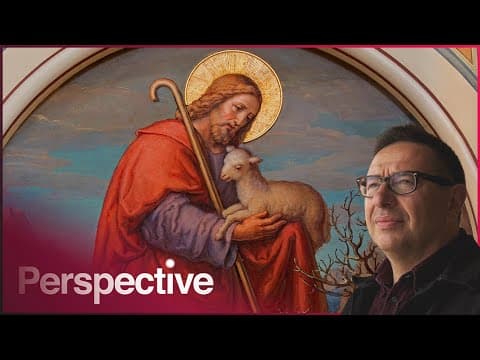
This blog post explores the evolution of Christian art during the Dark Ages, highlighting how early Christians used symbols and artistic representations to convey their faith and the identity of Jesus Christ, ultimately transforming perceptions of divinity and spirituality.
This article delves into a fascinating period often referred to as the Dark Ages, spanning from the fourth to the eleventh century. Contrary to its name, this era was not one of darkness but rather a time of significant artistic and cultural transformation, particularly in the realm of Christian art. This exploration reveals how early Christians navigated their faith through art, ultimately reshaping the image of Jesus Christ.
The term "Dark Ages" is used to describe a time when the Roman Empire began to crumble, leading to a shift in cultural and artistic expression. As the empire fell, various artistic forces emerged, including the early Christians, who began to create art that reflected their beliefs and experiences.
One of the earliest examples of Christian symbolism can be found in the ruins of Pompeii, where a mysterious inscription known as the Rotas Square was discovered. This square, composed of five Latin words, served as a secret sign among Christians, symbolizing their faith and warding off evil. The letters could be rearranged to form a cross, further emphasizing the Christian message.
The Roman catacombs, often thought to be hiding places for persecuted Christians, were actually vast underground cities filled with early Christian art. Here, Christians expressed their faith through symbols rather than direct representations of Jesus. The fish, anchor, and the Chi-Rho symbol became significant markers of Christian identity.
Interestingly, for the first few centuries of Christianity, there were no images of Jesus. Instead, early Christian art focused on symbols and allegorical representations. For instance, the story of Jonah, who was swallowed by a whale and later emerged, became a metaphor for resurrection and salvation, paralleling the story of Jesus.
As Christianity spread, artists began to grapple with the challenge of depicting Jesus. The Shroud of Turin, believed to be the burial cloth of Jesus, presents a controversial image that does not align with early artistic representations. Initially, Jesus was depicted as a youthful, curly-haired figure, often resembling the pagan god Apollo, rather than the suffering figure seen in later medieval art.
In the early stages of Christian art, Jesus was sometimes portrayed with feminine qualities, reflecting a desire to appeal to both male and female worshippers. This artistic choice was influenced by the absence of a female divine figure in Christianity, leading to a softer representation of Jesus.
The introduction of the Virgin Mary as a central figure in Christianity allowed for a more masculine portrayal of Jesus. Mary, often depicted holding the infant Jesus, became a powerful symbol of motherhood and nurturing, which further shaped the artistic representation of Jesus.
Initially, Christian worship took place in modest house churches. However, with the Edict of Milan in 313 AD, which legalized Christianity, the need for grander spaces arose. Constantine the Great initiated the construction of large basilicas, transforming the architectural landscape of Christian worship.
Christian basilicas borrowed heavily from Roman architectural styles, particularly the basilica used for public gatherings. This shift allowed for a new style of worship that emphasized community and movement, contrasting with the more static pagan temples.
As Christian art evolved, so did the representation of Jesus. The early youthful depictions gradually transformed into a more mature, bearded figure, influenced by the imagery of Roman gods like Jupiter. This change reflected the desire for a divine figure that commanded respect and authority.
The artistic journey of Jesus Christ during the Dark Ages illustrates a profound transformation in how early Christians expressed their faith. Through symbols, allegories, and evolving representations, they navigated their beliefs in a complex world. This era, often dismissed as dark, was in fact a time of significant artistic achievement that laid the groundwork for future Christian art and theology. The next exploration will focus on the contributions of the so-called barbarians and their impact on this artistic legacy.