This article explores how Deepseek's V4 models initially faced tool calling challenges, and how the development of a deterministic tool repair harness in the Command Code coding agent significantly improved performance, reliability, and stability. By learning from billions of tokens and continuously repairing common tool call errors, Deepseek now outperforms other models like Opus 4.7, offering faster, more stable, and cost-effective coding assistance.
Exactly one month ago, a viral Twitter post sparked an engineering deep dive into how Deepseek was made to outperform Opus 4.7. This article discusses the journey and technical insights behind that achievement.
Deepseek launched their V4 family, including Deepseek V4 Pro and Deepseek V4 Flash. The community's reaction was mixed:
This discrepancy prompted a deeper investigation into why tool calls were failing for many users.
Deepseek, being an open model, exhibited many tool calling issues. Upon analyzing error stacks and command code, it became clear that the problem was not with the model itself but with the harness—the software layer managing tool calls.
The harness needed to handle model hallucinations and mistakes effectively, sometimes deterministically fixing errors to maintain stability.
The key discovery was the development of a "tool repair" harness within Command Code, a coding agent framework. This harness could detect common tool call errors and fix them deterministically before passing results back to the model.
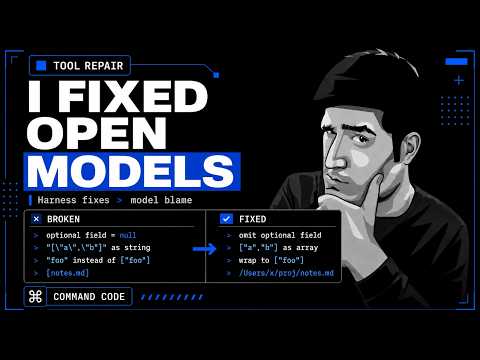
Open models often send malformed tool calls, such as:
null instead of omitting optional fields.These errors cause strict validators like Zod to reject the calls, leading to repeated failures and degraded performance.
Instead of letting the tool call fail and returning errors to the model repeatedly (sometimes 56 times per call), the repair harness intercepts the error, applies a deterministic fix, and sends back a corrected tool call result along with a repair note explaining the fix.
This approach is analogous to teaching a learner how to avoid mistakes proactively rather than letting them fail repeatedly.
To improve the repair harness, a "taste" model was developed—a continuous learning layer that learns coding preferences and common error patterns from extensive coding sessions.
The repair harness started with just four common tool call repairs and expanded to over 56,000 repair invariants, covering various languages, models, and scenarios.
This continuous improvement led to:
Deepseek Flash, after these improvements, became one of the favorite models, outperforming competitors like Claude Haiku while being 10-20 times cheaper.
The tool repair concept sparked widespread interest and adoption:
The failure of tool calls in open models like Deepseek is not random but stems from a finite set of common errors. By building a deterministic repair harness that learns from extensive usage data and continuously improves, Deepseek's performance was dramatically enhanced.
This innovation demonstrates that harness design is as crucial as the model itself in delivering reliable AI-powered coding assistance. The repair harness not only fixes errors but also educates the model, leading to better tool calls and a superior user experience.
If you are interested in exploring this further or contributing to the development of tool repairs, the community is open and collaborative.
This comprehensive approach to improving tool calls in open models marks a significant step forward in AI coding agents, making Deepseek a standout performer in the field.