This blog post explores the life and works of Michelangelo Buonarroti, highlighting his innovative contributions to sculpture, painting, and architecture during the Renaissance. It compares his masterpieces with those of his contemporaries, illustrating how he broke conventions to create deeper meanings in his art.
Michelangelo Buonarroti, one of history's greatest geniuses, is celebrated for his mastery in sculpture, painting, and architecture. His tomb features three statues of female figures, symbolizing these crafts, and his work stands out as innovative and rich in meaning compared to his Renaissance contemporaries. This post delves into Michelangelo's contributions across these three disciplines, illustrating why he is considered a game-changer in art history.
To understand Michelangelo's impact, we can compare his work with that of earlier Renaissance artists. For instance, Piero della Francesca's portraits are characterized by conventional representations, often influenced by Roman coinage, where figures are presented decorously and with an attempt to depict space. In contrast, Leonardo da Vinci's works, such as the Mona Lisa, showcase a more dynamic approach with the use of contrapposto, where the figure's weight is distributed on one foot, creating a sense of movement and depth.
Michelangelo's Doni Tondo exemplifies his complex approach to composition. Unlike typical Renaissance works that focus on symmetry and balance, Michelangelo's circular painting activates space in a unique way. The Virgin Mary holds the Christ child in a posture that exaggerates the contrapposto, suggesting a dynamic interaction rather than a static pose. The inclusion of nude figures around the Holy Family raises questions about their significance, possibly representing a transition from paganism to Christianity, reflecting Michelangelo's innovative thinking.
Michelangelo is often regarded as a pioneer of Mannerism, a style that emerged as a transition between the High Renaissance and Baroque periods. His works, such as David, showcase a departure from the balanced repose seen in earlier sculptures. While Donatello's David captures a moment of triumph, Michelangelo's version depicts a figure in contemplation, filled with tension and anticipation, emphasizing the psychological complexity of the character.
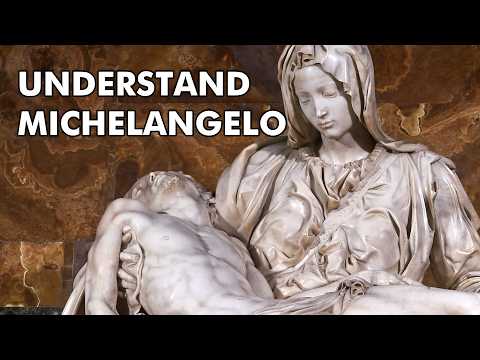
Another significant early work is the Vatican Pietà, which portrays the Virgin Mary mourning over the dead Christ. This sculpture is notable for its technical mastery and emotional depth. However, Michelangelo's choice to depict Christ as smaller than the Virgin raises questions about the representation of their relationship, suggesting a broader narrative that encompasses both birth and death. The youthful appearance of the Virgin further complicates the interpretation, as it blends her roles as both a grieving mother and the Virgin Mary.
As Michelangelo's career progressed, he began to explore the relationship between figures and the stone from which they were carved. His later works, such as the Rondanini Pietà, reflect a Gothic sensibility, emphasizing the struggle of the figures against the stone. This approach contrasts with the polished beauty of earlier works, showcasing a raw emotional power.
Michelangelo's tumultuous relationship with Pope Julius II, who commissioned a grand tomb, influenced his artistic direction. The unfinished sculptures, like Atlas, symbolize the struggle between the artist and his medium. The Moses statue, renowned for its lifelike detail, features horns due to a mistranslation of the Bible, illustrating the complexities of interpretation in art.
Perhaps Michelangelo's most famous work is the ceiling of the Sistine Chapel, where he depicted scenes from the Book of Genesis. His portrayal of God creating Adam is iconic, showcasing the tension between divine energy and human vulnerability. The composition reflects Michelangelo's Mannerist style, with figures that resemble sculptures rather than traditional paintings.
Later, Michelangelo painted the Last Judgment on the altar wall of the Sistine Chapel, presenting a dramatic scene of divine judgment. His self-portrait as Saint Bartholomew, depicted as a flayed skin, reveals his personal struggles and complex life. This work, like many of his others, reflects Michelangelo's ability to infuse traditional narratives with profound emotional depth and meaning.
Michelangelo Buonarroti's legacy as a master of sculpture, painting, and architecture is unparalleled. His innovative techniques and willingness to break conventions allowed him to create works that resonate with emotional power and complexity. As we explore his masterpieces, we see not just the evolution of art during the Renaissance but also the profound impact of one man's vision on the world of creativity. This exploration of Michelangelo's life and works sets the stage for a deeper understanding of his architectural contributions in the next part of this series.