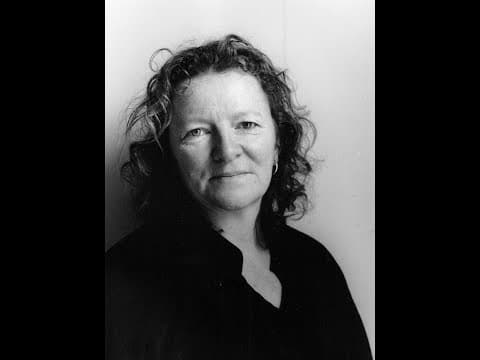
Rachel Whiteread, a British sculptor, gained international acclaim for her innovative use of everyday objects in her art, exploring themes of memory and loss. Her notable works include 'House' and the Holocaust Memorial in Vienna, showcasing her ability to transform mundane items into profound statements about human experience.
Rachel Whiteread, a British sculptor born in 1963, made her mark on the art world in 2001 at the age of 38. Her work, influenced by American minimalism and British post-war sculpture, is renowned for transforming ordinary, discarded household objects into striking pieces of art using materials such as concrete, resin, plaster, and rubber. Today, her sculptures occupy prominent public spaces around the globe, and she continues to create from her studio in London, where she has lived since childhood.
Whiteread grew up in a creative environment, heavily influenced by her mother, an artist. She recalls her childhood experiences of sharpening pencils and experimenting with tools, which laid the groundwork for her artistic journey. Initially trained as a painter in Brighton, she later shifted her focus to sculpture during her postgraduate studies in London.
Her early works involved casting household objects that she reclaimed from the streets, often rummaging through second-hand shops for inspiration. This process of discovery became a significant part of her artistic practice, allowing her to find beauty in the mundane.
Whiteread's work often explores themes of memory and loss, drawing on her personal experiences. One of her earliest pieces, "Shallow Breath," was created shortly after her father's death and involved casting the underside of a bed. This work encapsulated the idea of hidden spaces that evoke childhood memories, such as the comforting darkness of a wardrobe.
In 1990, she created "Ghost," a large sculpture that cast the interior of a North London bedsit. This piece marked a turning point in her career, leading to wider public recognition.
Whiteread gained significant attention when she won the Turner Prize in 1993 for her work "House," which was a cast of a Victorian terrace house in East London. The project was born out of a desire to create a monumental piece that reflected the changing landscape of the area, which was on the verge of gentrification.
The process of creating "House" involved meticulous planning and collaboration with structural engineers to ensure its stability. The final piece was a concrete shell that captured the essence of the home, provoking a complex emotional response from the public. The installation sparked debates about art, community, and the socio-political climate of the time, particularly in relation to housing and urban development.
In 1996, Whiteread was commissioned to create a memorial for the Austrian victims of the Holocaust. This project was particularly significant for her, as she had spent time in Berlin reflecting on the Holocaust and its impact. The memorial, located at Judenplatz, is a closed-off room that symbolizes the pain and secrets of history. Its design was intentionally brutal, challenging viewers to confront the weight of the past without providing easy answers.
The creation of the memorial was fraught with bureaucratic challenges and political tensions, especially following the rise of the far-right Freedom Party in Austria. Despite these obstacles, Whiteread remained steadfast in her vision, refusing to compromise her artistic integrity.
Whiteread's work continues to evolve, as seen in her recent projects, including a piece for the empty plinth in Trafalgar Square. This installation, which took over two years to complete, is a mirror image of the plinth itself and weighs 11 tonnes. It serves as a moment of reflection amidst the bustling environment of central London.
Currently, she is working on casting parts of a synagogue in East London, further exploring the themes of space and memory that have defined her career. This project involves intricate technical challenges, as she aims to preserve the integrity of the building while creating new artistic expressions.
Rachel Whiteread's artistic journey is marked by her ability to transform everyday objects into profound statements about human experience. Her work resonates with themes of memory, loss, and the complexities of urban life, making her one of the most significant contemporary artists today. Through her innovative approach to sculpture, Whiteread invites viewers to engage with the hidden narratives of their surroundings, ensuring that her art remains relevant and impactful in an ever-changing world.