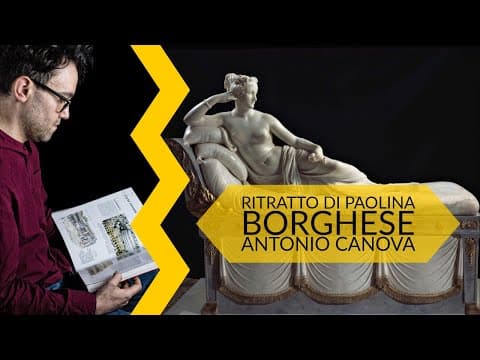
Antonio Canova's statue of Paolina Borghese, depicting her as Venus, showcases the artist's Neoclassical style and mastery of marble, blending beauty and mythology in a captivating representation.
Antonio Canova, a prominent sculptor and painter, was born on November 1, 1757, in Possagno, a small town in northeastern Italy. Renowned as the greatest exponent of Neoclassicism, he earned the nickname "the new Phidias" for his exceptional contributions to the art world. One of his most celebrated works is the statue of Paolina Borghese Bonaparte, the sister of Napoleon, which exemplifies Canova's artistic genius.
In this exquisite statue, Paolina is depicted as Venus, the Roman goddess of love and beauty. She holds the golden apple in her left hand, a symbol of her beauty that echoes the mythological tale where the Trojan prince Paris had to choose the most beautiful goddess among Minerva, Juno, and Venus. This allegorical representation immortalizes Paolina in the role of a divinity, celebrating her virtue and beauty.
The statue was commissioned by Paolina's husband, Prince Camillo Borghese, and sculpted in Rome between 1805 and 1808. The process of creation raises intriguing questions: Did Paolina pose nude for Canova, or did he simply incorporate her likeness onto a body that adhered to the ideals of Neoclassical beauty? The answer remains uncertain, adding an air of mystery to the artwork.
Once completed, the statue embarked on a long journey before finding its final home in the Borghese Gallery. Initially, it was taken to Camillo Borghese's residence in Turin, where it remained until 1814. Following the fall of Napoleon, the statue was moved to Genoa and then transported by sea to Rome. It was exhibited in Palazzo Borghese, where it was illuminated by torches at night, allowing viewers to appreciate the refinement of the marble and the wax patination applied by Canova.
After a brief display at Villa Pinciana, the statue found its permanent location in the Borghese Gallery in 1889.
A fascinating aspect of the statue is its construction. The marble portion, which concludes with the mattress, rests on a wooden structure that conceals a hidden mechanism, enabling the statue to rotate around its vertical axis. In 1953, two lion paws were added to the bed, enhancing its grandeur.
One of the most remarkable features of Canova's portrayal of Paolina is his ability to render different materials and surfaces with astonishing realism. From the velvety texture of Paolina's skin to the soft cushions and the delicate fabric draped over her legs, Canova's craftsmanship makes the marble appear to come to life. This mastery not only highlights his technical skill but also his deep understanding of the human form and the materials he worked with.
Antonio Canova's statue of Paolina Borghese is more than just a representation of a woman; it is a celebration of beauty, mythology, and artistic excellence. Through his Neoclassical style, Canova immortalizes Paolina as a divine figure, showcasing his ability to breathe life into marble and create a timeless masterpiece that continues to captivate audiences today.