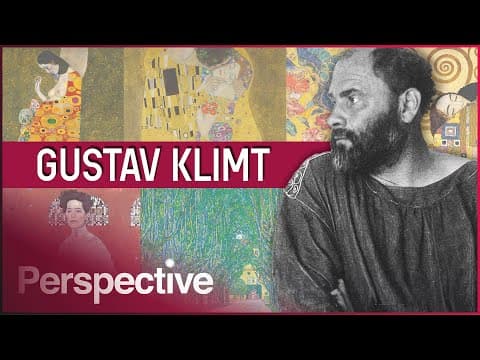
Gustav Klimt, a pivotal figure in the Vienna Secession movement, transformed the art scene in late 19th and early 20th century Austria. His journey from traditional naturalism to a bold, decorative style marked a significant cultural shift, characterized by sensuality, symbolism, and a deep exploration of human emotion and sexuality. Klimt's masterpieces, including 'The Kiss' and the Stoclet Palace decorations, reflect his innovative use of gold and intricate patterns, solidifying his legacy as a master of Art Nouveau.
In 1897, Vienna became the epicenter of a cultural revolution when 40 artists broke away from the established artist's house to form the Vienna Secession. This bold new institution was led by Gustav Klimt, a painter recognized as a giant of the age. The artists of the Secession sought to break down the barriers between art and craft, aiming for a suggestive psychological impact in their work. Klimt's enigmatic persona and his masterpieces would soon define the era.
Gustav Klimt was born on July 14, 1862, near Vienna. His father, a goldsmith, hoped his sons would follow in his footsteps. While one of Klimt's brothers became a goldsmith, Gustav displayed a broader artistic talent. At 14, he and his brother Ernst enrolled in the Vienna School of the Applied Arts, where they learned techniques in mosaic and fresco, as well as the history of design.
By 1883, Klimt was already securing commissions, showcasing his striking naturalism in early works. However, his greatest achievements came later in life, marked by a long and deliberate artistic evolution. His later works became known for their decorative and erotic qualities, which would ultimately make him globally famous.
Klimt's early career was characterized by conventional neoclassical images, but he soon began to explore more radical themes. His fascination with classical subjects remained, but the 1890s brought a shift in his work as he became immersed in avant-garde circles. The intellectual climate of Vienna encouraged a move away from strict naturalism towards a more suggestive and symbolic art that expressed deeper truths about the human condition.
In 1895, Klimt painted "Music," marking a departure from his earlier style. This work began to showcase his signature flat, frieze-like compositions and his innovative use of gold, a technique that would become a hallmark of his later masterpieces.
The dissatisfaction with the traditional art scene led to the formation of the Vienna Secession in 1897, with Klimt as its first president. This movement aimed to showcase contemporary art and break free from the constraints of the academic style favored by the established institutions. The first secession exhibition in 1898 attracted nearly 60,000 visitors, highlighting the public's eagerness for new artistic expressions.
Klimt's work during this period, including his famous poster for the exhibition, reflected the characteristic curving lines of Art Nouveau, emphasizing design and symbolism over realism. His painting "Palace Athenai" stirred controversy for its eroticism, earning him the title of the "demon of the secession" from critics.
In 1894, Klimt received a significant commission to paint the ceiling of the Great Hall at Vienna University. However, when he revealed his work in 1900, it sparked outrage among university authorities who expected a traditional celebration of reason and wisdom. Instead, they were met with a vague composition that defied their expectations, leading to a parliamentary debate over the appropriateness of Klimt's vision.
Despite the backlash, Klimt continued to push boundaries, creating works that explored themes of love, sexuality, and the human experience. His painting "The Naked Truth" exemplified his bold approach, challenging societal norms and expectations of decency in art.
Klimt's travels to Italy in the early 1900s, particularly his fascination with mosaics, marked the beginning of his so-called golden period. His use of gold became increasingly prominent in works like "Water Serpents" and the iconic "The Kiss," which is celebrated for its beauty and eroticism. "The Kiss" captures the intimate moment of a couple embracing, surrounded by a rich tapestry of gold and intricate patterns, symbolizing both love and sensuality.
As Klimt approached his 50s, he continued to innovate, creating significant works such as the Stoclet Palace freeze, which combined architecture and interior decoration in a cohesive artistic vision. His final years were marked by a focus on landscape painting and a continued exploration of female subjects, reflecting his complex views on womanhood.
Klimt's life came to an abrupt end in 1918 due to a stroke, but his legacy endures. His art, characterized by themes of love, sexuality, and sensuality, continues to resonate with audiences today. Klimt's ability to blend the figurative with the abstract, along with his luxurious use of materials, solidifies his place as a master of Art Nouveau and a pivotal figure in the history of modern art.