This blog post explores the competition between sculptors Ghiberti and Brunelleschi for the Baptistry doors in Florence, focusing on their panels depicting the sacrifice of Isaac. It highlights their artistic styles, techniques, and the implications of their works in the context of the Renaissance.
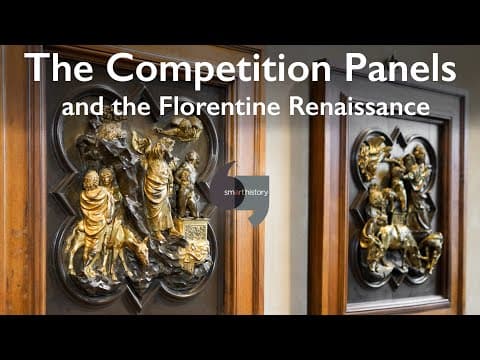
The Bargello in Florence houses two significant competition panels created for the Baptistry, one by the renowned sculptor Lorenzo Ghiberti and the other by Filippo Brunelleschi. This competition was pivotal in the artistic landscape of the Florentine Renaissance, showcasing the talents of two of its most prominent figures.
The Calimala guild, which included luxury cloth importers, was responsible for the decoration of the Baptistry. While it is believed that seven artists participated in the competition, the final decision rested between Ghiberti and Brunelleschi. Ghiberti claimed victory in his writings, while Brunelleschi contended that the competition ended in a tie, leading him to withdraw from collaboration.
Both artists were tasked with creating a quatrefoil, a sculptural scene enclosed within a four-lobed shape, as part of a series depicting major biblical events. The chosen subject for both panels was the sacrifice of Isaac, a poignant story from the Old Testament.
In this biblical narrative, Abraham, who had a miraculous late-life child, is commanded by God to sacrifice his beloved son, Isaac. In a moment of profound faith, Abraham prepares to carry out the act, poised to slit Isaac's throat. However, an angel intervenes, and instead, a ram is sacrificed. This story is often interpreted as foreshadowing the sacrifice of Christ, adding layers of meaning to the panels.
Brunelleschi's panel presents a more aggressive and emotionally charged scene. The moment captured is intense, with Abraham lifting the knife towards Isaac's throat, creating a sense of danger. The composition includes subsidiary scenes, such as a young man looking at his foot, which reflects Brunelleschi's admiration for classical art.
The angel in Brunelleschi's work physically restrains Abraham, emphasizing the urgency of the moment. The figures are dynamic, with Abraham depicted as a diagonal force, pushing forward with determination, contrasting sharply with the more serene and elegant figures in Ghiberti's panel.
In contrast, Ghiberti's panel exudes a sense of beauty and harmony. The angel is more reserved, emerging from the background rather than physically intervening. Ghiberti's Isaac is portrayed with a graceful torso, creating an unexpected elegance even amidst the violence of the scene.
Ghiberti's composition is unified, with a rocky landscape that connects the figures and enhances the overall narrative. The use of bronze is also notable; Ghiberti's panel is cast as a single piece, showcasing his skill as a metalworker and resulting in a more cost-effective production compared to Brunelleschi's approach.
The judges faced a challenging decision. If they sought drama and emotional intensity, Brunelleschi's panel would be the clear choice. However, for those valuing beauty and a cohesive narrative, Ghiberti's work would stand out. Ultimately, Ghiberti's skillful craftsmanship and the practical considerations of cost led to his victory in this competition.
The competition between Ghiberti and Brunelleschi not only highlights their individual artistic styles but also marks a significant moment in the evolution of Renaissance art. Ghiberti's success resulted in one of the most important sculptural programs of early Renaissance Florence, influencing generations of artists to come. The panels serve as a testament to the rich artistic heritage of the period and the enduring legacy of these two masters.