Jacques-Louis David's painting 'The Death of Socrates' captures the philosopher's final moments, emphasizing themes of moral integrity and the philosophical commitment to principles even in the face of death. The artwork reflects the socio-political climate of pre-revolutionary France and showcases the neoclassical style, highlighting the contrast between rationality and emotion.
Jacques-Louis David's painting, "The Death of Socrates," completed in 1787, stands as a quintessential example of the neoclassical movement in France. This artwork not only captivates viewers with its aesthetic qualities but also conveys profound philosophical and moral messages.
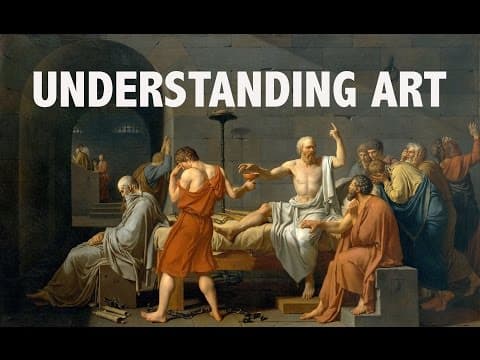
At first glance, the painting is strikingly clear and powerful. The central figure, Socrates, is depicted with a strong presence, reaching for the cup of poison. The interplay of light and shadow, the soft drapery of the figures' clothing, and the stark stone walls create a dramatic atmosphere. The scene illustrates Socrates' death as described by Plato in his dialogues, particularly in "Phaedo."
Socrates was condemned by the Athenian court for impiety and corrupting the youth, sentenced to die by consuming hemlock. Rather than fleeing to exile, he chose to embrace death, using the moment to impart his final teachings. For Socrates, death was not to be feared; it was a transition to the divine.
David captures the pivotal moment when Socrates reaches for the poison. He is depicted as calm and composed, seemingly unconcerned about his impending death. Instead, he appears eager to transition to the afterlife, embodying the philosophical belief in the immortality of the soul. The artist portrays Socrates at around 70 years old, though he is depicted with a youthful physique, emphasizing his vitality and strength of character.
The strong light from the upper left illuminates Socrates, making him the brightest figure in the painting. The muted colors surrounding him contrast sharply with the vibrant red of the executioner and the white of Socrates' robe, symbolizing the moral strength that transcends physical demise.
David's portrayal of Socrates serves as a symbol of moral fortitude and adherence to principles, even in the face of death. This message resonated deeply with the French populace just two years before the French Revolution, a time when the monarchy was in decline and reformists sought to establish democratic ideals. The painting reflects the struggles of Socrates in ancient times, paralleling the revolutionary sentiments in late 18th-century France.
Notably, Thomas Jefferson attended the unveiling of this painting at the Salon in 1787, highlighting its significance among radical political reformers of the time.
David had already established his reputation with his earlier work, "The Oath of the Horatii," which effectively defined the neoclassical style. This movement drew inspiration from the simplicity and severity of ancient Greek and Roman art, contrasting sharply with the ornate Rococo style that dominated the previous era. In both "The Oath of the Horatii" and "The Death of Socrates," figures dedicated to a cause are depicted with geometric precision, while those ruled by emotion appear weak and contorted.
The flat background in David's works directs the viewer's focus to the foreground, allowing for a clear reading of the actions and emotions of the characters involved.
One way to interpret "The Death of Socrates" is to read it from right to left, observing the anguish of Socrates' followers as they react to his calm demeanor. The tension culminates at the moment when Socrates reaches for the poisoned cup, creating a focal point of emotional intensity. The executioner's averted gaze and the seated figure at the edge of the bed add layers of complexity to the narrative.
While David does not explicitly identify the figures, it is widely believed that the woman in the background is Socrates' wife, Xanthippe, who stands in distress. The figure holding Socrates' leg is Crito, one of his most devoted disciples. David's signature beneath Crito suggests a connection to this character, emphasizing the moral struggle present in the scene.
David also introduces the character of Plato, who is depicted as an older man, despite being a young man during Socrates' death. This artistic choice highlights the philosophical bond between the two figures, as Plato immortalized Socrates' teachings through his dialogues. The historical intertwining of their philosophies raises questions about the boundaries between their ideas.
The painting can also be read from left to right, with the entire scene appearing to emanate from Plato's mind, reshaping the memory of Socrates into an idealized recollection. This artistic representation reflects how memories often resurface in a stylized manner, serving the needs of the present.
David's "The Death of Socrates" is a complex interplay of historical, personal, political, and aesthetic elements. The painting not only showcases the neoclassical style but also serves as a powerful commentary on moral integrity and the philosophical commitment to principles. Through this masterpiece, David communicates a timeless message about the strength of character in the face of adversity, making it a work of genius that continues to resonate with audiences today.