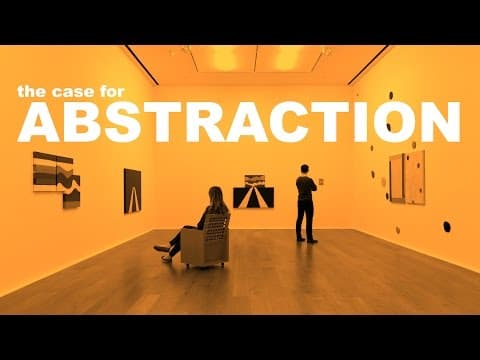
This blog post explores the historical development of abstraction in art, tracing its roots from early representations to modern interpretations. It highlights key movements, influential artists, and the philosophical underpinnings that have shaped abstract art, emphasizing its ongoing relevance and adaptability in contemporary society.
For much of human history, art was primarily about representation—depicting the world as it appeared. However, about a century ago, a radical shift occurred as artists began to explore abstraction, challenging traditional notions of what art could be. This blog post delves into the journey of abstraction in art, examining its origins, key movements, and the philosophical implications that continue to resonate today.
The transition to abstraction did not happen overnight. Artists like JMW Turner and James McNeil Whistler began to hint at abstraction in their works, demonstrating that recognizable subjects could appear abstract. As the 19th century progressed, the Industrial Revolution and the advent of photography transformed urban life, prompting artists to depict their surroundings in increasingly non-naturalistic ways. This led to the stylization and simplification of familiar subjects.
By the early 20th century, artists such as Henri Matisse and André Derain were painting familiar objects with bold colors and broad strokes, earning the nickname "Fauves" or wild beasts. Meanwhile, Pablo Picasso and Georges Braque pioneered Cubism, breaking down objects into geometric shapes and presenting multiple perspectives simultaneously. This movement not only revealed more than what the eye could see but also emphasized the flatness of the canvas itself.
The German Expressionists, including Ernst Ludwig Kirchner, used abstraction to convey the chaos of urban life, while artists like Wassily Kandinsky sought to connect with the spiritual realm through color and form. Kandinsky believed that abstraction could express emotions and consciousness, asserting that these intangible realities were just as valid as the visible world.
Kazimir Malevich introduced Suprematism, focusing on geometric forms to express pure artistic feeling. His contemporaries, including Hilma af Klint, explored spiritual themes through abstraction, often influenced by theosophy and emerging scientific discoveries about invisible forces.
The traumatic experiences of World War I led artists like Paul Klee to turn away from the material world, stating that as the world became more horrifying, art became more abstract. After the war, Klee and other abstract artists contributed to the Bauhaus School, which emphasized the integration of art and craft to improve everyday life.
The Dutch De Stijl movement sought to create a universal aesthetic language through simplified geometric forms. This period also saw the rise of Dada, where chance and randomness played a significant role in the creation of art, further pushing the boundaries of abstraction.
Following World War II, many European artists migrated to the United States, bringing new ideas that contributed to the rise of Abstract Expressionism in the 1940s and 1950s. Influenced by ancient myths, Jungian psychology, and jazz, these artists embraced improvisation, creating works that aimed to provoke strong emotional responses.
The landscape of abstraction continued to evolve with movements such as post-painterly abstraction, hard-edge painting, Op art, and Minimalism. Each of these movements explored different aspects of abstraction, from the physicality of materials to the conceptual underpinnings of art.
Today, abstraction is no longer seen as an iconoclastic choice but rather as a productive field for artists. Contemporary abstract works often build upon historical traditions, recycling and reinterpreting past approaches to create something new. Abstraction now serves as a lens through which to explore technology, human experience, and the nature of art itself.
Abstraction invites viewers to engage with art on a deeper level, challenging them to consider what is represented and how it relates to their own experiences. It reflects the complexities of modern life, where many core interactions—such as religion, markets, and currency—are inherently abstract.
Abstraction has been a fundamental aspect of human expression throughout history, often dismissed as mere decoration or relegated to craft. However, its long-standing presence in art challenges the notion that it was a recent invention. As we continue to navigate a world filled with abstract concepts, it becomes clear that abstraction is not just a style but a vital means of understanding and interpreting our reality. The question remains: when did humans not embrace abstraction? This ongoing dialogue ensures that abstraction will remain a significant and dynamic force in the art world for years to come.