This blog explores the decline of local culture in the West due to globalization, mass migration, and social media. It discusses the loss of regional accents, the impact of cultural homogenization on beauty, and the need for a revival of local traditions and family values to restore cultural richness.
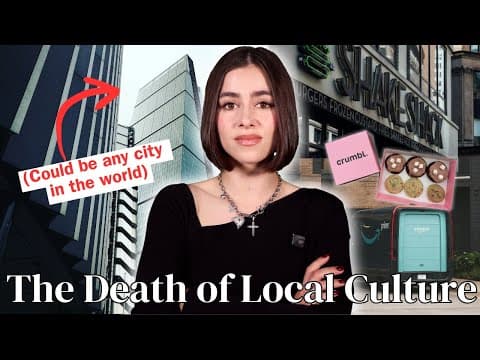
In recent years, a noticeable trend has emerged across American cities: a striking similarity in architecture, culture, and lifestyle. From Nashville to Los Angeles, cities are increasingly characterized by the same chain restaurants, apartment complexes, and public art installations. This phenomenon raises an important question: why do all these cities look the same?
The answer lies in the complex interplay of globalization, mass migration, and the pervasive influence of social media, which have collectively contributed to the decline of local culture and beauty in the West.
Globalization has led to the replacement of regional identities with a mass culture that lacks the unique characteristics that once defined local communities. As people migrate and travel more frequently, they become less connected to their local roots. This shift has resulted in a homogenized culture that is often perceived as aesthetically unpleasing.
Social media has played a pivotal role in shaping cultural norms and preferences. With the rise of platforms like TikTok and Instagram, young people are increasingly influenced by trends that transcend geographical boundaries. This has led to a preference for adopting accents and dialects that reflect popular culture rather than those of their local communities.
In Houston, for example, the demographic landscape has changed dramatically over the decades. In 1960, Harris County was predominantly white, but by 2019, the white population had decreased to just 31%. This shift has contributed to the decline of regional accents among younger generations, who often sound more like their peers than their parents.
The blending of cultures has resulted in a loss of distinct regional identities, which is a significant indicator of cultural decline. Studies have shown that regional accents are disappearing, reflecting a broader trend of cultural homogenization.
The renowned poet T.S. Eliot, in his book "Notes Towards the Definition of Culture," outlines three essential conditions for a thriving culture:
Eliot emphasizes that the survival of smaller, localized cultures is vital for the enrichment of the larger culture. When local cultures become indistinguishable from a dominant culture, both suffer a decline in cultural richness.
Eliot warns against the dangers of merging smaller cultures into a larger, uniform culture. He cites historical examples, such as the unification of Germany and Italy, to illustrate how this process can disrupt traditional cultures and hinder future cultural growth. His prophetic words resonate today, as we witness the consequences of a global culture that lacks distinctiveness.
As migration patterns shift, cities that were once cradles of beauty and civilization are experiencing a transformation. The influx of diverse populations has led to a dilution of local culture, with native inhabitants often feeling pressured to abandon their cultural identities in favor of accommodating newcomers. This dynamic contributes to the aesthetic decline of urban environments.
The proliferation of global corporations, such as Starbucks and Amazon, further exacerbates the loss of local culture. These entities prioritize uniformity over uniqueness, leading to a landscape that lacks the charm and character of local businesses and traditions.
To combat the decline of local culture, Eliot suggests that we cannot directly create or improve culture; instead, we must will the means that are favorable to cultural revival. This involves a commitment to fostering family values, supporting local businesses, and resisting the pressures of globalization.
Change begins at the individual level. By making small, actionable decisions—such as shopping locally or engaging with community traditions—we can gradually restore the richness of our local cultures. Eliot encourages us to focus on personal improvement as a means to enhance society as a whole.
The war on beauty and local culture is a pressing issue that requires our attention. As we navigate an increasingly globalized world, it is essential to recognize the value of our local identities and the beauty they bring to our communities. By taking small steps towards cultural revival, we can work together to preserve the unique characteristics that make our cities vibrant and beautiful.
In the face of cultural homogenization, let us strive to celebrate and protect the local cultures that enrich our lives and define our identities.