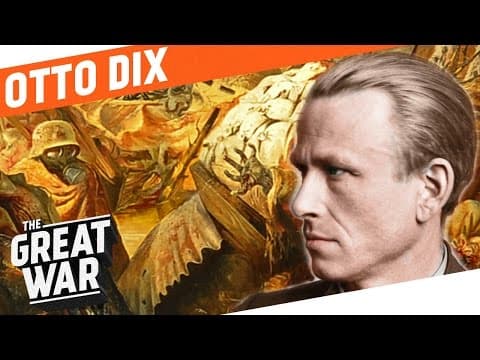
Otto Dix, a prominent German painter and printmaker, used his experiences as a soldier in World War I to create powerful anti-war art. His works, characterized by stark realism and political commentary, reflect the chaos of his time and the horrors of war, making him a key figure in the New Objectivity movement.
Otto Dix, a significant figure in the world of art, once stated, "All art is exorcism. I paint dreams and visions too – the dreams and visions of my time. Painting is the effort to produce order; order in yourself. There is much chaos in me, much chaos in our time." These words encapsulate the essence of his work and the tumultuous period he lived through. In this blog post, we explore the life of Otto Dix, his experiences during World War I, and how these experiences shaped his artistic legacy.
Otto Dix was born on December 2, 1891, in Untermhaus, Germany, to working-class parents, Franz and Louise. From a young age, he exhibited artistic talent, which led to an apprenticeship with a painter. His formal education began at the School of Decorative Art in Dresden, where he studied from 1909 to 1914. By 1912, Dix had connected with the Expressionist movement, which would significantly influence his later works.
When World War I erupted, Dix eagerly volunteered for military service. He was assigned to a field artillery regiment in Dresden and later transferred to a machine gun unit on the Western Front. His combat experiences included participation in the Battle of the Somme and the German Spring Offensive in Flanders, where he was awarded the Iron Cross second class.
Dix's time in the trenches left a profound impact on him. He was wounded multiple times and discharged shortly after the war ended. The horrors he witnessed haunted him, leading to recurring nightmares of crawling through destroyed homes. These traumatic experiences became central themes in his artwork.
Dix's artistic output during and after the war was marked by a political edge, reflecting his disdain for the treatment of wounded veterans. His paintings, such as "War Cripples" (1920) and "War Wounded" (1922), starkly depicted the grim realities faced by ex-soldiers. In 1924, his painting "The Trench" was exhibited, showcasing decomposed corpses in a German trench, which sparked public outrage.
That same year, Dix collaborated with fellow artists to create the traveling exhibition "No More War!" and published his book of etchings titled "Der Krieg." This book, modeled after Francisco Goya's "Los Desastres," utilized various etching techniques to convey the brutal truths of war. Critics hailed it as one of the most powerful anti-war statements in modern art, emphasizing its unflinching realism.
Dix dedicated six years to creating his masterpieces, "Metropolis" (1928) and "Trench Warfare" (1932), both of which are triptychs. In "Metropolis," he portrayed himself as a war cripple entering Berlin, greeted by a row of prostitutes. "Trench Warfare" depicted the journey of soldiers from the battlefield to their homes, with a central panel illustrating the devastation of war.
In 1926, Dix became a professor at the Art Academy in Dresden, but his career faced a severe setback with the rise of the Nazis. Hitler's regime condemned modern art, particularly Dix's anti-war works, leading to his dismissal and the display of his paintings in the Museum of Degenerate Art. Many of his works were ultimately destroyed.
Despite these challenges, Dix continued to paint, focusing on landscapes after relocating to Lake Constance. He was conscripted into the Volkssturm during World War II and captured by French forces, spending time in a POW camp. After his release, he resumed his artistic endeavors until his death from a stroke in 1969.
Otto Dix's art serves as a powerful reminder of the horrors of war and the chaos of his time. His works, characterized by stark realism and political commentary, continue to resonate today. Dix's legacy as a soldier-artist highlights the profound impact of war on individual lives and the importance of documenting these experiences through art. His commitment to portraying the truth of war ensures that future generations will remember the sacrifices and suffering endured during such tumultuous times.
As we reflect on Dix's contributions, we are reminded of the necessity of confronting the realities of conflict and the role of art in processing and understanding these experiences.