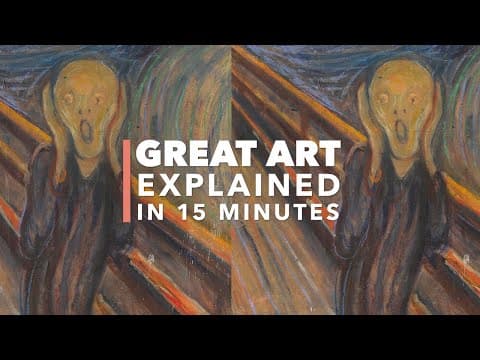
Edvard Munch's "The Scream" is a profound exploration of anxiety and alienation, reflecting the tumultuous changes in Europe during the modern era. This blog post delves into Munch's life, artistic influences, and the psychological themes that make this painting a universal symbol of human angst.
Under a blood-red sky, a terrifying figure with a skull-like face stares out, appearing to scream in anguish. Edvard Munch's "The Scream" has become a universal symbol of angst and anxiety, reflecting the intense anxieties of the modern era. This blog post explores the context, influences, and psychological themes behind this iconic artwork.
Munch painted "The Scream" during a time of exceptional change in Europe, marked by industrialization, economic shifts, and political unrest. Between Munch's birth in 1863 and the years leading up to World War I, European cities experienced profound transformations that brought fear, obsession, disease, and radicalism. Munch himself was deeply affected by these societal changes, as well as by personal tragedies, including the deaths of his mother and sister from tuberculosis and the mental illnesses that plagued his family.
Munch's childhood was marked by sickness and trauma. His father, a fundamentalist Christian, disapproved of Munch's desire to become an artist, viewing it as an unholy profession. This lack of support, combined with the loss of loved ones, left a lasting impact on Munch's psyche and artistic expression. His early works were grounded in realism, but after joining Christiania's bohemian circle in 1884, he began to explore his emotional and psychological state through art.
Munch's artistic journey took a significant turn during his time in Paris, where he encountered the revolutionary works of the Impressionists. Their use of color and form inspired him, leading to a shift from realism to a more expressive style. Influenced by artists like Vincent van Gogh and Paul Gauguin, Munch began to incorporate bold outlines and emotional depth into his work.
In 1892, Munch's solo exhibition in Berlin faced controversy due to the raw and unfinished nature of his paintings. However, this scandal propelled him to fame, allowing him to explore psychological themes in his art. His series "The Frieze of Life" encapsulated his exploration of life, love, and death, with "The Scream" being one of its most notable pieces.
Munch's inspiration for "The Scream" came from a personal experience he described in his diary: "I was walking down the road with two friends when the sun set. Suddenly the sky turned as red as blood... I felt as though a vast endless scream passed through nature." This moment of existential dread is captured in the painting, where the figure appears to be overwhelmed by the chaos of the world around it.
The composition of "The Scream" is simple yet powerful, featuring a bridge, fjords, and a swirling sky that suggests a world dissolving into chaos. The main figure, with its broad curves, blends into the background, emphasizing the emotional distance from the two figures walking away.
Munch often worked with unprimed cardboard and used diluted paint to achieve a unique texture. He left many paintings unfinished, embracing an anti-art statement that allowed the process to show. His unconventional methods, including leaving paintings outside to age naturally, contributed to the organic feel of his work.
The figure in "The Scream" is featureless and ungendered, allowing viewers to project their own emotions onto it. This universality is part of what has made the painting an enduring symbol of anxiety. Munch's later addition of the inscription "Could only have been painted by a madman" reflects his awareness of the public's perception of his mental health, adding another layer of complexity to the work.
The setting of "The Scream" is based on a scenic walk Munch took near Oslo Fjord, where he was visiting his sister Laura, who had been confined to an asylum. This personal connection to the location adds depth to the painting, as Munch grappled with feelings of abandonment and distress during a time of personal and societal upheaval.
Edvard Munch's "The Scream" is more than just a painting; it is a profound exploration of the human condition, capturing the essence of anxiety and alienation in a rapidly changing world. Through his unique artistic vision and personal experiences, Munch created a work that resonates with audiences across generations, reminding us of the universal struggles we all face in our lives.