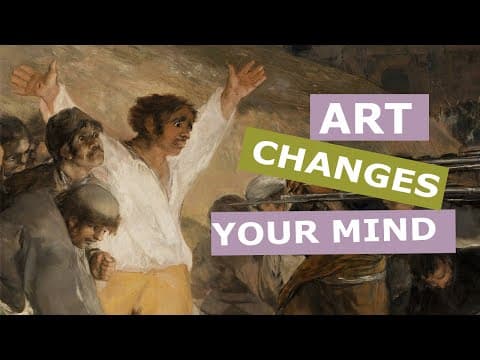
Francisco Goya's painting, The Third of May 1808, serves as a powerful commentary on the horrors of war and the human condition, challenging viewers to confront the stark realities of violence and the loss of humanity in conflict.
Can a painting change your mind? This question resonates deeply when we consider the work of Spanish artist Francisco Goya, particularly his monumental piece, The Third of May 1808. Created just six years after the events it depicts, this painting captures a moment of profound tragedy and horror, inviting viewers to reflect on the nature of war and the human experience.
The Third of May 1808 illustrates the brutal execution of Spanish rebels by French soldiers during the Peninsular War. In 1808, Napoleon Bonaparte's forces invaded Spain, leading to widespread resistance among the Spanish populace. Goya's painting serves as a stark reminder of the consequences of this conflict, showcasing the grim reality faced by ordinary people caught in the crossfire of political ambitions.
At the heart of the painting is a solitary man, dressed in a bright white shirt and mustard trousers, who stands out against the dark backdrop. His arms are raised in a Christ-like pose, symbolizing both submission and defiance. This central figure embodies the culmination of a life filled with choices that have led him to this tragic moment. Despite the viewer's lack of knowledge about his personal story, there is an innate sympathy evoked for him, highlighting our shared humanity.
Goya's portrayal of the execution is devoid of glorification. Unlike the heroic battle scenes favored by his contemporaries, this painting reveals the raw horror of war. The executioners are depicted as faceless soldiers, stripped of individuality and humanity, executing their orders with cold precision. The contrast between the disciplined soldiers and the disordered line of victims emphasizes the dehumanization inherent in such acts of violence.
The painting captures the early hours of the morning, with the sky dark and foreboding. Below the central figure lie the bodies of those already executed, while others await their fate, hands covering their faces in despair. The ground is stained with blood, a visceral reminder of the violence that has transpired. Goya's choice to depict this scene in such a stark manner forces the viewer to confront the grim realities of war, stripping away any romantic notions of heroism.
Through The Third of May 1808, Goya critiques not only the soldiers but also the political leaders who orchestrate such violence. The painting serves as a commentary on the failures of leadership and the consequences of political ambition. Both soldiers and victims are portrayed as pawns in a larger game, highlighting the tragic outcomes of misguided ideologies and the pursuit of power.
Returning to the initial question, can a painting change our mind? Goya's work certainly challenges viewers to reconsider their perceptions of war and violence. It compels us to reflect on the human condition and the flaws that lead to such atrocities. Art, particularly great art, has the power to evoke emotions and provoke thought, often without our conscious awareness.
In conclusion, Francisco Goya's The Third of May 1808 is more than just a representation of a historical event; it is a profound exploration of the human experience in the face of brutality. The painting invites us to ponder the complexities of our existence and the moral implications of our actions. While not all art may resonate on such a deep level, Goya's work undeniably leaves a lasting impact, reminding us of the darker aspects of humanity that we must confront and understand.