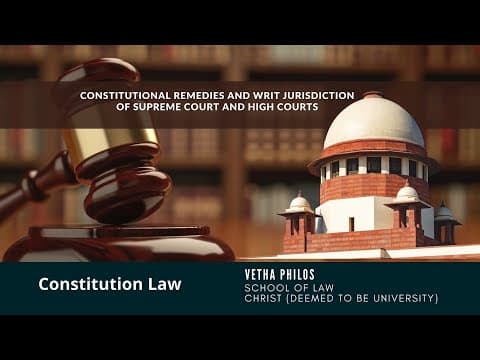
This blog post explores the jurisdiction of constitutional courts in India, focusing on original and appellate jurisdiction, and details the constitutional remedies available under Articles 32 and 226, including the five types of writs: habeas corpus, mandamus, quo warranto, certiorari, and prohibition.
This lecture on constitutional remedies and the jurisdiction of constitutional courts is divided into two parts. First, we will examine the jurisdiction of constitutional courts through which they exercise their powers. Secondly, we will understand the nature of constitutional remedies available when the court exercises its jurisdiction.
Jurisdiction refers to the power of the court to hear a matter and order a remedy for a wrong. For the purpose of this discussion, we will focus on two kinds of jurisdiction:
In appellate jurisdiction, the court assesses whether the lower court's decision was correct. Typically, a case must first be argued before the lowest competent court before it can be escalated to a higher court. However, in cases of public importance, such as violations of fundamental rights, individuals can directly approach the High Court or the Supreme Court under their original jurisdiction.
The Supreme Court and High Courts exercise original jurisdiction under the powers conferred by the Constitution, specifically:
Article 32 states:
From this, we can infer that:
Article 226 states:
Key points from Article 226 include:
The language of Articles 32 and 226 suggests two types of remedies:
There are five main writs mentioned in Articles 32 and 226:
Habeas Corpus: This writ translates to "have the body" and is used to release a person who has been unlawfully detained. The court directs the detained person to be brought before it to examine the legality of the detention. If found unlawful, the person is released.
Mandamus: Meaning "we command," this writ is issued to direct a public authority to perform a public legal duty that it has failed to perform. It cannot be issued against private individuals or bodies and is applicable only when the duty is mandatory.
Quo Warranto: This writ translates to "by what authority" and is used to call upon a person holding a public office to show under what authority they hold that office. If found unqualified, the person may be ousted from the office.
Certiorari: This is a curative writ issued when a lower court or tribunal has passed an order beyond its power or committed an error of law. It allows the higher court to transfer the case to itself or quash the lower court's order.
Prohibition: This writ is issued to prohibit lower courts or tribunals from acting beyond their jurisdiction. It is sought before an authority makes an order to prevent it from doing so.
In addition to the named writs, courts can also issue non-writ remedies when necessary for the enforcement of rights. These may include declaratory remedies, the establishment of committees to oversee functions, and special investigations.
Understanding the jurisdiction of constitutional courts and the remedies available under Articles 32 and 226 is crucial for the enforcement of fundamental rights in India. The various writs serve as powerful tools for individuals seeking justice against unlawful actions by authorities, ensuring that the rule of law is upheld in the country.