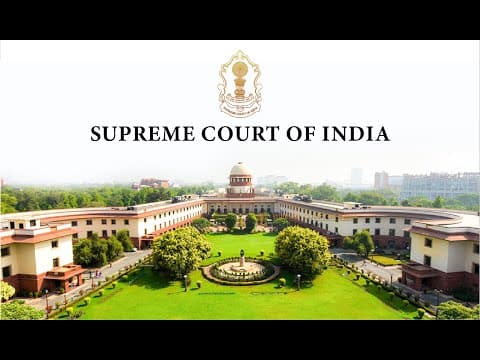
This blog post explores the recent discussions in the Supreme Court of India regarding the powers of courts to modify arbitration awards, focusing on the implications of Section 34 of the Arbitration and Conciliation Act. It highlights the arguments for and against the modification of awards, the doctrine of merger, and the importance of maintaining the integrity of arbitration as a dispute resolution mechanism.
The Supreme Court of India has been engaged in a significant discourse regarding the powers of courts to modify arbitration awards under the Arbitration and Conciliation Act. This discussion is crucial as it impacts the efficiency and finality of arbitration as a dispute resolution mechanism. This blog post aims to dissect the arguments presented in court, focusing on the interpretation of Section 34 and the implications of modifying arbitration awards.
Arbitration is a preferred method for resolving disputes in India, particularly in commercial matters. The Arbitration and Conciliation Act, 1996, was enacted to provide a framework for arbitration, ensuring minimal judicial intervention and promoting the finality of arbitral awards. However, the recent discussions in the Supreme Court have raised questions about the extent of judicial powers in modifying these awards.
One of the central arguments revolves around whether Section 34 of the Arbitration Act allows courts to modify arbitration awards. Proponents of modification argue that the courts should have the discretion to correct errors in awards to ensure justice and uphold the integrity of the arbitration process. They contend that allowing modifications can prevent prolonged litigation and enhance the efficiency of dispute resolution.
A significant point of contention is the doctrine of merger, which posits that once an award is set aside, it ceases to exist. This raises the question of whether a modified award can be enforced if it is deemed to have merged with the court's order. Critics of modification argue that allowing courts to modify awards undermines the finality of arbitration and could lead to confusion regarding which version of the award is enforceable.
The discussions also highlighted the limits of judicial discretion. While courts have the power to set aside awards, the argument is that this power should not extend to modifying the awards. The concern is that modification could lead to a re-evaluation of the merits of the case, which is contrary to the principles of arbitration that prioritize finality and minimal intervention.
Section 34 of the Arbitration Act allows a party to apply to the court to set aside an arbitral award on specific grounds. The interpretation of this section is critical in determining whether modification is permissible. The language of Section 34 suggests that the court's role is limited to setting aside or refusing to set aside the award, without any explicit provision for modification.
Critics argue that introducing a power to modify awards would lead to an increase in litigation, as parties may seek to challenge every aspect of an award. This could create a scenario where arbitration becomes just another step in a lengthy judicial process, undermining its purpose as a swift and efficient means of dispute resolution.
The discourse also touched upon international practices regarding the modification of arbitration awards. In jurisdictions like Singapore and England, there are specific provisions that allow for the modification of awards under certain conditions. However, the Indian context is unique, and the absence of such provisions in the Arbitration Act raises concerns about the enforceability of modified awards in international forums.
The ongoing discussions in the Supreme Court of India regarding the modification of arbitration awards highlight the delicate balance between ensuring justice and maintaining the integrity of the arbitration process. While the arguments for modification are compelling, the potential implications for the finality of awards and the efficiency of arbitration cannot be overlooked. As the court deliberates on this matter, the legal community and stakeholders in arbitration await a decision that could reshape the landscape of dispute resolution in India.