This blog post explores the roles of courts and corrections in the American legal system, detailing the adversarial process, the objectives of corrections, and the multifaceted nature of justice, emphasizing the balance between punishment and rehabilitation.
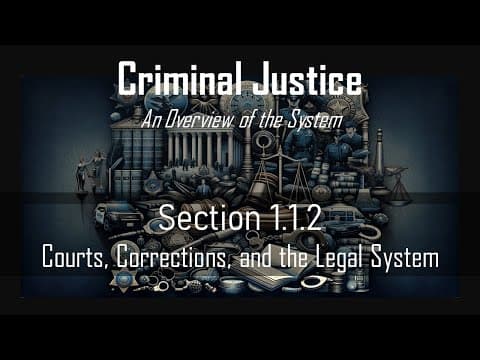
In this exploration of the American legal system, we delve into the intricate workings of courts and corrections, as outlined in Dr. Adam McKee's book, "Criminal Justice: An Overview of the System." This discussion not only highlights the procedural aspects of the legal system but also engages with the philosophical underpinnings of justice itself.
The courts serve as the pivotal arena where justice is pursued and the fate of individuals accused of breaking the law is determined. Imagine standing in a courtroom, your future hanging in the balance. This environment is where the intricate dance of legal proceedings unfolds, designed to ensure fairness and uphold the principles of justice.
At the heart of the American judiciary is the adversarial system, a distinctive feature that involves two opposing sides: the prosecution and the defense. The prosecutor represents the government and strives to prove beyond a reasonable doubt that the defendant committed the crime. Armed with evidence and witnesses, the prosecutor's mission is to convince the judge and jury of the defendant's guilt.
Opposing the prosecutor is the defense attorney, who acts as the defendant's champion in the courtroom. Like a skilled strategist, the defense attorney counters the prosecution's moves, challenges evidence, questions witnesses, and presents alternative narratives. Their goal is to instill reasonable doubt in the minds of the jurors and advocate for the defendant's legal rights.
Presiding over this legal contest is the judge, the impartial arbiter who ensures that courtroom rules are followed. The judge's role is akin to that of a referee, making rulings on the admissibility of evidence and guiding the proceedings. In bench trials, the judge also serves as the finder of fact, determining guilt or innocence when a jury is not present.
The jury, composed of ordinary citizens, plays a crucial role as the ultimate deciders of fact. Tasked with weighing the evidence presented by both sides, the jury's verdict represents the community's voice in the administration of justice. Their decision, reached through collective deliberation, determines whether the defendant is found guilty or not guilty, embodying the democratic principles at the core of the American legal system.
This adversarial setup, with its checks and balances, ensures that the pursuit of justice is a dynamic and interactive process. It provides a platform for the accused to have their day in court, for evidence to be critically examined, and for the truth to emerge from the clash of opposing viewpoints. Through rigorous debate and examination, the courts seek to ensure that justice is not only done but also seen to be done, maintaining public trust in the legal system's integrity and fairness.
The concept of corrections within the criminal justice system encompasses a multifaceted array of strategies and facilities designed to manage individuals accused or convicted of crimes. This broad term covers everything from probation and parole to incarceration in jails and prisons.
The primary purpose of corrections is often debated: is it to punish those who have broken the law, rehabilitate them for reintegration into society, or protect the public from potential harm? While different stakeholders emphasize various priorities, a consensus often emerges around the need to ensure public safety, which serves as the guiding principle for correctional policies and practices.
Jails serve as the entry point for many into the correctional system, housing individuals awaiting trial who are presumed innocent until proven guilty, as well as those serving short sentences for lesser offenses. The transient population of jails reflects the system's front end, dealing with a wide range of individuals whose final outcomes are yet to be determined.
In contrast, prisons are designed for the long haul, housing individuals convicted of more serious crimes serving sentences that can span from a year to life. Prisons are structured to be more secure and often offer comprehensive rehabilitation programs, addressing the root causes of criminal behavior through education, vocational training, substance abuse treatment, and psychological counseling.
The journey from arrest to re-entry is fraught with challenges and opportunities for reflection on what corrections should aim to achieve. While the punitive aspect of incarceration is clear, the potential for rehabilitation and transformation is equally significant. The correctional system's dual focus on protecting the public while offering avenues for personal growth underscores the complexity of its mission.
Ultimately, the effectiveness of the correction system is measured not just by its capacity to punish but by its ability to foster positive change in individuals, reduce recidivism, and enhance public safety in a sustainable and humane manner. This delicate balancing act between punishment and rehabilitation is at the heart of correctional philosophy, reflecting society's enduring hope in the potential for redemption.
Defining justice within this system is akin to navigating a labyrinth. Is justice about equality, ensuring everyone is treated the same, or about equity, where outcomes are based on individual actions? Perhaps it is about retributive justice, where the punishment fits the crime, or procedural justice, focusing on the fairness of the process itself.
The due process clause of the Fifth Amendment underscores the protection of civil liberties, acting as a guardian for rights deemed essential for fairness, such as the right to privacy. This principle demands that criminal proceedings are conducted fairly, respecting all legal rights.
In wrapping up this exploration of courts and corrections, we see how these components, along with the police, form the intricate tapestry of the U.S. criminal justice system, linked by the rule of law and guided by the Constitution. This system aims to ensure fairness, protect rights, and serve justice in its many forms. As we ponder the complexities of justice and the critical role of due process, we invite you to reflect on what justice means to you and how you perceive the balance between punishment and rehabilitation. Join the conversation and share your thoughts as we continue to explore the vital aspects of criminal justice.