This article explores the concepts of jurisdiction and venue in cyberspace, detailing the types of jurisdiction, the significance of minimum contacts, service of process, and the distinctions between choice of law and forum selection clauses, as well as the Full Faith and Credit Clause in the context of cyber law.
In the digital age, understanding jurisdiction and venue in cyberspace is crucial for both individuals and businesses. This article delves into the various types of jurisdiction, the concept of minimum contacts, service of process, and the distinctions between choice of law and forum selection clauses. Additionally, we will explore the Full Faith and Credit Clause and its implications in the context of cyber law.
Cyber Law refers to the legal framework that governs the internet and digital communications. It encompasses various legal fields, including intellectual property, contract law, and tort law, and addresses issues arising from the use of the internet and the Internet of Things (IoT). While Cyber Law can be narrowly defined, it often intersects with other legal areas, making it essential to understand its broader implications.
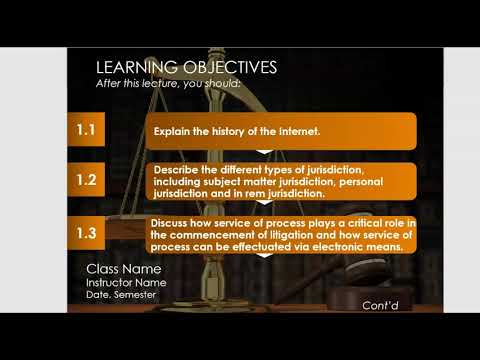
Jurisdiction is the authority of a court to hear and decide a case. It determines where a lawsuit can be filed and which court has the power to adjudicate a dispute. There are three main types of jurisdiction:
Subject matter jurisdiction refers to the court's authority to hear cases of a specific type. For instance, federal courts in the United States have jurisdiction over intellectual property disputes. If a patent is denied by the U.S. Patent and Trademark Office, the case can be appealed in federal court, which has the requisite subject matter jurisdiction.
In rem jurisdiction pertains to the court's authority over a specific property or thing. Generally, a court located where the property is situated has jurisdiction over disputes related to that property. For example, if a farm in Texas is sold and issues arise, any lawsuit would typically be handled by a Texas court.
Personal jurisdiction relates to the court's authority over a specific individual or entity. The general rule is that a lawsuit must be filed in the defendant's state of residence. For example, if you are suing someone who lives in Florida, the lawsuit must be initiated in Florida.
The concept of minimum contacts is crucial in determining personal jurisdiction, especially in cases involving online interactions. Established in the landmark case International Shoe Co. v. Washington, the minimum contacts test assesses whether a defendant has sufficient connections to a state to justify the court's jurisdiction.
For instance, if a user in Utah wishes to sue Facebook, which is based in California, the Utah court must determine if Facebook has minimum contacts with Utah. If Facebook has not conducted business or established a presence in Utah, the lawsuit would need to be filed in California instead.
Service of process is the formal procedure of notifying a defendant that they are being sued. It involves delivering legal documents, such as a summons or complaint, to the defendant. Proper service is essential; if not executed correctly, the court may dismiss the case.
Understanding the difference between choice of law and forum selection clauses is vital for contract drafting.
A choice of law clause allows parties to a contract to specify which jurisdiction's laws will govern their agreement. This is particularly important in international transactions where parties may prefer different legal systems.
A forum selection clause designates the specific court or jurisdiction where any disputes arising from the contract will be resolved. This clause is crucial for determining the venue of litigation.
The Full Faith and Credit Clause, found in Article IV, Section 1 of the U.S. Constitution, mandates that states must recognize and enforce the public acts, records, and judicial proceedings of other states. This clause ensures that legal decisions made in one state are honored in another, provided the originating court had proper jurisdiction.
For example, if a court in Wisconsin rules in favor of a plaintiff, that judgment must be recognized and enforced in California if the plaintiff seeks to collect damages there. This clause reinforces the interconnectedness of state legal systems and the importance of jurisdiction.
In summary, understanding jurisdiction and venue in cyberspace is essential for navigating legal disputes in the digital realm. This article has explored the definitions and types of jurisdiction, the significance of minimum contacts, the process of serving legal documents, and the distinctions between choice of law and forum selection clauses. Additionally, the Full Faith and Credit Clause highlights the importance of recognizing judicial decisions across state lines. As the digital landscape continues to evolve, so too will the complexities of cyber law, making it imperative for individuals and businesses to stay informed.