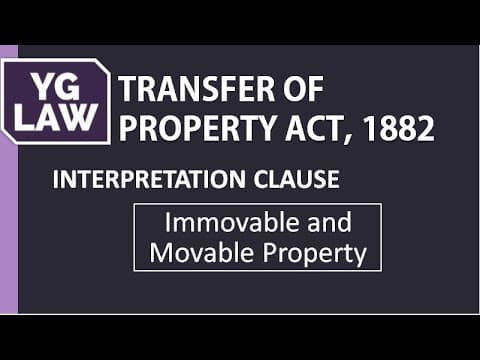
This blog post explores the definitions and distinctions between movable and immovable property as outlined in Section 3 of the Transfer of Property Act, 1882. It discusses the implications of these definitions on property registration, legal rights, and relevant case laws, providing a comprehensive understanding of property classification in legal terms.
In this blog post, we will delve into Section 3 of the Transfer of Property Act, 1882 (TPA), focusing on the definitions and distinctions between movable and immovable property. Understanding these concepts is crucial for anyone involved in property transactions, as they have significant legal implications.
According to Section 3 of the TPA, immovable property is defined as:
"Every property which does not include standing timber, growing crops, and grass."
This definition is notably brief, comprising only a few words. However, it raises questions about what constitutes immovable property beyond this narrow scope. For instance, if a tree is growing on a property, is it considered movable or immovable? The answer is not straightforward and requires further exploration.
Movable property, on the other hand, is defined negatively in relation to immovable property. Essentially, anything that does not fall under the category of immovable property is considered movable. This includes items that can be transferred from one location to another without causing damage to the property itself.
Understanding the difference between movable and immovable property is essential for several reasons:
Immovable property includes:
The definition also encompasses benefits arising from the land, such as:
The Registration Act further clarifies the definition of land, including buildings and rights associated with land use. It emphasizes that benefits arising from land are also considered immovable property, reinforcing the connection between land and its inherent rights.
Movable property includes:
The General Clauses Act provides a broader definition of movable property, encompassing all descriptions of property that do not fall under the category of immovable property.
In this landmark case, Shantabai was granted rights to cut trees on her husband’s land. The court had to determine whether her rights constituted movable or immovable property. The ruling emphasized that her rights were tied to the land and thus classified as immovable property, highlighting the importance of registration in property rights.
This case further clarified that standing timber, such as certain types of trees, is considered movable property because the ultimate objective is to cut them down. However, trees that provide ongoing benefits, like fruit-bearing trees, are classified as immovable property due to their connection to the land.
This case discussed the degree of annexation and the purpose of attachment. If machinery is permanently attached to the land for long-term use, it is classified as immovable property.
Understanding the distinctions between movable and immovable property under the Transfer of Property Act, 1882 is vital for legal clarity in property transactions. The definitions provided in the Act, along with relevant case laws, illustrate the complexities involved in property classification. Proper registration and awareness of legal rights are essential to ensure valid property transfers and to protect one’s interests in property dealings.