This blog post explores the concept of realism in 19th century American art, particularly through the works of Winslow Homer. It discusses the distinction between realism and naturalism, the evolution of Homer's artistic style, and the themes of struggle and survival in his paintings, reflecting the changing relationship between humanity and nature.
Realism is a significant movement in American art, particularly during the second half of the 19th century. It is often misunderstood, with many associating it solely with meticulous detail. However, realism transcends mere technique; it is about depicting one's own time and environment in a truthful manner. This blog post delves into the essence of realism, focusing on the works of Winslow Homer, a pivotal figure in this movement.
Realism in art is not just about style or technique; it is fundamentally about content and concept. It encourages artists to represent their own time without idealism, portraying both the good and the bad as they are. This approach allows for a direct and honest reflection of society and the human condition.
While realism is often confused with naturalism, the two are distinct. Naturalism emphasizes a detailed, almost photographic representation of subjects, while realism focuses on the broader context of human experience. For instance, Winslow Homer’s work may appear less detailed than that of Thomas Eakins, yet it embodies the principles of realism through its thematic content.
Winslow Homer, born in 1836 and passing in 1910, began his career as an illustrator before transitioning to fine art. His early works were influenced by the Hudson River School, depicting a harmonious relationship between humanity and nature. However, his artistic journey took a significant turn after he traveled to England in 1881.
Initially, Homer’s work reflected a benign view of nature, as seen in his painting "Fresh Air," which portrays a carefree shepherdess. However, his perspective shifted dramatically after his visit to the fishing village of Timmouth, England, where he encountered the harsh realities of life at sea.
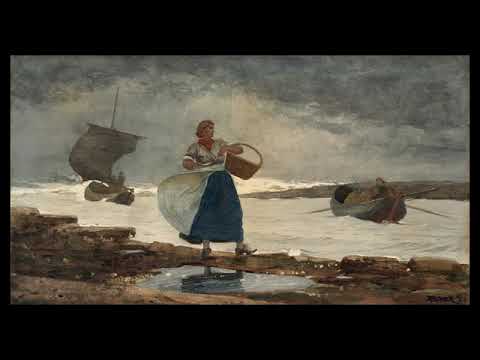
Homer's time in Timmouth marked a pivotal change in his artistic focus. He began to explore themes of struggle and survival, particularly in relation to the violent forces of nature. This is evident in his watercolor "Inside the Bar at Timmouth," which captures the ruggedness of fishermen's lives and the strength of women who supported them.
Homer’s works increasingly reflected the Darwinian struggle for survival, a theme that resonated with the societal changes of his time. His paintings often depicted the battle between humanity and nature, showcasing the resilience required to endure the elements.
Homer favored watercolor as his primary medium, appreciating its ability to capture the fleeting effects of light and weather. His technique evolved, moving from imitating oil painting to embracing the fluidity and spontaneity of watercolor. This shift allowed him to create dynamic compositions that conveyed the power of nature.
Some of Homer’s most significant works include:
As Homer continued to develop his style, he increasingly focused on the human condition in relation to nature. His later works, such as "After the Hunt," reflect a more complex relationship where humanity is not merely a part of nature but actively alters it.
Homer’s portrayal of women evolved significantly, showcasing their strength and resilience in the face of adversity. His works often depicted women as central figures, reflecting their vital roles in both domestic and public spheres.
Winslow Homer’s contributions to realism in American art are profound. His ability to capture the essence of human struggle against nature, combined with his innovative use of watercolor, solidified his place as a key figure in 19th-century art. Through his works, we gain insight into the complexities of life during a transformative period in American history, making his art not only visually compelling but also deeply resonant with the themes of survival and resilience.