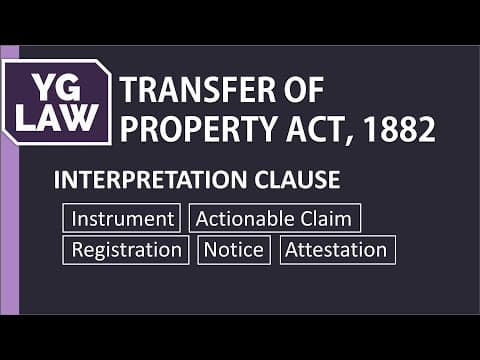
This blog post explores the key definitions and concepts outlined in Section 3 of the Transfer of Property Act (TPA), including instruments, actionable claims, attestation, registration, and notices, providing a comprehensive understanding of these legal terms and their implications in property transactions.
In this blog post, we will delve into the interpretation clause of the Transfer of Property Act (TPA), focusing on essential definitions such as instruments, actionable claims, attestation, registration, and notices. We will also touch upon the distinctions between movable and immovable property. Let's get started without wasting any time.
The term "instrument" in the context of the TPA refers to a legal document. Specifically, it is defined as a non-testamentary instrument, which means it is not related to a will. A legal instrument is any formally executed written document. In this context, a testamentary document, such as a will, is not considered an instrument under the TPA because it activates only after the death of the person who created it. The TPA governs transfers between living persons, and thus, a will, which involves the transfer of property from a deceased person to a living person, falls under succession laws rather than the TPA.
An actionable claim is a claim that can be enforced through legal action. For example, if you are owed money (say ₹5,000,000) by someone and they fail to repay you as per the agreement, you can take legal action against them to recover the debt. This concept will be explored in detail in Chapter 8 of the TPA.
Attestation refers to the process of witnessing the signing of a document. For a property transfer to be valid, it must be attested by two or more witnesses who are not parties to the transaction. These witnesses must be of sound mind and of legal age (18 years or older). Their role is crucial because, in case of a dispute, the court will rely on their testimony to confirm that the signing occurred as stated.
The TPA stipulates that registration of property documents must comply with the relevant laws in force at the time. According to the Registration Act of 1908, Section 17 specifies which documents require mandatory registration, while Section 18 outlines those that do not. Here are some key points regarding registration:
Notices can be classified into two types: express notice and implied notice.
The 1929 amendment introduced the concept of gross negligence in the context of notice, meaning that if a person fails to make reasonable inquiries, they may be deemed to have notice of the relevant facts.
Constructive notice refers to the legal assumption that a person is aware of a fact due to their negligence in failing to inquire about it. For example, if a property is registered under someone else's name, a buyer should check the registration before purchasing. If they fail to do so, they cannot claim ignorance of the existing registration.
In this post, we have covered the definitions of instruments, actionable claims, attestation, registration, and notices as outlined in Section 3 of the Transfer of Property Act. Understanding these concepts is crucial for anyone involved in property transactions, as they form the foundation of legal property transfers. In the next video, we will explore the differences between movable and immovable property in detail. If you found this information helpful, please like, subscribe, and comment to support our growth. Stay tuned for more insights on the Transfer of Property Act!