This article explores the essential elements of torts, including duty, breach of duty, causation, and injury, providing examples to illustrate each component and their significance in legal contexts.
The law of torts is a crucial aspect of legal studies, focusing on civil wrongs that cause harm or loss to individuals. To establish a tort, certain essential elements must be present. This article delves into these elements, providing clarity on each component and its significance.
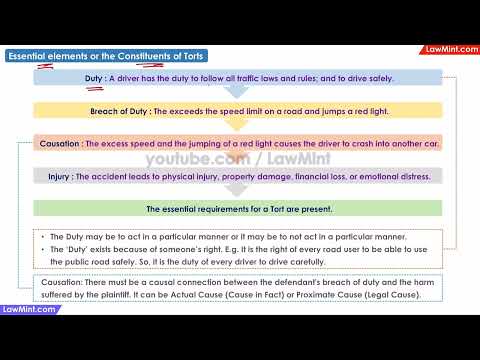
The first essential element of a tort is the existence of a duty. This duty can manifest in two forms:
A driver is required to follow traffic laws, which includes obeying speed limits and traffic signals. This duty arises from the rights of all road users to safely utilize public roads.
Once a duty is established, the next element is a breach of that duty. A breach occurs when an individual fails to meet the standard of care expected in a given situation.
If a driver exceeds the speed limit and runs a red light, they have breached their duty to drive safely and responsibly. This negligent behavior violates the legal obligation to avoid causing harm to others.
Following a breach of duty, there must be a clear causation link between the breach and the injury or damage suffered by the plaintiff. Causation can be categorized into two types:
In the scenario where a driver speeds and runs a red light, the actions directly lead to a collision with another vehicle. Here, the driver's breach of duty (speeding and ignoring traffic signals) is the actual cause of the accident.
The final essential element is injury. For a tort to be established, there must be some form of harm resulting from the breach of duty. This injury can take various forms, including:
It is important to note that the injury must be a legal injury, which means that a right of the plaintiff has been violated. A legal injury may not always coincide with an actual injury, but it is recognized by law as a violation of rights.
In summary, the essential elements of torts include duty, breach of duty, causation, and injury. When all these elements are present, a tort can be established. Understanding these components is vital for anyone studying law or involved in legal matters, as they form the foundation of tort liability and the protection of individual rights.