David Friedman discusses the relationship between economics and law, emphasizing how legal rules serve as incentives to modify behavior. He explores the implications of economic analysis on legal systems, the nature of justice, and the challenges of intellectual property in the digital age.
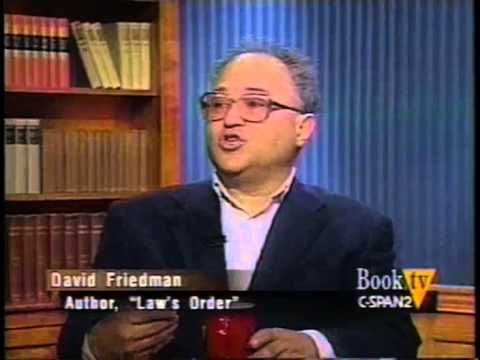
In a recent discussion with Book TV, law professor David Friedman, son of renowned economist Milton Friedman, delves into his new book, "Laws Order: What Economics Has to Do with the Law and Why It Matters." This article summarizes key insights from his conversation, highlighting the intricate relationship between economic principles and legal frameworks.
Friedman begins by explaining that legal rules are primarily designed to influence behavior. For instance, consider a speeding ticket. While it may seem like a tax on drivers, its true purpose is to encourage safer driving. This perspective allows us to view the legal system as a collection of incentives aimed at modifying individual actions, particularly when those actions impose costs on others.
Friedman argues that understanding the law through an economic lens can clarify its purpose and effectiveness. He provides an example involving armed robbery: if the punishment for armed robbery is life imprisonment, but the punishment for murder is the same, robbers may have an incentive to kill their victims to eliminate witnesses. This illustrates how economic reasoning can reveal unintended consequences of legal rules.
Friedman advocates for using economic analysis not only to comprehend existing laws but also to evaluate potential reforms. By recognizing that legal rules exist to achieve specific objectives, legal professionals can better assess their effectiveness and propose necessary changes.
When discussing justice, Friedman acknowledges the lack of a satisfactory theory that defines it. He references Judge Richard Posner, who critiques academic moral philosophy as largely ineffective. Interestingly, Friedman notes that economically efficient laws often align with common intuitions of justice, suggesting that our understanding of justice may be shaped by internalized norms that promote efficiency.
Friedman dedicates a significant portion of his book to intellectual property (IP), arguing against its current legal framework. He defines IP as the rights granted to creators to control the use of their works, such as copyrights and patents. However, he questions the necessity of such protections, suggesting that they may hinder innovation rather than promote it.
In his analysis, Friedman distinguishes between copyright and patent laws, arguing that the former is easier to enforce because it protects original works, while the latter requires a lengthy application process. He posits that the differences in enforcement mechanisms reflect the nature of the goods they protect. For example, copyright protects creative works that are unlikely to be independently replicated, while patents restrict potential innovations that could arise from similar ideas.
Friedman discusses the implications of technological advancements on IP enforcement, particularly in the context of digital media. He cites the Napster case as an example of how centralized systems can be targeted for legal action, while decentralized systems may evade enforcement altogether. He predicts that as technology evolves, traditional IP protections will become increasingly difficult to uphold, forcing creators to seek alternative revenue models.
Friedman reflects on the contributions of influential figures like Ronald Coase and Aaron Director in shaping the field of economic analysis of law. He highlights Coase's work on externalities, which challenges conventional wisdom about how costs are imposed and suggests that efficient solutions often arise from private bargaining rather than government intervention.
Friedman notes that while economic analysis has influenced legal thinking, significant political factors still shape the law. He cites the example of sentencing guidelines, where political pressures can override economic reasoning. Despite these challenges, he believes that the integration of economic principles into legal analysis has led to meaningful discussions and potential reforms.
David Friedman’s insights into the application of economic analysis to law reveal a complex interplay between legal rules and economic incentives. His work encourages a reevaluation of existing legal frameworks, particularly in the realm of intellectual property, and highlights the importance of understanding the broader implications of legal decisions. As technology continues to evolve, the legal system must adapt to ensure that it remains effective and just in promoting societal welfare.