This article explains the single-purpose container exception, a legal loophole allowing police to search certain containers without a warrant. It covers the landmark case US v. Gust, the doctrine's relation to the Plain View Doctrine, circuit court splits on its application, and practical advice on how to protect your rights when confronted by law enforcement regarding searches of containers like gun cases.
Can police officers assume a container has a gun in it and open it without a warrant? The answer depends on specific legal concepts. This article explores a little-known legal loophole known as the single-purpose container exception, which some police officers use to search containers without a warrant. We will discuss how this exception works, its legal background, and how you can protect yourself from unwarranted searches.
Normally, police cannot search you, your home, or your property unless they have:
However, there is a legal exception that allows police to search certain containers without a warrant, known as the single-purpose container exception.
This exception was highlighted in the case of US versus Gust. Officer Wade Holzer of the Liberty Lake Police Department responded to a dispatch about people shooting shotguns on private property. Upon arrival, Officer Holzer saw Mr. Gust and his friends carrying cases that the officers identified as gun cases.
Mr. Gust admitted to shooting for target practice with the owner's permission and also admitted that the cases contained guns. Officer Holzer then searched the gun cases and found a sawed-off shotgun, leading to Gust's arrest for possession of an unregistered firearm.
Gust claimed his Fourth Amendment rights were violated because the police searched the gun case without a warrant. The government relied on the single-purpose container exception to justify the search.
The single-purpose container doctrine states that some containers, based on their size, shape, weight, and use, are so distinctive that a reasonable officer would immediately know they could only contain illegal contraband. In other words, these containers "announce" to anyone who sees them that there is something illegal inside.
These containers are considered to have no privacy interest or rights because their contents can be inferred from their outward appearance.
Before this doctrine, police needed probable cause and an arrest or consent to search a container. The Supreme Court created the single-purpose container doctrine to allow warrantless searches of such containers.
The single-purpose container exception is similar to the Plain View Doctrine, which allows police to seize evidence without a warrant if it is in plain sight. For example, if illegal drugs are visible on a coffee table when a police officer enters your home, they can seize it without a warrant.
Similarly, if a container's contents are obvious (like drugs visible through a glass jar), police can open and search it without a warrant.
The courts have stated that the single-purpose container exception allows warrantless searches of containers so distinctive that their contents are a foregone conclusion and can be considered in plain view.
The application of this exception is not settled law and varies by jurisdiction. Different Circuit Courts of Appeals have different standards:
Ninth and Tenth Circuits: The determination of whether a container qualifies as a single-purpose container must be made from the perspective of an objective reasonable person, not just the police officer's opinion.
Fourth and Seventh Circuits: The decision can be based on the subjective opinion of the police officer, considering their training and experience.
This split means that the rights of individuals can depend heavily on where they live.
The key to protection lies in the nature of the container:
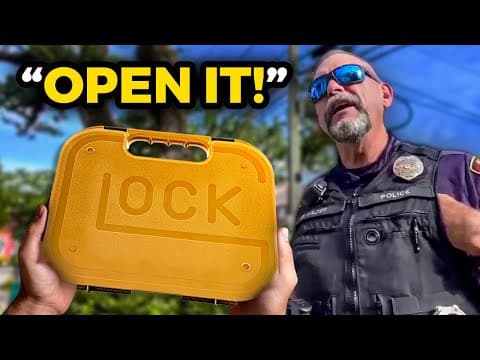
If the container is obviously designed to hold illegal items (e.g., a gun case labeled "Glock"), police may claim they do not need a warrant to search it.
If the container can hold other items (e.g., a guitar case or a cooler), it likely does not qualify as a single-purpose container, and police should not be able to search it without a warrant or consent.
Therefore, if you want to protect your rights, avoid carrying contraband in containers that are clearly identifiable as holding illegal items.
If police approach you claiming they have a search warrant, it is important to know your rights and how to respond. Understanding the validity and scope of the warrant is crucial.
For more detailed information on how to handle search warrants and protect your rights, consider consulting legal resources or watching educational videos on the topic.
The single-purpose container exception is a significant legal concept that can impact your Fourth Amendment rights. While it allows police to search certain containers without a warrant, its application varies by jurisdiction and depends on the container's nature. Being informed about this exception and how to protect yourself can help you navigate encounters with law enforcement more confidently.
Stay informed and know your rights to ensure your privacy and legal protections are upheld.