This blog post explores the conditions under which arbitration proceedings can be terminated, including the issuance of a final award, mutual agreement between parties, and other circumstances that render continuation unnecessary or impossible.
Arbitration and alternative dispute resolution (ADR) are essential mechanisms for resolving disputes outside of traditional court systems. However, there are specific circumstances under which these proceedings can be terminated. This article delves into the conditions that lead to the termination of arbitration proceedings, ensuring a comprehensive understanding of the topic.
Termination of proceedings refers to the formal conclusion of arbitration or ADR processes. This can occur for various reasons, and understanding these reasons is crucial for parties involved in such proceedings.
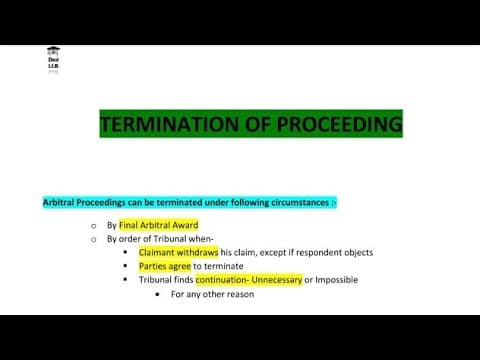
One of the primary conditions for terminating arbitration proceedings is the issuance of a final award. Once the tribunal has delivered its final decision, there is no further justification for continuing the proceedings. The final award signifies that the dispute has been resolved, and thus, the arbitration process is concluded.
Another condition for termination arises when a claimant decides to withdraw their claim. For instance, if a claimant requests to retract their claim based on certain circumstances, the tribunal may order the termination of the proceedings. However, this is contingent upon the agreement of the respondent. If the respondent insists on continuing the proceedings despite the claimant's withdrawal, the arbitration will not be terminated.
Termination can also occur if both parties mutually agree to conclude the proceedings. This agreement can be formalized through a request to the tribunal, which may then issue an order to terminate the arbitration. Such mutual consent is a significant factor in the termination process.
There are instances where the tribunal may find that continuing the proceedings is unnecessary or impossible. This could be due to various reasons, such as changes in circumstances or the realization that the issues at hand cannot be resolved through arbitration. In such cases, the tribunal has the authority to terminate the proceedings.
The tribunal plays a crucial role in the termination of proceedings. Once the proceedings are terminated, the tribunal's mandate to conduct further actions ceases. However, there are exceptions where the tribunal retains certain powers:
If there is a need to correct or interpret the final award, the tribunal may resume its functions to address these specific issues. This ensures that any ambiguities or errors in the award can be rectified.
In cases where a party seeks to challenge the validity of the award in court, the tribunal may be called upon to resume proceedings to clarify or eliminate the grounds for such a challenge. This allows the tribunal to ensure that the award remains valid and enforceable.
Understanding the conditions under which arbitration proceedings can be terminated is vital for all parties involved in dispute resolution. Whether through the issuance of a final award, mutual agreement, or other circumstances, the termination process is a critical aspect of arbitration and ADR. As we continue to explore this topic, future discussions will focus on the implications and procedures following the termination of proceedings.