Editorial Team
6 min read
Dropbox agreed to buy Tigris for about $350 million in cash and unveiled DBX Agent Cloud, starting with standalone object storage. The expansion accompanies AI actions for existing file customers, while pricing and evidence of competitive performance and productivity gains remain absent from the announcement.
Dropbox, the file-storage and collaboration company, agreed to acquire Tigris Data, a globally distributed object-storage platform aimed at AI workloads, for approximately $350 million in cash. Announced on November 5, the pending deal accompanies DBX Agent Cloud, a new offering for developers, and AI tools that act on files inside Dropbox.
The expansion gives Dropbox two ways to seek business from AI: sell storage independently to developers running applications across computing providers, and make its existing file subscriptions more useful through approved AI actions. Dropbox brings nearly two decades of storage operations to that effort. It is entering a market where portable storage and freedom from data-transfer charges already have competitors.
Dropbox signed the agreement on November 3 to buy all of Tigris’s outstanding equity. Its regulatory disclosure says the price is subject to customary adjustments and closing is expected in the fourth quarter of 2026, subject to customary conditions.
Founded by former Uber engineers, Tigris supplies storage across cloud providers. Dropbox describes Tigris’s technology as placing data for low-latency access worldwide without customers managing replication and caching themselves. Those are company descriptions, rather than comparative performance results. Dropbox says buying the platform and its developer relationships will accelerate its entry into AI infrastructure.
DBX Agent Cloud begins with S3-compatible object storage: a service for keeping data that works with familiar tools built for Amazon’s S3 storage service. Dropbox says it can hold training datasets, model artifacts, images and video while applications run on other companies’ clouds and computing platforms.
Dropbox’s next planned layers, also described in a report on its announcement, are content processing to turn documents and media into inputs AI systems can use, and filesystem capabilities to let agents manage files across tasks and sessions. Those additions matter to the agent pitch, but they are roadmap items rather than the initial product. The offering is a storage and data layer designed to work alongside customers’ computing providers.
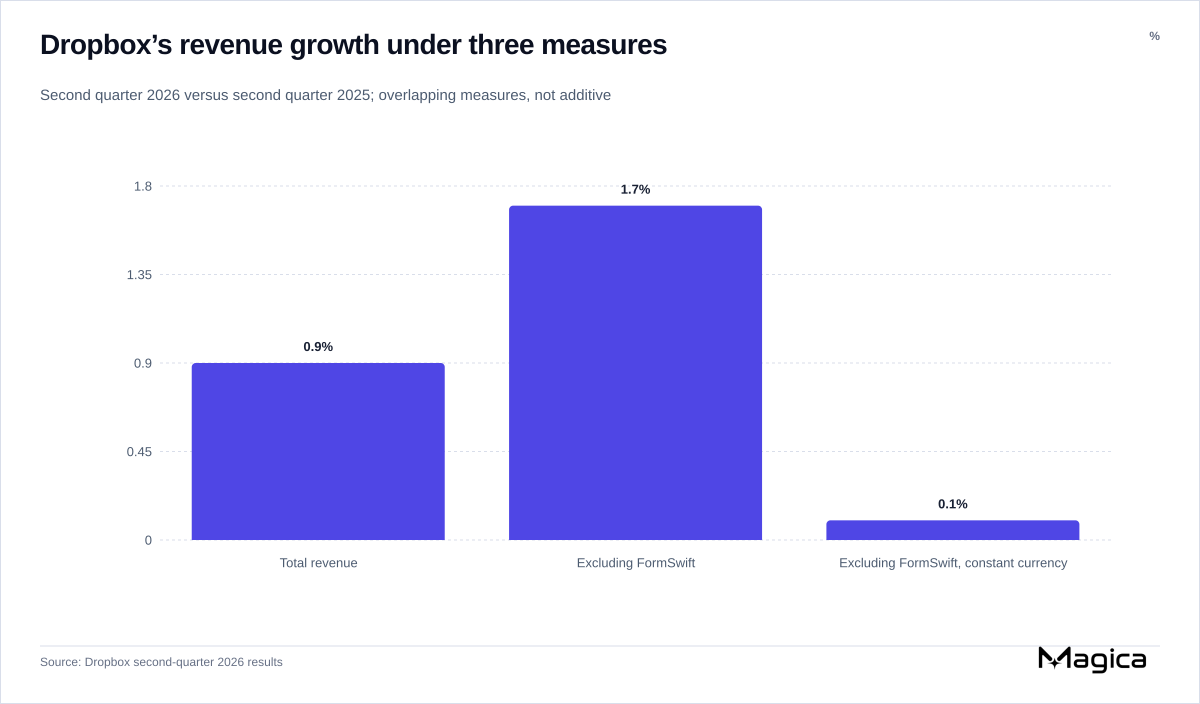
Company-reported revenue growth for Dropbox’s second quarter of 2026 under three overlapping measures. Source: Dropbox; chart: Magica. Source: Dropbox quarterly results.
In its results for the quarter ended June 30, 2026, Dropbox reported $631.5 million in revenue, up 0.9% from a year earlier. Excluding FormSwift, a business it plans to wind down by the end of 2026, revenue rose 1.7%. Growth excluding FormSwift was just 0.1% on a constant-currency basis, which applies prior-period exchange rates to current results.
Paying users totaled 18.19 million, compared with 18.13 million a year earlier, and rose by 96,000 from the preceding quarter. That subscription base gives Dropbox an audience for its AI update; selling infrastructure seeks another customer market.
The proposed purchase is substantial relative to disclosed liquidity. Dividing the approximately $350 million price by Dropbox’s $1.114 billion in cash, cash equivalents and short-term investments at June 30 gives roughly 31%. That is a comparison with a historical balance, not a statement of its cash at announcement or how it will fund the purchase.
Dropbox generated $238.5 million in operating cash during the second quarter. Its June-end balance sheet also reported net balances of about $2.61 billion in term loans and $690.7 million in convertible senior notes. The acquisition announcement provides neither Tigris revenue nor an expected revenue contribution, leaving the return on that cash commitment unresolved.
Inside the core product, the shift is from retrieving information to carrying out work. The update brings Dash, previously a separate AI search and chat product, into Dropbox, according to a report on the new tools. Dropbox is extending an existing AI effort, rather than introducing AI search for the first time.
Customers can describe a task, have Dropbox identify relevant content and propose a plan, then approve supported actions. The company lists folder summaries, document comparisons and drafting, PDF and image editing, transcription, video edits, and moving or renaming files in its announcement. Several steps can be requested together.
Those abilities increase the importance of permissions and recovery. Dropbox says actions respect existing permissions, are recorded for review, and can be undone where supported. Approval and undo are therefore part of the product’s operating mechanism, with limits: the announcement does not promise that every possible action is supported or reversible.
Dropbox also says users can switch supported models during a session and work with files through supported external AI tools, including ChatGPT, Claude and Muse, without repeatedly uploading content, with resulting work returning to Dropbox. The intended point of continuity is the content repository, even when the AI interface changes.
Dropbox says the experience has rolled out to more than 70,000 teams. The initial rollout focuses on eligible Standard and Advanced teams in the United States, United Kingdom and Australia, starting in English. That is a deployment count, not evidence of how frequently teams use the features or how much time they save. Dropbox’s more than 700 million registered users worldwide are a separate measure from both teams and paying users.
Dropbox describes Tigris as providing storage without vendor lock-in or egress fees—the charges for moving data out. Avoiding those charges matters when AI applications use different computing providers, but neither S3 compatibility nor eliminating egress fees is new to the market.
Cloudflare made its R2 object-storage service generally available in September 2022, advertising both an S3-compatible interface and no egress fees in its launch announcement. Its pricing model in that announcement charged for storage volume and read and write operations. That historical precedent establishes both a competing approach and a limit to the sales pitch: eliminating transfer fees still leaves other storage costs.
Dropbox’s proposition instead combines infrastructure with an existing content and collaboration business. Whether that combination wins developer workloads will depend on execution and economics. The acquisition announcement does not provide DBX Agent Cloud pricing or comparative performance measurements, so it cannot establish that the service is cheaper or faster than alternatives.
Dropbox still needs to close and integrate Tigris. Its disclosure flags risks including integration difficulties, loss of key personnel and failure to realize expected benefits. Filesystem and content-processing capabilities must also move from plans to delivered services.
For existing customers, broader availability is planned for 2027. The practical test is whether approved actions complete useful work reliably within team permissions. For developers, pricing and comparable measurements of access latency and reliability would help establish whether Dropbox’s storage merits a switch. The launch announcement supplies neither those comparisons nor measured productivity results, so rollout scale alone cannot resolve either buying decision.
The Cambridge startup has secured backing described as eight figures in capital and compute, including UK government support. Its wager is that cheaper, accurate quantum calculations can supply better AI training data; full performance results remain forthcoming.
Japan’s Nikkei fell 7.09% in Friday morning trading, with AI, chip and data center-related shares hit hard after Wall Street losses. Reports linked the rout to fears of U.S. regulation following Democratic election victories, without identifying an enacted restriction or a cut in AI spending.
Potential investors are pressing Anthropic for a lower valuation as a technology selloff threatens its November IPO timetable. Rapid revenue growth and substantial cash complicate a financing debate driven by losses and long-term infrastructure commitments.
Visa's new benchmark finds that AI shopping models often miss customer requirements and struggle to repeat successful decisions. The tests cover product discovery, leaving checkout and payment reliability for future rounds.
Agility Robotics began trading after its Churchill Capital Corp XI merger, bringing a commercially deployed humanoid robot maker to U.S. public markets. Its next test is turning conditional Digit 5 orders into deliveries and sustainable economics.
Goldman Sachs sees temporary halts potentially affecting about 45% of planned US data center expansion after Democratic election victories. In Texas, where approvals were already paused, the next fight is over how long restrictions last and what developers must pay for.
Core Scientific’s third-quarter colocation revenue rose 57.6% to $215.4 million. Its expansion beyond CoreWeave could diversify sales from 2027, but the next projects require additional financing rather than the same customer funding that supported its existing conversions.
Meta is rolling out voice conversations and animated avatars for Muse in the US. The update adds personality to a cloud-based task agent whose costs, permissions and reliability matter more than its expressions.
Anthropic is rolling out Personal Finance to paid Claude users in the US, using Plaid to read bank data. Its pitch rests on ad-free answers and privacy controls, while its own documentation warns that balances and budgets can be incomplete.
OpenAI president Greg Brockman predicts significant medical advances within 12 to 18 months and raises the possibility of death becoming a choice. OpenAI’s cell research and a separate early drug trial show narrower progress, with financial ties, safety questions and clinical testing still central to judging the promise.
Citrini Research is recasting its AI investments around relative value as it warns that financing and construction constraints threaten returns. Its reported Oracle–Nebius trade faces a crucial counterargument: Nebius has substantial customer commitments, although delivery remains conditional.
Shield AI has agreed to acquire Echodyne for up to $5.3 billion, backed by a $2.5 billion financing package. The radar maker brings a profitable, defense-heavy business and commercial customers, with a promise to keep supplying outside system builders.
Gemini Omni 1.2 Flash lowers Google's quoted 720p generation price to $0.07 per second and extends native clips from 10 to 15 seconds. Editing limits and early commercial tests show why cheaper output does not guarantee the same savings on finished videos.
Mercedes-Benz plans to add Liquid AI’s on-device models to its North American voice assistant. The deal combines local processing with existing cloud AI, while customer availability, measured performance and contract economics remain unconfirmed.
Mistral is expanding Studio with managed agents, apps and workflow tools, extending its existing enterprise platform. Its private-deployment pitch sits alongside cloud-hosted app services and vendor-stored agent sessions, making the chosen configuration central to customer control.
Meta president Dina Powell McCormick expects tougher conditions for new US data centers after Democratic election victories, but says states still want investment. The test is whether electricity commitments, local jobs and tax benefits can secure community support.
OpenAI is releasing GPT-6 Cyber to selected verified defenders with stronger monitoring. Its Linux research shows the scale and cost of automated exploitation, while mixed benchmark results and unfinished patching limit what the launch proves about safer software.
Black Hills plans $1.8 billion of gas generation under agreements to serve Google’s proposed $17 billion Cheyenne campus through 2048. Google has advanced equipment funding, but delivery, fuel-cell conditions and local impacts remain unresolved.
ElevenMusic creators can now publish directly to SoundCloud, with a three-month Pro offer for Artist Pro subscribers. The integration shortens distribution while preserving disclosure and rights requirements.
A researcher demonstrated how a browser extension could use Claude Dispatch to execute code through a connected desktop agent. Anthropic reportedly acknowledged the flaw in May and proposed retiring Dispatch, but existing users still have access, leaving questions about authorization across devices.