Editorial Team
8 min read
Mistral is expanding Studio with managed agents, apps and workflow tools, extending its existing enterprise platform. Its private-deployment pitch sits alongside cloud-hosted app services and vendor-stored agent sessions, making the chosen configuration central to customer control.
Mistral AI, the France-based AI model developer, expanded Studio, its platform for building and operating enterprise AI systems, on November 5, 2026. Managed agents and apps join new workflow, enterprise-data, monitoring and evaluation capabilities. The expansion offers companies more of the software needed to turn models into business processes, with control depending on which deployment they choose.
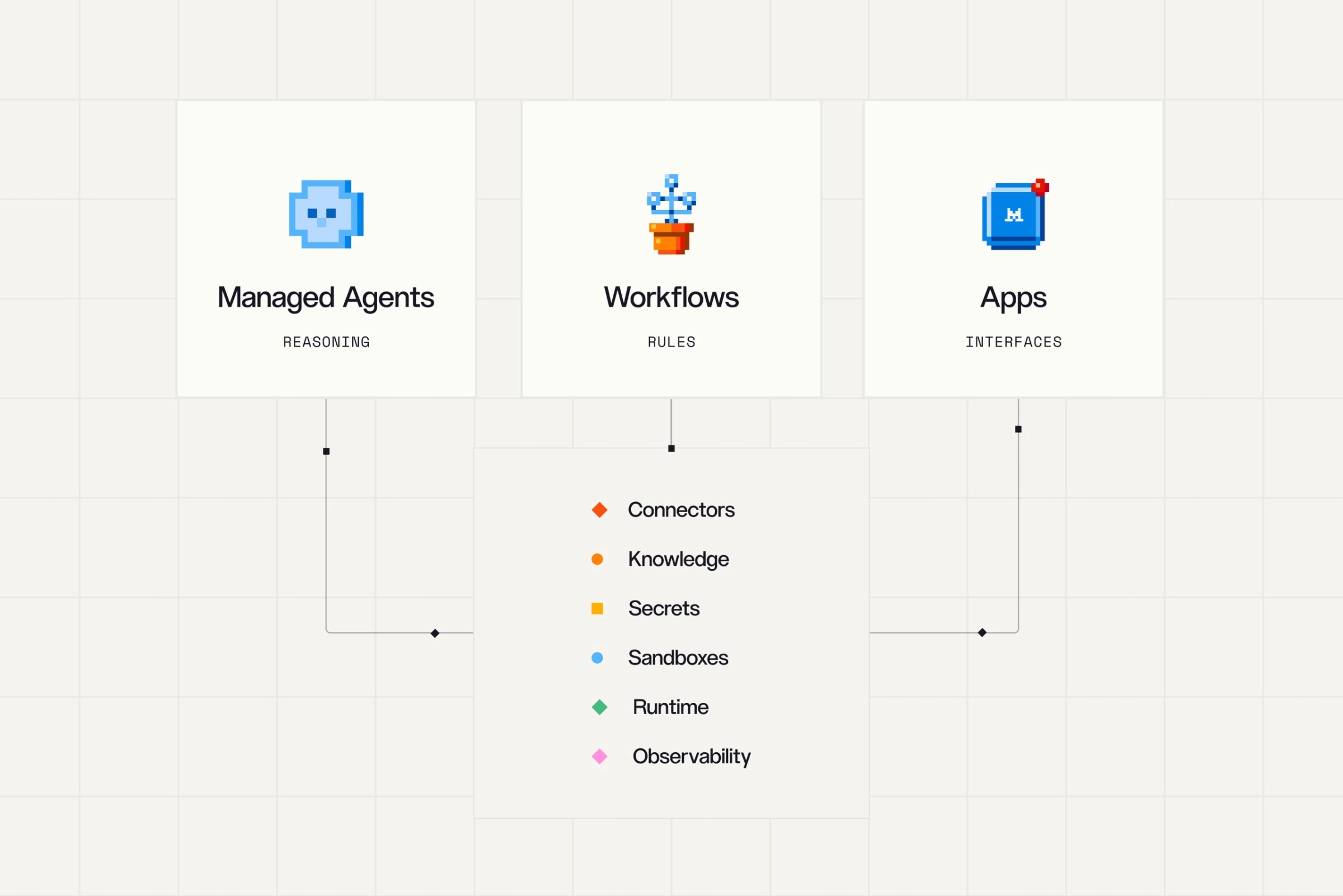
Mistral’s diagram shows agents, workflows and apps using shared platform services. Source: Mistral AI. Source: Mistral AI.
Mistral frames the release around putting its open model Mistral Large 4, also called Le Chonk, to work with company data and tools. Studio supplies three building blocks: agents choose steps as they investigate and act, workflows coordinate rules and approvals, and apps let employees use the systems. Shared connectors, instructions and infrastructure can be reused across projects.
That extends an existing strategy. Mistral introduced Studio on October 24, 2025, inviting enterprises into a private beta. That announcement already described a durable agent runtime, observability, an asset registry and hybrid or self-hosted deployment. The latest release expands a previously announced production platform rather than introducing those ambitions for the first time.
Mistral’s enterprise push has industrial backing. Semiconductor equipment maker ASML announced a €1.3 billion investment in September 2025, leading Mistral’s Series C round for an approximately 11% share on a fully diluted basis. The investment accompanied a long-term agreement to explore AI across ASML’s products, research, development and operations—a relationship combining financial backing with prospective industrial uses.
Managed agent infrastructure is already a competitive category. Amazon Web Services, Amazon’s cloud division, offers Bedrock AgentCore, a set of services for running and operating agents. Its announcement, updated in October 2025 to record general availability, describes serverless execution, session isolation, memory, identity controls and observability, with support for different models and frameworks. It also covers converting APIs into agent tools. Bundling these functions is therefore insufficient by itself to distinguish Studio; integration, deployment boundaries and operating costs are the consequential comparisons.
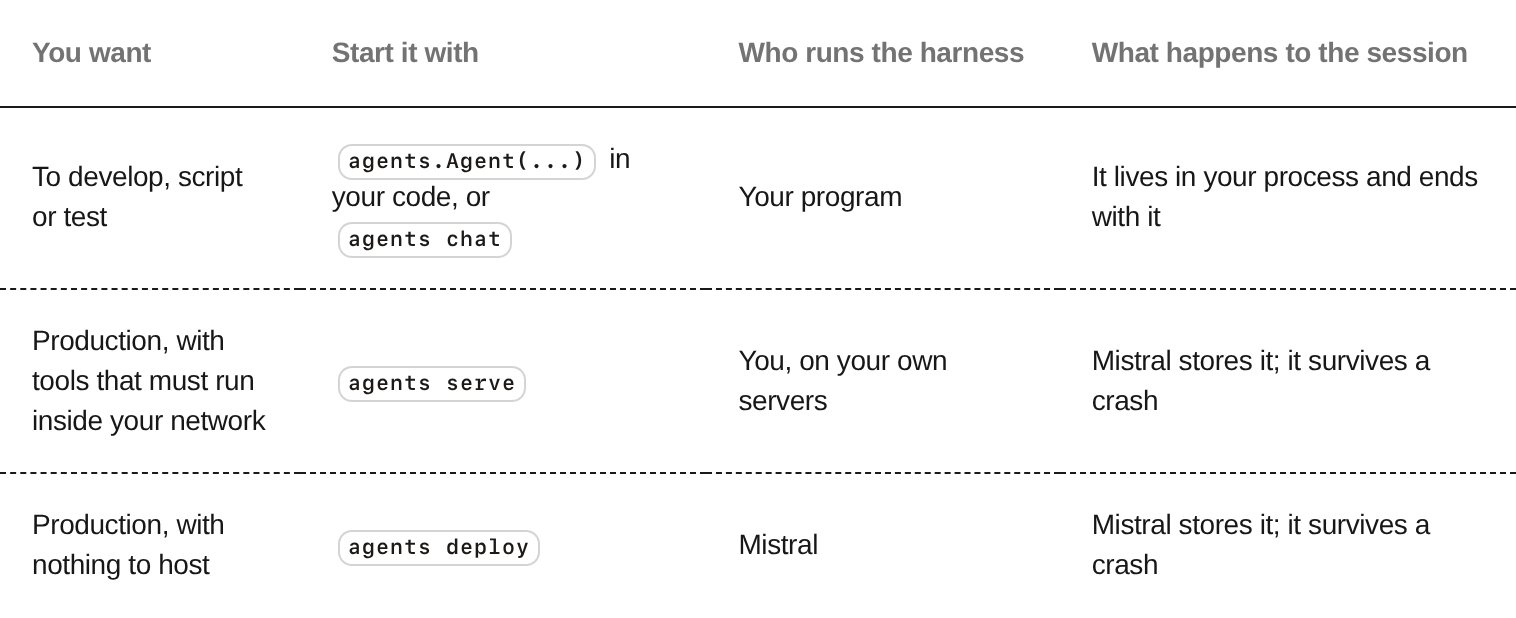
Mistral’s documented Studio deployment modes store sessions with Mistral for both customer-hosted and managed workers. Source: Mistral Docs. Source: Mistral Docs.
The Managed Agents documentation describes a Python SDK that controls the loop between a model and its tools. Developers specify instructions, connectors, reusable skills, an execution environment and which actions require approval. Agents can use isolated environments to run code and delegate work to subagents.
The same agent code can run locally, on a customer-operated worker or on a Mistral-managed worker. Deployed agents retain completed steps so a task can resume after a crash, and an approval can remain pending after the calling application closes. Managed Agents and its SDK are in public preview; Mistral warns that updates can require code changes.
Durability also has defaults. Deployed sessions normally end after 24 hours, or after four hours idle, although those limits can be raised. Approval waits default to one hour. A task described as capable of running for days therefore needs its session configuration checked.
The location of the worker is only part of the control question. In the documented Studio deployment path, Mistral stores sessions even when the customer runs the agent worker on its own servers. Those sessions contain messages, tool calls and results. Self-hosting the worker therefore lets tools execute inside the customer’s network without placing the entire session record there.
This is narrower than the launch announcement’s offer to deploy both models and the platform in a customer cloud, virtual private cloud or on-premises environment, including mixed arrangements. In that announcement, banking group BNP Paribas says it runs Studio on its own infrastructure for sensitive processes. Mistral also says customers retain their traces and evaluations, preserving the knowledge built through use. Ownership of those records and where they are stored are separate questions.
The developer overview says agents and workflows can run on customer infrastructure while apps run on Mistral Cloud. The hosted-service documentation does not establish the limits of every private installation; buyers need to establish which arrangement covers their models, execution, sessions and apps.
Existing developers also face a transition: the overview directs new agent development to the SDK, moves Agents API guides to a deprecated section and says durable agents in Workflows are about to be deprecated.
Workflows supply explicit execution rules around the agent’s discretionary reasoning. Mistral says interrupted runs can resume, while the update adds enterprise-system event triggers and a graph showing workflow logic. Its Vibe coding agent can generate, test and deploy workflow code from a description while leaving that code open to inspection and editing.
The integration changes reach beyond MCP, the Model Context Protocol used to connect AI applications to tools and data. HTTP connectors import an API’s OpenAPI specification and turn supported operations into tools, removing the need to build an MCP server for that API. Developers must review operations that cannot be converted and configure authorization scopes correctly.
The new Mistral MCP server exposes Studio workspace operations to coding assistants, so development need not begin in Vibe. Requests inherit the API key’s permissions; some tools can change or delete resources, making tool-level approvals consequential.
Event-driven execution has its own identity boundary. The trigger guide says a workflow runs as the trigger’s creator, rather than the person responsible for the external event. In Mistral’s Slack investigation example, users share the connector access of the account opening agent sessions. The example explicitly restricts tools to a reviewed read-only list. Managed infrastructure does not remove the developer’s responsibility to define whose access an agent uses.
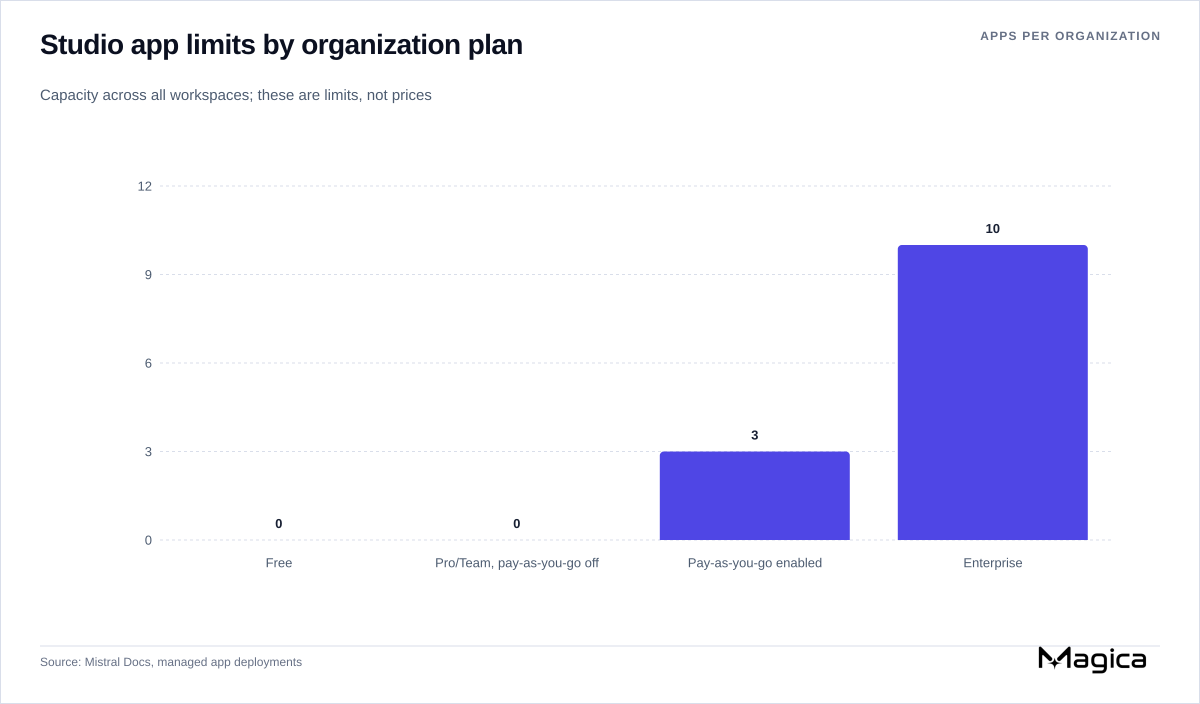
Mistral’s documented app limits apply across an organization’s workspaces. Deleted apps do not count toward the limit. Chart: Magica; data: Mistral Docs. Source: Mistral Docs.
An app packages resources such as a frontend, API, database, agents and workflows into one deployable project. Studio supplies hosting, authentication and access control. Reusable components are intended to reduce the code requiring fresh security review, and apps can be made available at their own link or inside Vibe. The standard setup still requires local development tools and a GitHub repository; its deployment command builds the pushed code and provisions the services.
The managed deployment guide sets limits across all workspaces in an organization:
| Organization plan | App limit |
|---|---|
| Free, or Pro/Team without pay-as-you-go | 0 |
| Pay-as-you-go enabled | 3 |
| Enterprise | 10 |
These are capacity limits, not a price comparison. The release materials do not establish a comparable total cost for running a business process on Studio versus alternative infrastructure.
Enterprise context also becomes more of a managed service. The release notes describe a hosted vector search index, datasets imported from files and tools to turn production traces into evaluation records. Managed-agent tracing is enabled by default, with redaction on the worker before traces leave it. Secrets Manager is in public preview, with workspace access controls, versioning and runtime credential injection.
The developer overview reserves observability and evaluations for Enterprise-tier organizations. Mistral’s recommended development sequence includes testing an agent before deployment, then using production traces to build datasets and compare later changes.
Online evaluations, in public preview, use model-based judges to score selected production spans asynchronously. Scoring stays off the application’s request path. If the judge queue fills, an evaluation can be dropped while the underlying telemetry is preserved. A trace record and an evaluation score are therefore different assurances.
Mistral offers internal examples rather than a controlled economic comparison. It says an incident-investigation agent saves its engineering team hundreds of hours each month, and a workflow routing internal ideas and customer feedback saves product operations about 35 hours a week. A staffing app recommends people for projects and presents evidence for human review.
Those figures describe different teams and time windows. The announcement does not supply task volumes, a measurement method or the running and review costs needed to calculate net savings. They should not be converted into a general productivity rate or a customer return forecast.
There is evidence of an existing production footprint, although it is supplied by Mistral: the company names customers and partners already using Studio and says its agent runtime draws on infrastructure supporting millions of Vibe sessions each week. That figure measures use of the underlying infrastructure, not adoption of the newly released Managed Agents service.
The launch also includes a statement from shipping and logistics group CMA CGM that it has built systems with Mistral’s engineers for cargo release, customer assistance and transport orders. With the new Studio version, the group says its own teams and partners will do more of the building to retain expertise internally. That is a concrete next test of the platform: whether customers can extend existing systems with less dependence on bespoke implementation work.
The next meaningful evidence would connect those ambitions to completed tasks, failure rates, human review time and full operating costs. For enterprises choosing a deployment now, the immediate decision also requires establishing where code, credentials, sessions and traces reside under their chosen arrangement.
The Cambridge startup has secured backing described as eight figures in capital and compute, including UK government support. Its wager is that cheaper, accurate quantum calculations can supply better AI training data; full performance results remain forthcoming.
Japan’s Nikkei fell 7.09% in Friday morning trading, with AI, chip and data center-related shares hit hard after Wall Street losses. Reports linked the rout to fears of U.S. regulation following Democratic election victories, without identifying an enacted restriction or a cut in AI spending.
Potential investors are pressing Anthropic for a lower valuation as a technology selloff threatens its November IPO timetable. Rapid revenue growth and substantial cash complicate a financing debate driven by losses and long-term infrastructure commitments.
Visa's new benchmark finds that AI shopping models often miss customer requirements and struggle to repeat successful decisions. The tests cover product discovery, leaving checkout and payment reliability for future rounds.
Agility Robotics began trading after its Churchill Capital Corp XI merger, bringing a commercially deployed humanoid robot maker to U.S. public markets. Its next test is turning conditional Digit 5 orders into deliveries and sustainable economics.
Goldman Sachs sees temporary halts potentially affecting about 45% of planned US data center expansion after Democratic election victories. In Texas, where approvals were already paused, the next fight is over how long restrictions last and what developers must pay for.
Core Scientific’s third-quarter colocation revenue rose 57.6% to $215.4 million. Its expansion beyond CoreWeave could diversify sales from 2027, but the next projects require additional financing rather than the same customer funding that supported its existing conversions.
Meta is rolling out voice conversations and animated avatars for Muse in the US. The update adds personality to a cloud-based task agent whose costs, permissions and reliability matter more than its expressions.
Anthropic is rolling out Personal Finance to paid Claude users in the US, using Plaid to read bank data. Its pitch rests on ad-free answers and privacy controls, while its own documentation warns that balances and budgets can be incomplete.
OpenAI president Greg Brockman predicts significant medical advances within 12 to 18 months and raises the possibility of death becoming a choice. OpenAI’s cell research and a separate early drug trial show narrower progress, with financial ties, safety questions and clinical testing still central to judging the promise.
Citrini Research is recasting its AI investments around relative value as it warns that financing and construction constraints threaten returns. Its reported Oracle–Nebius trade faces a crucial counterargument: Nebius has substantial customer commitments, although delivery remains conditional.
Shield AI has agreed to acquire Echodyne for up to $5.3 billion, backed by a $2.5 billion financing package. The radar maker brings a profitable, defense-heavy business and commercial customers, with a promise to keep supplying outside system builders.
Gemini Omni 1.2 Flash lowers Google's quoted 720p generation price to $0.07 per second and extends native clips from 10 to 15 seconds. Editing limits and early commercial tests show why cheaper output does not guarantee the same savings on finished videos.
Mercedes-Benz plans to add Liquid AI’s on-device models to its North American voice assistant. The deal combines local processing with existing cloud AI, while customer availability, measured performance and contract economics remain unconfirmed.
Meta president Dina Powell McCormick expects tougher conditions for new US data centers after Democratic election victories, but says states still want investment. The test is whether electricity commitments, local jobs and tax benefits can secure community support.
OpenAI is releasing GPT-6 Cyber to selected verified defenders with stronger monitoring. Its Linux research shows the scale and cost of automated exploitation, while mixed benchmark results and unfinished patching limit what the launch proves about safer software.
Black Hills plans $1.8 billion of gas generation under agreements to serve Google’s proposed $17 billion Cheyenne campus through 2048. Google has advanced equipment funding, but delivery, fuel-cell conditions and local impacts remain unresolved.
Dropbox agreed to buy Tigris for about $350 million in cash and unveiled DBX Agent Cloud, starting with standalone object storage. The expansion accompanies AI actions for existing file customers, while pricing and evidence of competitive performance and productivity gains remain absent from the announcement.
ElevenMusic creators can now publish directly to SoundCloud, with a three-month Pro offer for Artist Pro subscribers. The integration shortens distribution while preserving disclosure and rights requirements.
A researcher demonstrated how a browser extension could use Claude Dispatch to execute code through a connected desktop agent. Anthropic reportedly acknowledged the flaw in May and proposed retiring Dispatch, but existing users still have access, leaving questions about authorization across devices.