Editorial Team
8 min read
Black Hills plans $1.8 billion of gas generation under agreements to serve Google’s proposed $17 billion Cheyenne campus through 2048. Google has advanced equipment funding, but delivery, fuel-cell conditions and local impacts remain unresolved.
Google, whose data centers support Google Cloud, Search, Maps and Workspace, has secured power agreements through 2048 for its proposed $17 billion Project Tembo campus near Cheyenne. Utility company Black Hills Corp. plans to build generation and manage a private microgrid under the long-term agreements.
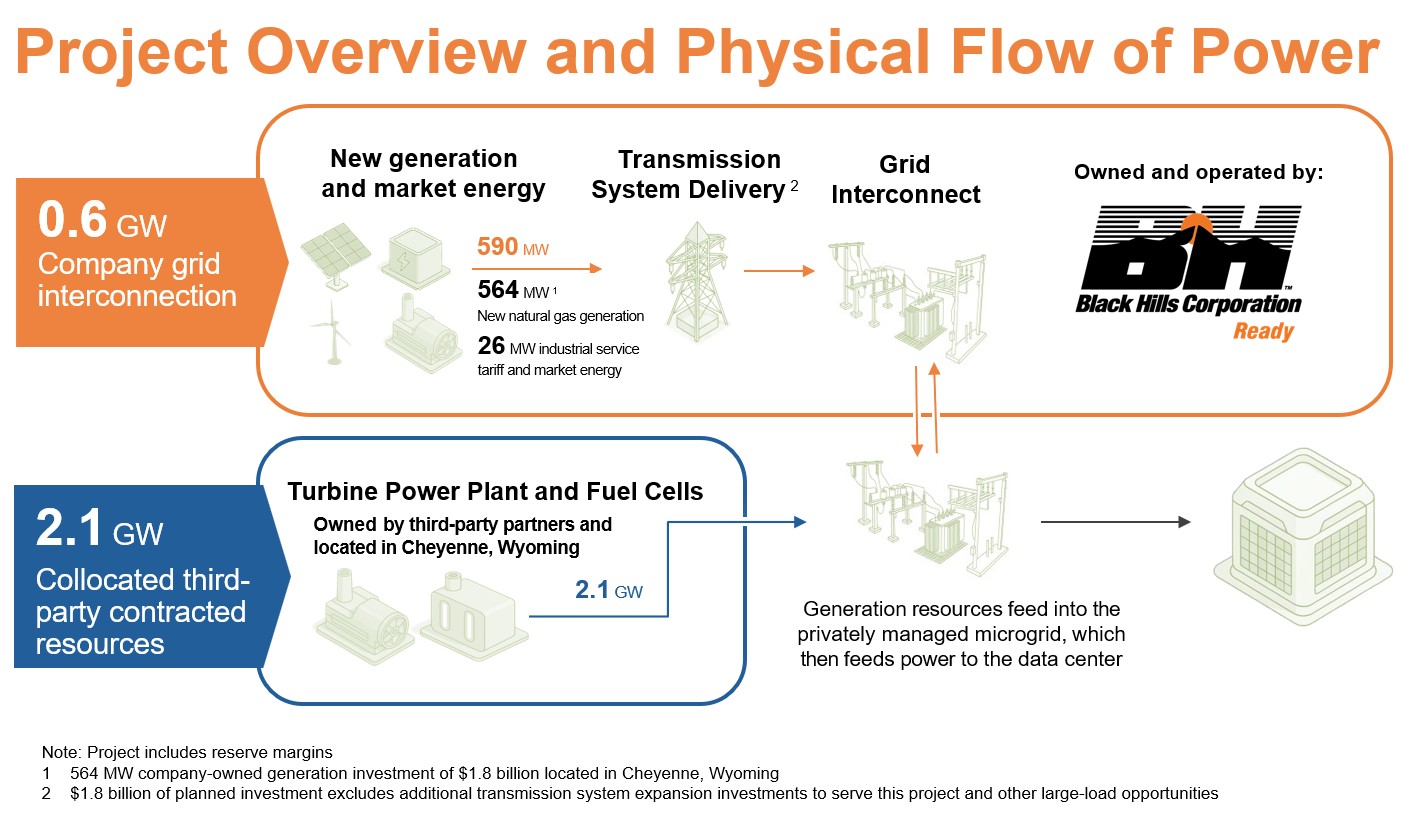
Black Hills Corp.’s company-reported power plan combines up to 590 MW of grid-connected service with approximately 2.1 GW of third-party resources, including reserve margins. Source: Black Hills Corp..
Black Hills said in its October 6 announcement that the agreements took effect September 30. Energy service is planned to begin in late 2027, with the project reaching peak load in 2030. Its anticipated resource mix totals 2.7 gigawatts, including reserve margins.
Google has invested in computing infrastructure for decades, according to its December 2024 account of its energy strategy. That statement also announced a partnership with clean-energy company Intersect Power and its private-equity investor TPG Rise Climate to develop U.S. data center parks alongside new clean-energy plants. Google said acting as an anchor power buyer would support new generation and reduce transmission needs and time to operation. Pairing computing and power development therefore predates the Wyoming agreements, whose announced portfolio includes substantial natural-gas infrastructure.
The local utility partner brings an existing generation site and a tariff for negotiated large-customer service. Black Hills, based in Rapid City, South Dakota, serves 1.37 million gas and electric utility customers across eight states. Its role extends beyond selling electricity: it will coordinate dispatch, reliability services and grid operations across contracted resources.
Under the agreements, Black Hills will provide up to 590 megawatts of grid-connected service and manage approximately 2.1 GW of Wyoming-based third-party resources through the private microgrid. For scale, the state had 10,846 MW of net summer generating capacity in 2024, according to the federal electricity profile. That is a statewide measure of generating capability, whereas Google’s planned portfolio includes reserves; neither figure establishes how much electricity the campus will consume annually.
Black Hills plans to spend $1.8 billion between 2027 and 2029 on 564 MW of new natural-gas generation at its existing Cheyenne Prairie Generating Station. A nonregulated affiliate will own the plant. The remaining 26 MW of its grid-connected service will come from market purchases and retail utility service.
Black Hills says in its announcement filed with the SEC that the agreements and regulatory mechanisms are structured so Google bears all costs associated with serving the planned data center. Black Hills describes provisions covering cost pass-throughs, recovery of generation investment, early termination and collateral. These protections matter because the generating assets and their financing extend far beyond the initial construction period.
Google has already provided $399 million in refundable advances for equipment with long procurement times. The advances equal about 22% of the planned $1.8 billion generation investment, but are temporary funding: Black Hills expects to repay them by June 30, 2027. It is evaluating a financing mix that includes debt and project-generated cash flow. Black Hills says debt costs will pass through contractually and it will receive cash returns during construction. The announcement does not disclose Google’s electricity price or the microgrid fee rate, so the investment totals do not establish its cost per unit of power.
The utility expects returns on generation investment to begin during construction in 2027, alongside microgrid management fees beginning late that year. Those fees depend on a contracted minimum peak load and a scheduled ramp. Black Hills forecasts approximately $150 million in project net income in 2030 and $2.4 billion of unlevered free cash flow through 2048, after the $1.8 billion generation investment. These are company projections, not realized earnings.
American Electric Power, another utility holding company, separately announced a roughly $4 billion, 702 MW Bloom Energy fuel-cell facility near Cheyenne on October 14. Google will buy its output under a 20-year agreement, according to the energy-sector report. AEP owns and controls about 92% of the project company, Cheyenne Fuel Cell LLC; funds advised by Basalt Infrastructure Partners own nearly 8%.
The report describes an earlier, smaller deployment: AEP’s Ohio utility signed contracts in 2025 for about 98 MW of fuel-cell service for two data centers operated by Amazon Web Services and Cologix. The Wyoming project would substantially increase that scale.
AEP and its partners plan construction to begin in 2026 and full operation by the end of 2028. AEP says the fuel cells produce electricity without combusting natural gas and that planned carbon capture would enable near-zero-emissions power. The emissions description depends on that planned capture system; it is not a reported operating result.
Neither AEP nor Black Hills had confirmed in that report whether the 702 MW facility belongs within Black Hills’ 2.1 GW third-party portfolio. Adding it to the 2.7 GW total would risk double counting. The separately announced utility investments also should not simply be added to the reported $17 billion campus figure without a reconciled accounting of their scope.
The fuel-cell plan has contractual and timing qualifications. The report traced an earlier AEP agreement to filings describing conditions and a December 2026 milestone. It also cited AEP’s July earnings call: the customer could choose an alternative location for the fuel cells if the Cheyenne site did not advance, while AEP retained financial protections if the milestone was missed or further changes were requested. AEP’s October announcement named Google but, as the report noted, did not explicitly confirm that all remaining conditions had been satisfied. AEP’s finance chief also said the units needed to be installed and ready by the end of 2028 to qualify for an investment tax credit.
The fuel cells are one of several supply options AEP is pursuing. The same report says AEP had secured about 13 GW of gas turbines for deployment through 2031 and bought an initial 190 MW of Mainspring Energy linear generators, with deliveries beginning in 2027 and an agreement allowing purchases up to 1.6 GW through 2034. The linear generators are a separate procurement, not confirmed supply for Google’s campus. AEP’s finance chief said in July that much of the potential new demand was limited by generation availability.
Project Tembo would occupy Switchgrass Industrial Park, eight miles south of Cheyenne. A September account of Google’s public presentation described a revised version of Project Jade, previously led by Crusoe, which withdrew in the spring. Google’s plan removed one of five proposed data center buildings and halved the projected peak construction workforce. At that report’s publication, the campus remained under local-government review and had not broken ground.
The energy-sector report, citing local reporting, identifies Tallgrass Integrated Logistics Solutions as Google’s development partner. Tallgrass had partnered with Crusoe on Project Jade before Crusoe withdrew in April 2026. The revised campus has four data center buildings totaling approximately 3.08 million square feet. Tallgrass is also developing an associated natural-gas power hub. The report cites county records saying that hub was already under construction in July; that is a different construction status from the campus itself.
Google told residents it expected about 2,500 construction roles at peak and approximately 250 long-term operating jobs, according to local reporting cited in the September account. It also described an air-cooled, closed-loop water system supplied by deep wells, wastewater treatment and lined evaporation ponds. The company invoked its companywide pledge to replenish 120% of freshwater consumption by 2030. That pledge does not itself quantify the campus’s withdrawals or demonstrate its effect on the local watershed.
Residents raised concerns about cumulative development pressures and a road near an existing home. The September account says Google confirmed that the road plan would involve demolishing a nearby house. Google also said diesel backup generators would undergo state air-permit review and that it would comply with county noise limits. These are distinct questions from whether electricity infrastructure costs shift to other ratepayers.
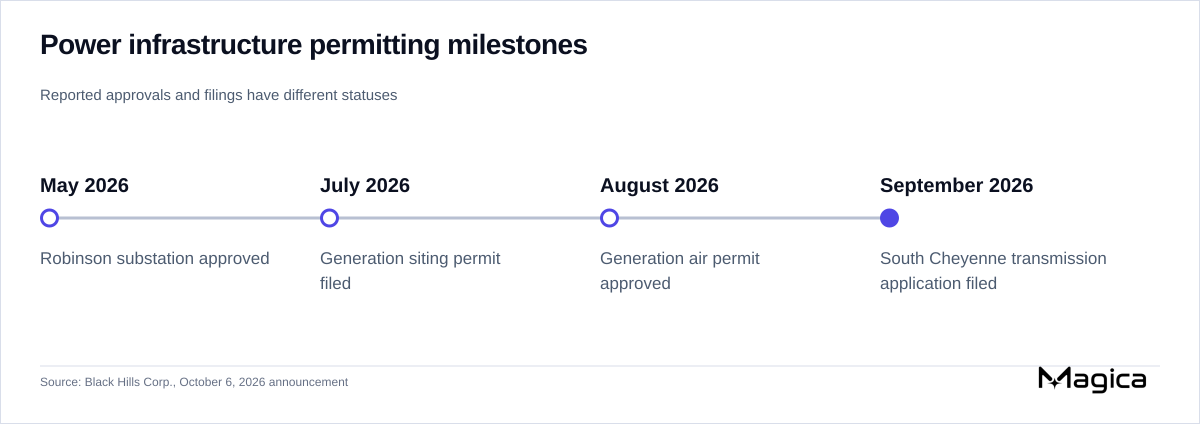
Company-reported permitting milestones for supporting infrastructure. Filing an application does not establish approval or completion. Source: Black Hills Corp.; graphic: Magica. Source: Black Hills Corp..
Transmission remains another part of the buildout. Black Hills’ October announcement excluded additional transmission expansion investment and listed further regulatory filings. It said the Robinson substation had received approval in May and the generation expansion’s air-quality permit had been approved in August, while an industrial siting permit had been filed in July. A South Cheyenne transmission expansion application was filed in September, and another Wyoming transmission expansion filing was planned for the fourth quarter. The next test is whether permits, equipment, generation and transmission arrive on schedules that support the planned late-2027 start of energy service—and whether local water and land-use evidence supports the assurances made to residents. For the fuel-cell plant, evidence that the remaining offtake conditions have been satisfied would clarify how firm the Cheyenne commitment is.
The Cambridge startup has secured backing described as eight figures in capital and compute, including UK government support. Its wager is that cheaper, accurate quantum calculations can supply better AI training data; full performance results remain forthcoming.
Japan’s Nikkei fell 7.09% in Friday morning trading, with AI, chip and data center-related shares hit hard after Wall Street losses. Reports linked the rout to fears of U.S. regulation following Democratic election victories, without identifying an enacted restriction or a cut in AI spending.
Potential investors are pressing Anthropic for a lower valuation as a technology selloff threatens its November IPO timetable. Rapid revenue growth and substantial cash complicate a financing debate driven by losses and long-term infrastructure commitments.
Visa's new benchmark finds that AI shopping models often miss customer requirements and struggle to repeat successful decisions. The tests cover product discovery, leaving checkout and payment reliability for future rounds.
Agility Robotics began trading after its Churchill Capital Corp XI merger, bringing a commercially deployed humanoid robot maker to U.S. public markets. Its next test is turning conditional Digit 5 orders into deliveries and sustainable economics.
Goldman Sachs sees temporary halts potentially affecting about 45% of planned US data center expansion after Democratic election victories. In Texas, where approvals were already paused, the next fight is over how long restrictions last and what developers must pay for.
Core Scientific’s third-quarter colocation revenue rose 57.6% to $215.4 million. Its expansion beyond CoreWeave could diversify sales from 2027, but the next projects require additional financing rather than the same customer funding that supported its existing conversions.
Meta is rolling out voice conversations and animated avatars for Muse in the US. The update adds personality to a cloud-based task agent whose costs, permissions and reliability matter more than its expressions.
Anthropic is rolling out Personal Finance to paid Claude users in the US, using Plaid to read bank data. Its pitch rests on ad-free answers and privacy controls, while its own documentation warns that balances and budgets can be incomplete.
OpenAI president Greg Brockman predicts significant medical advances within 12 to 18 months and raises the possibility of death becoming a choice. OpenAI’s cell research and a separate early drug trial show narrower progress, with financial ties, safety questions and clinical testing still central to judging the promise.
Citrini Research is recasting its AI investments around relative value as it warns that financing and construction constraints threaten returns. Its reported Oracle–Nebius trade faces a crucial counterargument: Nebius has substantial customer commitments, although delivery remains conditional.
Shield AI has agreed to acquire Echodyne for up to $5.3 billion, backed by a $2.5 billion financing package. The radar maker brings a profitable, defense-heavy business and commercial customers, with a promise to keep supplying outside system builders.
Gemini Omni 1.2 Flash lowers Google's quoted 720p generation price to $0.07 per second and extends native clips from 10 to 15 seconds. Editing limits and early commercial tests show why cheaper output does not guarantee the same savings on finished videos.
Mercedes-Benz plans to add Liquid AI’s on-device models to its North American voice assistant. The deal combines local processing with existing cloud AI, while customer availability, measured performance and contract economics remain unconfirmed.
Mistral is expanding Studio with managed agents, apps and workflow tools, extending its existing enterprise platform. Its private-deployment pitch sits alongside cloud-hosted app services and vendor-stored agent sessions, making the chosen configuration central to customer control.
Meta president Dina Powell McCormick expects tougher conditions for new US data centers after Democratic election victories, but says states still want investment. The test is whether electricity commitments, local jobs and tax benefits can secure community support.
OpenAI is releasing GPT-6 Cyber to selected verified defenders with stronger monitoring. Its Linux research shows the scale and cost of automated exploitation, while mixed benchmark results and unfinished patching limit what the launch proves about safer software.
Dropbox agreed to buy Tigris for about $350 million in cash and unveiled DBX Agent Cloud, starting with standalone object storage. The expansion accompanies AI actions for existing file customers, while pricing and evidence of competitive performance and productivity gains remain absent from the announcement.
ElevenMusic creators can now publish directly to SoundCloud, with a three-month Pro offer for Artist Pro subscribers. The integration shortens distribution while preserving disclosure and rights requirements.
A researcher demonstrated how a browser extension could use Claude Dispatch to execute code through a connected desktop agent. Anthropic reportedly acknowledged the flaw in May and proposed retiring Dispatch, but existing users still have access, leaving questions about authorization across devices.