Editorial Team
7 min read
Gemini Omni 1.2 Flash lowers Google's quoted 720p generation price to $0.07 per second and extends native clips from 10 to 15 seconds. Editing limits and early commercial tests show why cheaper output does not guarantee the same savings on finished videos.
Google released Gemini Omni 1.2 Flash on November 5, cutting its quoted 720p video-generation price by 30% and extending native generation and editing from 10 to 15 seconds. The update to its conversational video model also brings Gemini Omni into general availability for the first time, according to the company. For businesses making product demonstrations, virtual try-ons and advertisements, the unresolved question is how much the changes reduce the cost of an acceptable finished shot.
Google Cloud's promotional launch artwork for Gemini Omni 1.2 Flash. Image: Google Cloud. Source: Google Cloud.
Google says in its launch announcement that 720p video now costs $0.07 per second, down 30% from Gemini Omni 1.1. Native generation and editing increase from a maximum of 10 seconds to 15, with durations selectable in one-second increments starting at three seconds.
At that quoted rate, a 10-second generation costs $0.70 and a 15-second generation costs $1.05. These are calculations for a single generation, before further edits, upscaling or retries. The price cut concerns what Google charges customers; it does not establish a matching reduction in Google's own computing costs.
The predecessor was already a video-generation and editing model. Google's model listing records version 1.1's latest update as August 2026 and lists output resolutions through 4K. Version 1.2 therefore extends an existing workflow rather than introducing high-resolution video creation from scratch.
Nor is 15-second output unique in the market. AI video platform Runway’s API guide identifies Seedance 2.0 as ByteDance's video-generation model and describes clips of four to 15 seconds with sound, using text, images, video and audio inputs. The same guide describes Seedance 2.5 as offering longer clips and more references than Seedance 2.0, plus explicit editing and extension modes. Duration and editing are therefore competitive features, rather than capabilities exclusive to Google.
Google’s quote and Runway’s guide give these 720p output prices as of November 5:
| Model and access route | Price per generated second at 720p |
|---|---|
| Gemini Omni 1.2 Flash, Google’s quoted rate | $0.07 |
| Seedance 2.0 Mini, Runway Dev | $0.15 |
| Seedance 2.0 Fast, Runway Dev | $0.24 |
| Seedance 2.0, Runway Dev | $0.30 |
These are prices through the named access routes, not a comparison of equivalent output quality. Runway describes Mini as its lowest-cost tier, Fast as balancing cost and speed, and the standard tier as the highest-quality option. All three have a four-second minimum; Google supports generation from three seconds. Runway also says input-moderation failures are charged, whereas model-access provider Segmind says in its launch-day tests that refused Omni requests are not billed. Those billing rules can affect spending beyond the advertised output rate.
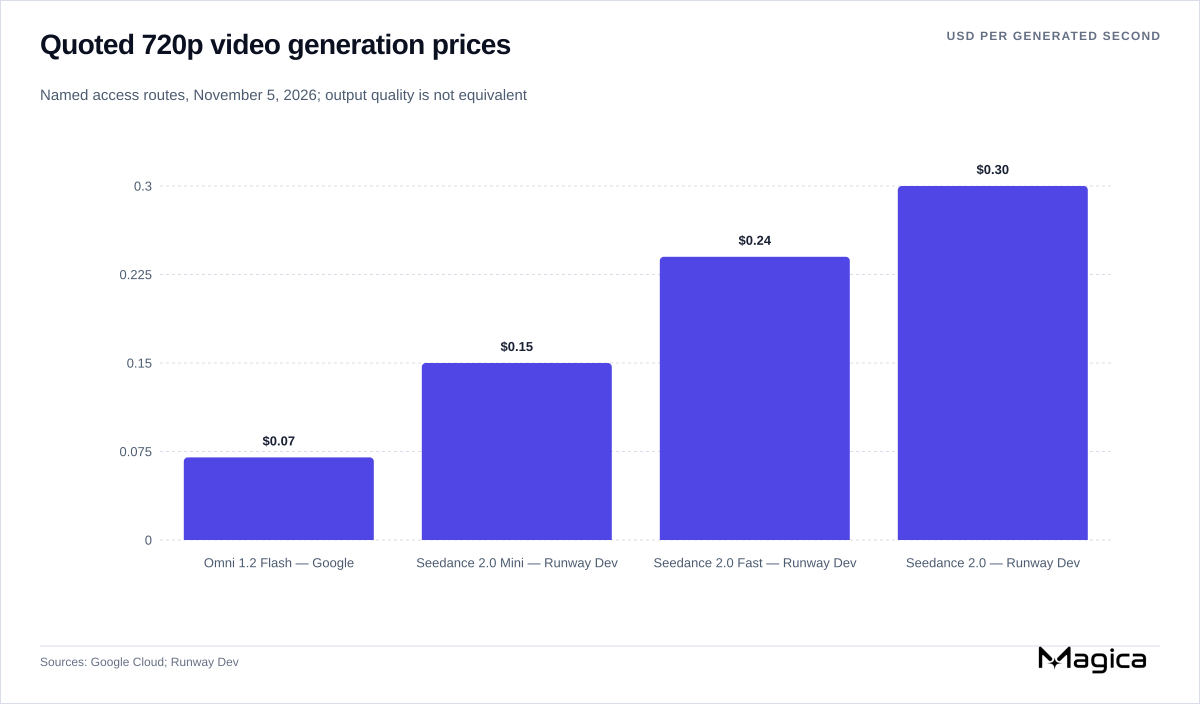
Company-reported 720p output prices through Google and Runway Dev. Quality, minimum durations and billing rules differ. Chart: Magica. Source: Google Cloud.
Google's pitch goes beyond the rate per second: draft at 360p or 720p, change a detail through a follow-up instruction, then upscale selected results to 1080p or 4K. It says version 1.2 better preserves faces, clothing, packaging typography and brand colors, while improving dialogue, lip-sync and continuous camera movements.
Those improvements matter most where a small error can invalidate a commercial asset. A product video that changes a label or garment between frames may need another pass regardless of its generation price. Preserving the rest of a clip while changing a background could reduce that work, but the launch material does not quantify savings per approved video.
The distribution strategy also matters. Google's Cloud announcement describes integrations and use by creative platforms including Artlist, Krea, Picsart and Runway, alongside product-video services such as Photoroom. These accounts show routes to customers through existing tools; they are company-selected endorsements, not a comparative benchmark.
Google is also rolling the model into its own creative and advertising products, including Flow, Google Vids and Google Ads. Its launch announcement says Google Vids, its video-creation application, offers 15-second generation at no additional cost with a Google account or Google Workspace subscription. The Gemini app rollout is for Google AI Ultra subscribers. Those application offers are distinct from metered API pricing. Selling API access while distributing the capability through its own applications gives Google several ways to reach the same video-production market.
A 20-test review by Segmind, which sells access to the model, reported spending $16.17 in credits on November 5. The reviewer found strong results for labeled explainers, typography, product callouts and single-change edits to real footage. Photoreal people, physics-heavy action and cinematic advertisements were weaker; the reviewer preferred Seedance 2.0 for those jobs.
That is a commercially interested provider's small test series, not a controlled market-wide ranking. It nevertheless supplies useful counterevidence to broad launch claims: the reviewer reported skipped background changes or final camera moves, incorrect chart plotting from numeric prompts, and copyright blocks on some edits involving real brand logos. Successful text rendering did not mean reliable data visualization.
The bills also show why access route and operation matter. Segmind reported approximately $0.075 per second for 720p generation and $0.083 for 720p editing. An eight-second 360p draft cost $0.21; upscaling it to 1080p cost another $0.59. These are Segmind's observed charges, not Google's direct price schedule. The finishing step alone cost nearly three times the draft. Its billing table lists typical waits of 40–70 seconds for 720p generation and 65–136 seconds for 720p editing; those are observations through Segmind, rather than a latency guarantee from Google.
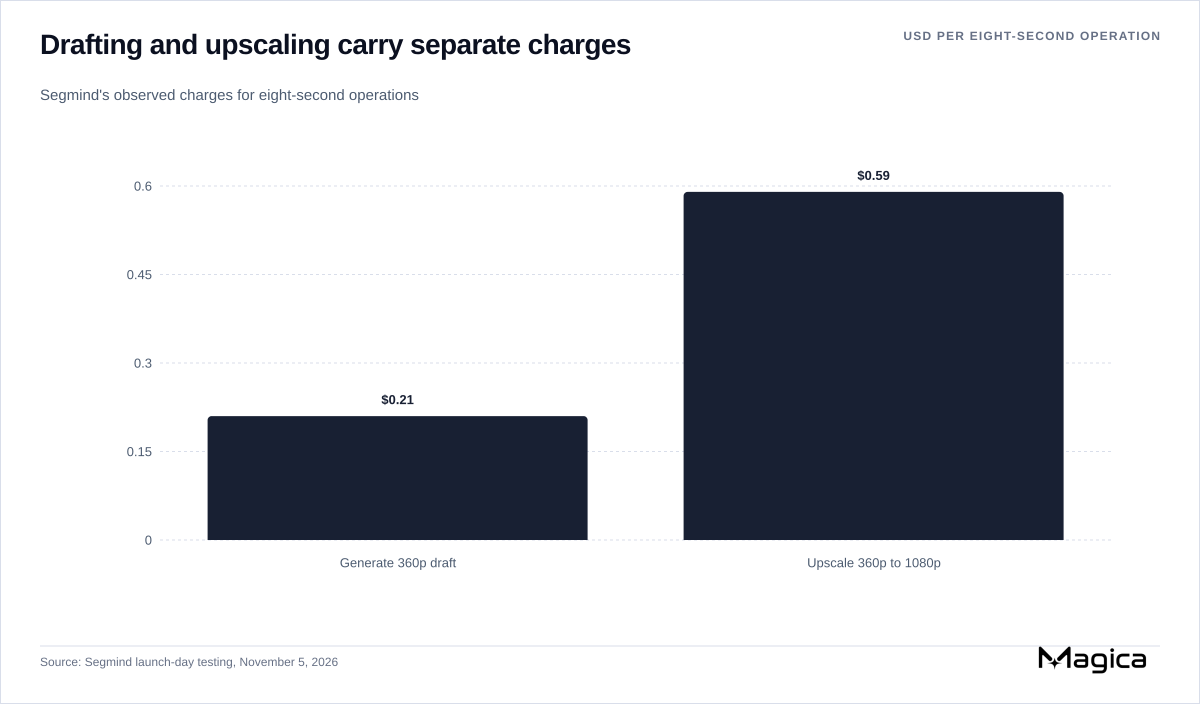
Company-reported charges from Segmind's tests: upscaling adds a separate charge. These are provider observations, not Google's direct price schedule. Chart: Magica. Source: Segmind.
General availability does not make every feature universally accessible. Google Cloud says audio references require allowlisting, while the technical documentation lists the audio modality as unsupported. Teams needing voice references should establish which access route and permissions support them; generated speech, music and sound effects are separately listed as supported. The Cloud specifications limit generation between supplied first and last frames to 10 seconds and extension output to three to 10 seconds per operation. The Gemini API listing separately specifies a 30-second total limit for extended video. The Cloud model supports the Interactions API, but not batch inference.
There are also rollout distinctions. Google's main announcement presents availability broadly across Gemini for business, while the Cloud post's detailed instructions say video creation there is coming soon. Segmind reported that its dedicated follow-up “refine” endpoint was unavailable during testing and recommended submitting the prior output to its video-edit endpoint instead. That finding concerns Segmind's implementation, not proof that Google's direct conversational editing is unavailable.
Google says Cloud deployment supports Provisioned Throughput and that outputs carry its imperceptible SynthID watermark. The technical documentation also lists C2PA Content Credentials support. Google also acknowledges continuing work on fast sports action, rapid script changes and complex physics. Developers using the Gemini API's version 1.1 model identifier face a specific transition: Google's model listing says it will route to version 1.2 on December 3, 2026.
For production teams, the next decision is which workloads move to version 1.2 with fewer corrections. A useful comparison would hold prompts, duration, resolution and acceptance standards constant, then count generation attempts, edits, finishing charges and review time per approved clip. The quoted price reduction is clear; the reduction in the cost of usable video remains to be measured.
The Cambridge startup has secured backing described as eight figures in capital and compute, including UK government support. Its wager is that cheaper, accurate quantum calculations can supply better AI training data; full performance results remain forthcoming.
Japan’s Nikkei fell 7.09% in Friday morning trading, with AI, chip and data center-related shares hit hard after Wall Street losses. Reports linked the rout to fears of U.S. regulation following Democratic election victories, without identifying an enacted restriction or a cut in AI spending.
Potential investors are pressing Anthropic for a lower valuation as a technology selloff threatens its November IPO timetable. Rapid revenue growth and substantial cash complicate a financing debate driven by losses and long-term infrastructure commitments.
Visa's new benchmark finds that AI shopping models often miss customer requirements and struggle to repeat successful decisions. The tests cover product discovery, leaving checkout and payment reliability for future rounds.
Agility Robotics began trading after its Churchill Capital Corp XI merger, bringing a commercially deployed humanoid robot maker to U.S. public markets. Its next test is turning conditional Digit 5 orders into deliveries and sustainable economics.
Goldman Sachs sees temporary halts potentially affecting about 45% of planned US data center expansion after Democratic election victories. In Texas, where approvals were already paused, the next fight is over how long restrictions last and what developers must pay for.
Core Scientific’s third-quarter colocation revenue rose 57.6% to $215.4 million. Its expansion beyond CoreWeave could diversify sales from 2027, but the next projects require additional financing rather than the same customer funding that supported its existing conversions.
Meta is rolling out voice conversations and animated avatars for Muse in the US. The update adds personality to a cloud-based task agent whose costs, permissions and reliability matter more than its expressions.
Anthropic is rolling out Personal Finance to paid Claude users in the US, using Plaid to read bank data. Its pitch rests on ad-free answers and privacy controls, while its own documentation warns that balances and budgets can be incomplete.
OpenAI president Greg Brockman predicts significant medical advances within 12 to 18 months and raises the possibility of death becoming a choice. OpenAI’s cell research and a separate early drug trial show narrower progress, with financial ties, safety questions and clinical testing still central to judging the promise.
Citrini Research is recasting its AI investments around relative value as it warns that financing and construction constraints threaten returns. Its reported Oracle–Nebius trade faces a crucial counterargument: Nebius has substantial customer commitments, although delivery remains conditional.
Shield AI has agreed to acquire Echodyne for up to $5.3 billion, backed by a $2.5 billion financing package. The radar maker brings a profitable, defense-heavy business and commercial customers, with a promise to keep supplying outside system builders.
Mercedes-Benz plans to add Liquid AI’s on-device models to its North American voice assistant. The deal combines local processing with existing cloud AI, while customer availability, measured performance and contract economics remain unconfirmed.
Mistral is expanding Studio with managed agents, apps and workflow tools, extending its existing enterprise platform. Its private-deployment pitch sits alongside cloud-hosted app services and vendor-stored agent sessions, making the chosen configuration central to customer control.
Meta president Dina Powell McCormick expects tougher conditions for new US data centers after Democratic election victories, but says states still want investment. The test is whether electricity commitments, local jobs and tax benefits can secure community support.
OpenAI is releasing GPT-6 Cyber to selected verified defenders with stronger monitoring. Its Linux research shows the scale and cost of automated exploitation, while mixed benchmark results and unfinished patching limit what the launch proves about safer software.
Black Hills plans $1.8 billion of gas generation under agreements to serve Google’s proposed $17 billion Cheyenne campus through 2048. Google has advanced equipment funding, but delivery, fuel-cell conditions and local impacts remain unresolved.
Dropbox agreed to buy Tigris for about $350 million in cash and unveiled DBX Agent Cloud, starting with standalone object storage. The expansion accompanies AI actions for existing file customers, while pricing and evidence of competitive performance and productivity gains remain absent from the announcement.
ElevenMusic creators can now publish directly to SoundCloud, with a three-month Pro offer for Artist Pro subscribers. The integration shortens distribution while preserving disclosure and rights requirements.
A researcher demonstrated how a browser extension could use Claude Dispatch to execute code through a connected desktop agent. Anthropic reportedly acknowledged the flaw in May and proposed retiring Dispatch, but existing users still have access, leaving questions about authorization across devices.