Editorial Team
7 min read
PwC finds growth in a subset of AI-exposed junior job postings demanding senior skills, alongside pressure on entry-level opportunities. Workplace research suggests AI can support learning, but leaves employers to demonstrate how recruits acquire independent expertise.
PwC, the audit, tax and consulting network, identifies a demanding route into work in its 2026 Global AI Jobs Barometer: among the most AI-exposed US entry-level occupations, postings classified as requiring new senior skills grew 35% between 2019 and 2025, while other junior postings fell 10%. The opening for newcomers comes with a question the advertisements cannot answer: how will they acquire the judgment employers increasingly want?
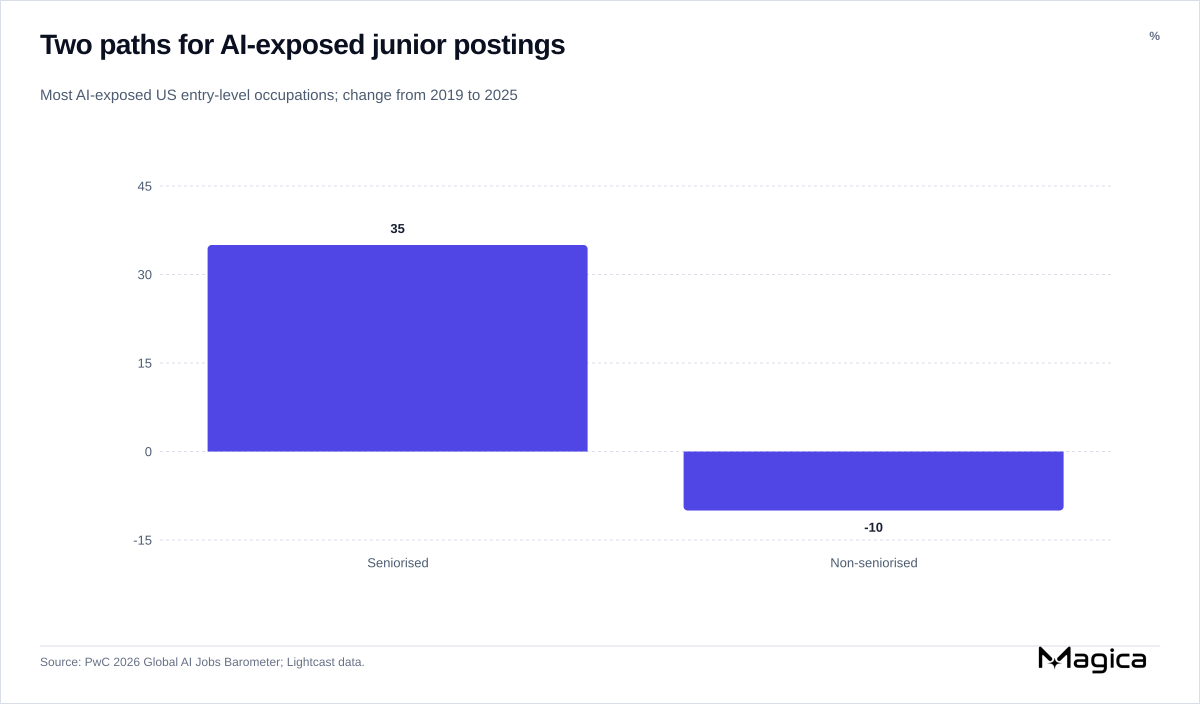
Company-reported: PwC’s analysis of Lightcast data shows diverging entry-level posting trends. Its prose and chart note define “seniorised” differently; the comparison does not establish AI causation. Source: PwC — 2026 Global AI Jobs Barometer report.
The network analysed more than one billion job advertisements across 27 countries and territories for its annual barometer. Its June 15 announcement says the targeted US entry-level analysis covered 2.4 million jobs.
The full report says traditionally senior capabilities accounted for 52% of new skills required in the most AI-exposed entry-level jobs, compared with 7% in the least exposed. These are shares of newly required skills, not shares of all jobs. Examples include motivating teams, managing stakeholders, mentoring colleagues and making decisions using data.
AI exposure describes whether a job includes tasks within AI’s capabilities; it does not establish that an employer has deployed AI. Within the most exposed group, the report finds sharply different trajectories:
| US entry-level postings | Change, 2019–2025 |
|---|---|
| Classified as “seniorised” | +35% |
| Classified as “non-seniorised” | −10% |
The classification needs care. The report’s prose describes roles requiring more than 10 new, traditionally senior skills, but its chart note instead specifies at least 10 mentions of a qualifying skill. That inconsistency limits how precisely readers can translate “seniorised” into the number of additional abilities an applicant needs.
The underlying comparison also begins before generative AI’s recent expansion. It shows changes in advertised requirements, rather than proof that AI caused them or that recruits possess the requested capabilities.
PwC’s broader early-career analysis defines such postings as asking for zero to two years’ experience. Its four-country comparison covers Canada, Singapore, the UK and the US, with US advertisements accounting for roughly 73% of that sample. Entry-level work is therefore neither synonymous with graduate employment nor represented by an evenly balanced global sample.
The gains in one subset do not resolve the overall hiring pressure. PwC’s report says highly AI-exposed entry-level postings have broadly flatlined in its wider analysis. It also cites its latest CEO survey: 49% of CEOs expect AI adoption to reduce junior hiring over the next three years, compared with 12% for senior hiring. Those are expectations, not observed job losses.
Actual employment provides a separate test. Stanford University’s Digital Economy Lab, which researches technology’s economic effects, updated its employment analysis on August 12, 2026, extending work first published in 2025. Using ADP administrative payroll data covering millions of US workers through June 2026, it found employment among people aged 22–25 in AI-exposed occupations stood 19% below a benchmark based on growth among less-exposed peers. That is a relative gap, not a 19% absolute fall.
Experienced workers showed no comparable gap, and the adjustment primarily reflected reduced hiring of young workers rather than increased departures. Declines were concentrated where AI use mainly substituted for human tasks; where it complemented workers, employment was flat or rising, especially among experienced workers.
The researchers found no evidence of widespread economy-wide displacement. Their results survive several checks, including excluding technology firms and computer occupations, but weaken with education controls. Some divergent trends predate generative AI, and the patterns are stronger in the ADP sample than in national survey benchmarks. The authors present descriptive evidence rather than causal estimates.
That evidence adds pressure to the question of entry into a profession. It does not establish whether recruits who do get hired learn faster or lose opportunities to practise.
PwC distinguishes work where AI removes routine tasks and increases the importance of human expertise from work where it performs expert tasks and leaves people less specialised activities. Both can create opportunities, but they imply different development paths.
There is an advertised financial reward for AI skills: PwC reports an average wage premium of 62% in 2025, compared with 57% in the previous barometer. Its sector-level method compares advertised salaries in AI-skill and non-AI-skill postings; the average covers 16 sectors. It is a snapshot of different groups of jobs, not a measured pay rise from learning prompting or a graduate-specific return.
A communications-agency example shows why new titles should not automatically be counted as beginner opportunities. Business-to-business agency Fight or Flight promoted Edward Leung to head of generative engine optimization in January 2026. Previously its North America digital lead, Leung had joined from Burson in July 2025. He was assigned to develop and apply GEO Navigator, the agency’s framework for adapting communications to discovery through generative AI.
The expansion included a GEO data analyst, a GPT and prompt engineer, and a GEO content specialist, following the appointment of a head of innovation and AI in May 2025. The agency said it was responding to growing demand for communications suited to AI-influenced discovery alongside traditional channels. The reported appointments demonstrate specialist hiring and an experienced leadership layer; the account does not establish that the new jobs were graduate roles or describe their training.
PwC also has a commercial stake in the response. It provides consulting services, and its report recommends work redesign, AI investment and revised career pathways. Its analysis and its prescriptions should be assessed separately.
A 2025 workplace study of 5,172 customer-support agents offers evidence against assuming that AI assistance necessarily prevents learning. Access to a conversational assistant increased issues resolved per hour by 15% on average. Less experienced and lower-skilled agents improved speed and quality, while the most experienced and highest-skilled saw small speed gains and small quality declines.
During software outages, previously assisted agents still handled chats faster than before adoption, consistent with learning beyond immediate reliance on recommendations. That outage analysis measured chat duration, not issues resolved per hour. Results from this customer-support setting do not establish that AI will develop independent expertise across professions.
A 2025 study hosted by Microsoft Research points to another possibility. Its survey of 319 knowledge workers collected 936 examples of workplace generative AI use. Greater confidence in AI was associated with less reported critical thinking, while greater confidence in one’s own abilities was associated with more. Participants described a shift toward verifying information, combining responses and overseeing tasks.
The survey concerns perceived thinking and effort. It does not demonstrate a long-term decline in professional knowledge, and it does not contradict the customer-support finding: the studies examine different workers, tasks and outcomes.
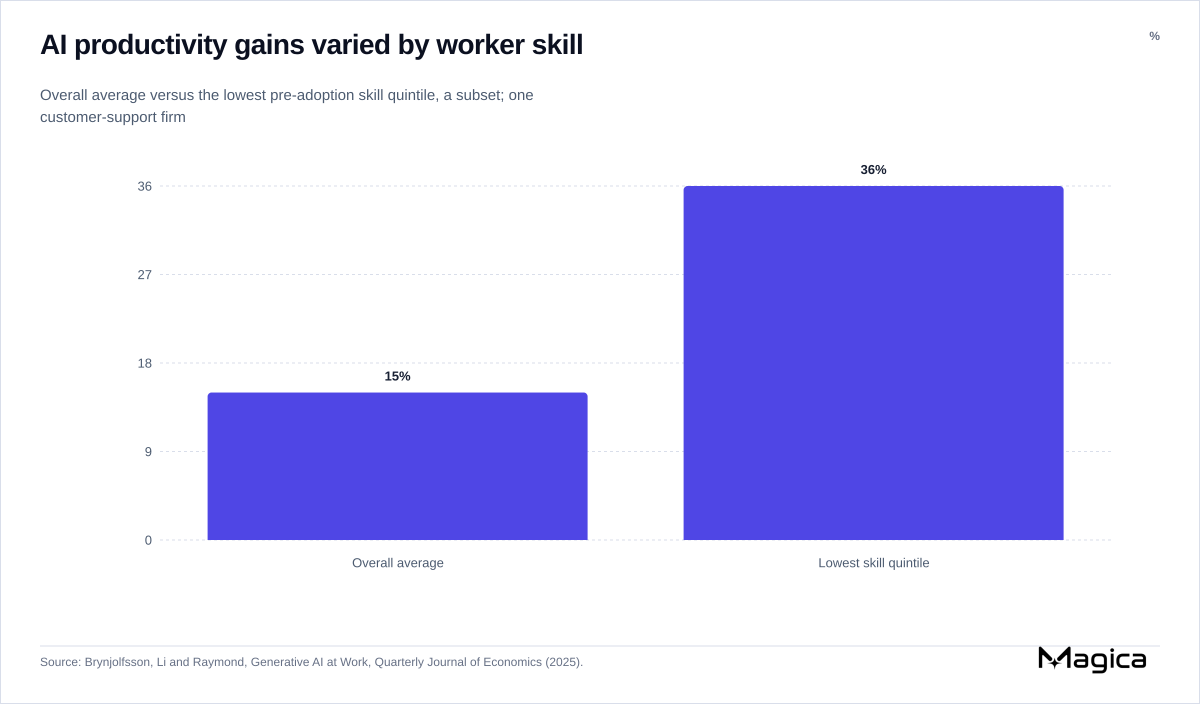
Brynjolfsson, Li and Raymond found larger gains in issues resolved per hour for the lowest-skilled customer-support workers than the overall average. AI-assisted productivity is distinct from independent expertise. Source: Generative AI at Work — published paper, author-hosted copy.
PwC recommends redesigning onboarding, mentoring and training so juniors can develop advanced capabilities earlier. Whether employers provide that development is the unresolved consequence of raising entry requirements while changing the tasks through which experience is gained.
The evidence needed goes beyond advertised skills or AI-assisted output. Employers would need to track whether recruits can perform independently, recognise errors and progress into more demanding responsibilities. Hiring data can reveal which doors remain open; those measures would show whether the jobs behind them still build expertise.
Five technology groups have accumulated an estimated $3.2 trillion in future purchase and lease commitments. Filings show the funding pressure, but broad spending categories, long payment schedules and a methodology change limit what the total says about AI debt and growth.
CoreWeave bonds fell after the election of candidates favoring data center restrictions. Texas governor-elect Gina Hinojosa wants to extend an existing approvals pause until lawmakers pass protections, adding delivery uncertainty for an industry whose expansion depends on power and financing.

Walmart plans new permissions and a gateway for outside shopping agents, while Amazon blocks unauthorized tools and sells ads through its own assistant. The stakes are product discovery, customer data and whether delegated purchases add sales or displace advertising opportunities.
Apple reportedly cut some engineers’ daily AI allowances from $300 to $200 in October and is weighing deeper restrictions. The limits tighten control over model use, but unused allowances make the savings uncertain.
Factory is acquiring coding-agent collaboration platform HumanLayer after raising $200 million in September. It plans to integrate shared tasks and planning tools, while HumanLayer promises open source, refunds and at least 30 days of continued service.
A minister identifies Google-commissioned research behind the action plan’s £400 billion AI claim. The government’s central estimate is £120 billion, but different methods and adoption assumptions prevent a straightforward forecast-cut comparison.
Research has separated language models’ detection of altered internal activity from their ability to identify its content. Mechanistic studies and skeptical controls leave the interpretation disputed—and one intervention that improved detection made other measures of self-knowledge worse.
The IEA maps 134 policies governing data-center integration, arguing that credible project queues, coordinated tariffs and flexible connections can protect consumers while accommodating AI growth. Many measures remain too new to judge.
Three watchdog groups seek to halt Project Meridian, alleging that its contractor-heavy membership and closed meetings violate federal advisory committee law. MITRE’s invitation for outside ideas complicates the dispute over public participation.
Meta is seeking up to €9 billion in its first euro bond sale, drawing record orders while offering wider spreads than Alphabet. Its advertising business and large liquid reserves cushion an AI investment push that has overtaken quarterly operating cash flow.
Pangram is expanding its text-detection business into images and video. Browser checks and developer access broaden its reach, while company benchmark scores leave real-world error rates and costs unresolved.
About two dozen restrictive data center measures appeared to pass in initial returns. Texas governor-elect Gina Hinojosa’s promised construction pause adds a state-level constraint, though the capacity ultimately delayed remains uncertain.
Riot Platforms says its 15-year Corsicana lease with Anthropic will generate about $28 billion in revenue. The tenant owns and operates the compute, while Riot develops power infrastructure and funds module reimbursements through debt or credits against future rent.
Sonos plans limited U.S. early access for its conversational assistant, with a reported November 6 start. Users can return to older voice controls—a choice that also separates local audio processing from the new assistant’s cloud processing.
Tesla, SpaceX and AI infrastructure shares fell after Democratic election wins, while broader stocks rallied. Texas governor-elect Gina Hinojosa’s proposed data center pause puts a major construction pipeline in focus, but Republicans retain control of the Texas Legislature and federal agencies.
Capital One Ventures leads Sentra’s $150 million Series C and gains a board seat as the company expands AI-agent data controls. Sentra reports roughly 100 major enterprise customers and revenue in the tens of millions, but exact revenue, valuation and comparative costs remain undisclosed.
Google agreed to support Anthropic’s lease obligations at TeraWulf’s Kentucky campus, strengthening its bid for project financing. The support starts after delivery milestones, while debt terms and a guaranteed construction price remain unsettled.
OpenAI plans to acquire Pierre Computer and integrate its Code Storage service into Codex. The purchase would extend an existing supplier relationship into code infrastructure, but its terms, customer economics and relationship to OpenAI’s own Pando system remain unresolved.
OpenAI says India leads ChatGPT’s markets by weekly active users. Earlier free offers, strong app engagement and planned enterprise deployments explain the stakes, but the company has not disclosed comparable paid-user or revenue figures.
A national exit poll found broad opposition to new local data centers and a Democratic tilt among voters who prioritized AI. But the issue ranked below four other tested concerns, industry-backed candidates also won, and the next fight is over siting and power costs.