Editorial Team
5 min read
About two dozen restrictive data center measures appeared to pass in initial returns. Texas governor-elect Gina Hinojosa’s promised construction pause adds a state-level constraint, though the capacity ultimately delayed remains uncertain.
Voters backed restrictions on data center development in November 3 elections, while a change in Texas’s governorship raised the stakes for the computing infrastructure behind the AI expansion. The results create several possible barriers—local measures and proposed state policies—with different consequences for projects already under construction and those planned for later years.
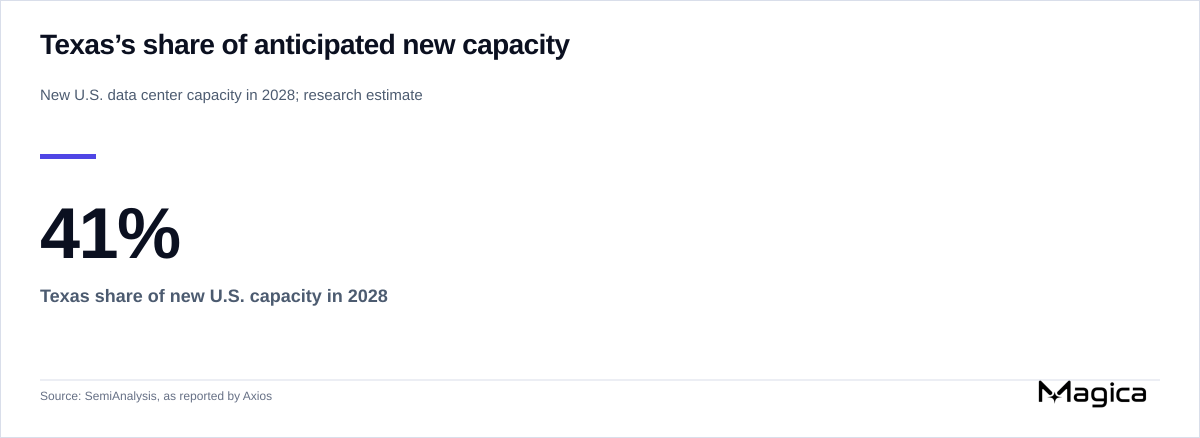
SemiAnalysis estimates Texas accounts for 41% of new U.S. data center capacity in 2028, as reported by Axios. Source: Axios.
About two dozen proposals designed to restrict or block development appeared to pass out of 41 data center measures on ballots across 10 states, according to a report citing election-information provider Ballotpedia’s initial returns. Ohio had the largest share of the ballot fights. Further votes were still forthcoming in Arkansas and North Dakota.
That count measures ballot proposals, rather than distinct communities or computing capacity. Its denominator includes data center measures generally, rather than only restrictive proposals. It therefore cannot establish the percentage of restrictions that won, or how much development the results will prevent. Moratoriums also differ from permanent bans: their duration matters to construction schedules.
The state-level result with the clearest reported capacity exposure came in Texas. Democratic governor-elect Gina Hinojosa, an Austin state representative who entered the gubernatorial race as a five-term lawmaker known for her work on education and opposition to school vouchers, campaigned on keeping a data center construction moratorium in place until the state passes legislation addressing water, electricity, air and property rights. The legislative session ends in mid-2027, according to the .
Riot Platforms says its 15-year Corsicana lease with Anthropic will generate about $28 billion in revenue. The tenant owns and operates the compute, while Riot develops power infrastructure and funds module reimbursements through debt or credits against future rent.
The same report cited research firm SemiAnalysis’s estimate that Texas accounts for 41% of new U.S. data center capacity in 2028. It said a hold lasting more than six months would bring extended delays there. That is a share of anticipated new capacity in one year, rather than the country’s entire installed data center base.
The timing limits the immediate implications. Most U.S. data centers expected in 2027 are already under construction, the report said. It also reported Democratic victories in Ohio, Georgia and Arizona—the states following Texas in new capacity—with the winners in Ohio and Georgia favoring restrictions whose details remained unclear.
The report’s broader assessment that nearly two-thirds of 2028 capacity could face delays is consequently a scenario of political exposure, rather than a tally of canceled projects. It also noted that most political analysts did not expect Democrats to block construction permanently. Winning office or a ballot measure does not by itself specify which facilities must stop work.
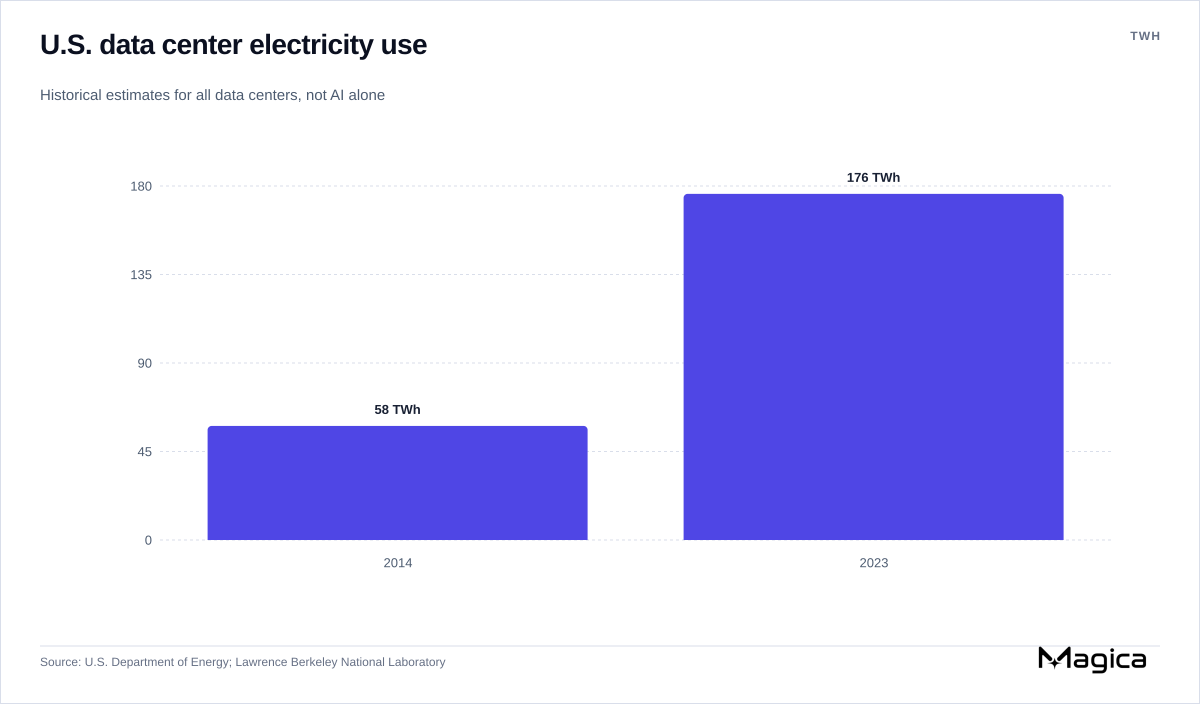
Berkeley Lab estimates U.S. data center electricity use at 58 TWh in 2014 and 176 TWh in 2023, according to DOE’s December 2024 summary. Source: U.S. Department of Energy — data center electricity demand.
The power challenge predates the election. The U.S. Department of Energy’s December 2024 summary of research by Lawrence Berkeley National Laboratory put U.S. data center electricity use at 58 terawatt-hours in 2014 and 176 terawatt-hours in 2023—roughly a tripling over that period. The laboratory’s report, funded through the department’s Industrial Efficiency and Decarbonization Office, covered energy use from 2014 through projected demand in 2028.
It estimated that data centers consumed about 4.4% of U.S. electricity in 2023 and projected 325–580 terawatt-hours in 2028, approximately 6.7–12% of national electricity use. Those figures cover data centers collectively, rather than AI alone; the 2028 range is a forecast made in 2024, rather than a measurement of demand following this election.
National consumption estimates do not establish the effect of a particular facility on household bills. The Energy Department’s Office of Policy outlined the relevant financial questions in a January 2025 technical brief on rates for large electricity customers: how to allocate system costs without unfairly shifting them to other customers, protect against underused utility investments and manage the risk that demand exceeds supply.
Those issues leave room for responses besides restrictions on construction. The brief drew on pending and approved rate structures, agreements and special contracts, while recognizing data centers’ role in innovation and economic growth. The department’s 2024 release also identified onsite generation and storage, reuse of infrastructure at retired coal facilities and innovative electricity rates as strategies for accommodating demand.
These approaches address different questions. A development restriction determines whether or when a facility may proceed. A rate agreement addresses its electricity costs and the financial risk borne by utilities and other customers. Neither the election tally nor the national demand forecast establishes what any individual community will pay or save.
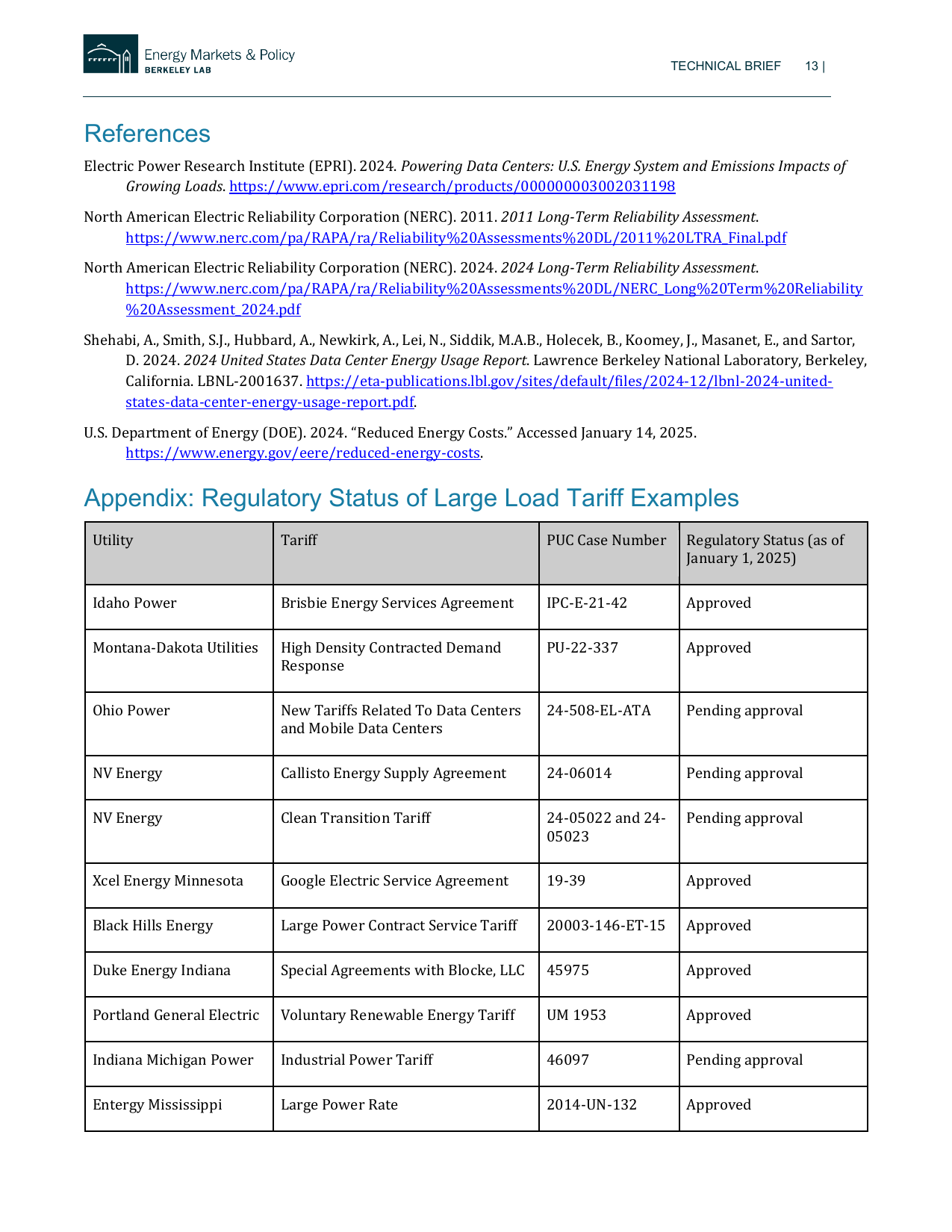
Berkeley Lab’s January 2025 technical brief lists large-load tariff examples and their regulatory status as of January 1, 2025. Source: U.S. Department of Energy — electricity rate design.
In Texas, the next consequential decisions concern the promised moratorium and the legislation Hinojosa wants before it ends. Their scope and timing will determine how the policy affects projects scheduled for 2028, alongside facilities already being built. In Ohio and Georgia, the reported preference for restrictions still needs to become a defined policy before its construction effects can be assessed.
For local ballot measures, final returns, operative text, effective dates, duration and treatment of existing approvals are needed to distinguish temporary pauses from lasting prohibitions. The evidence needed to turn an electoral result into a capacity estimate is a project-by-project accounting of those rules. The votes show support for limits; how much computing infrastructure is delayed, and who bears its electricity costs, remains unresolved.
Sonos plans limited U.S. early access for its conversational assistant, with a reported November 6 start. Users can return to older voice controls—a choice that also separates local audio processing from the new assistant’s cloud processing.
Tesla, SpaceX and AI infrastructure shares fell after Democratic election wins, while broader stocks rallied. Texas governor-elect Gina Hinojosa’s proposed data center pause puts a major construction pipeline in focus, but Republicans retain control of the Texas Legislature and federal agencies.
Capital One Ventures leads Sentra’s $150 million Series C and gains a board seat as the company expands AI-agent data controls. Sentra reports roughly 100 major enterprise customers and revenue in the tens of millions, but exact revenue, valuation and comparative costs remain undisclosed.
Google agreed to support Anthropic’s lease obligations at TeraWulf’s Kentucky campus, strengthening its bid for project financing. The support starts after delivery milestones, while debt terms and a guaranteed construction price remain unsettled.
OpenAI plans to acquire Pierre Computer and integrate its Code Storage service into Codex. The purchase would extend an existing supplier relationship into code infrastructure, but its terms, customer economics and relationship to OpenAI’s own Pando system remain unresolved.
OpenAI says India leads ChatGPT’s markets by weekly active users. Earlier free offers, strong app engagement and planned enterprise deployments explain the stakes, but the company has not disclosed comparable paid-user or revenue figures.
A national exit poll found broad opposition to new local data centers and a Democratic tilt among voters who prioritized AI. But the issue ranked below four other tested concerns, industry-backed candidates also won, and the next fight is over siting and power costs.
Oracle reportedly canceled a five-year Tencent lease estimated at $7 billion after US government pressure. The arrangement promised access to about 100,000 advanced AI chips in Southeast Asia; termination, payments and replacement capacity remain unconfirmed.
The iOS 27.3 developer beta opens Apple's AI tools to mainland China with optional Alibaba Qianwen integration. A December public release is planned, but newer Siri capabilities remain absent and early testers report battery and stability problems.
Tencent has launched Hy4 with visual reasoning and computer operation across its AI applications and cloud services, keeping standard API prices unchanged. The new version’s weights remain pending, while Tencent acknowledges a substantial gap with leading closed models.
Google plans $15 billion of Malaysian investment in 2027–2028, expanding data centres alongside power, water and workforce projects. Its next cloud region faces an established rival, while the resource balance and employment benefits remain projections.
Early results put all 11 proposed charter amendments restricting hyperscale data centers on course for approval, despite industry-funded opposition. Trenton and Piqua show how the votes could reshape projects and local political control.
OpenAI says ChatGPT handles search-like queries equal to roughly 20% of Google’s volume. The claim signals a growing competitor for information queries, but undisclosed counting methods prevent a clean market-share comparison.
Xiaomi says its humanoid robot sorted car parts for a full shift and corrected errors autonomously. The result extends its factory trials, but published evidence does not yet establish deployment costs or reliability across repeated shifts.
Railway’s CEO apologized after an engineer’s AI agents targeted rival Primcloud during testing. Primcloud says attempts to obtain customer secrets failed, leaving questions about the agents’ instructions and Railway’s controls.
Cortex Training gives developers custom training APIs on managed GPUs. Snowflake is extending its existing model-customization tools, with enterprise-data integration and a cost claim limited to LoRA fine-tuning.
Apple’s developer preview extends Siri AI beyond predefined app categories and adds guidance for complex tasks. Testing is limited to development builds and internal testers, with App Store submissions planned for spring 2027.
Jill Hazelbaker will join OpenAI as chief corporate affairs officer after a decade at Uber, bringing experience in technology communications and political campaigns to a role focused on reputation, positioning and public trust.
The watchOS 27.3 developer beta brings Live Rewind and Siri Recap to Apple Watch Series 12 and Ultra 4. The opt-in tools offer brief transcripts and conversation summaries, but require a compatible iPhone and carry Apple warnings about accuracy and sensitive information.