Editorial Team
9 min read
Riot Platforms says its 15-year Corsicana lease with Anthropic will generate about $28 billion in revenue. The tenant owns and operates the compute, while Riot develops power infrastructure and funds module reimbursements through debt or credits against future rent.
Riot Platforms, the Nasdaq-listed bitcoin miner expanding into data-center development, announced on November 4 that it had signed a 15-year lease covering its entire Corsicana, Texas campus with Anthropic, the developer of Claude AI models and tools and an existing tenant at Riot’s Rockdale campus. Riot puts the initial contract value at approximately $28 billion. That figure represents revenue over the lease term, rather than an upfront payment, and comes with a projected $5.5 billion development requirement.
In its announcement, Riot described a transaction for 910 megawatts of critical IT capacity on 332 contiguous acres. The announcement identified the tenant only as a frontier AI lab. But Riot’s quarterly filing names Anthropic PBC and says the lease was signed October 28 and became effective November 4. The two campuses share that major customer.
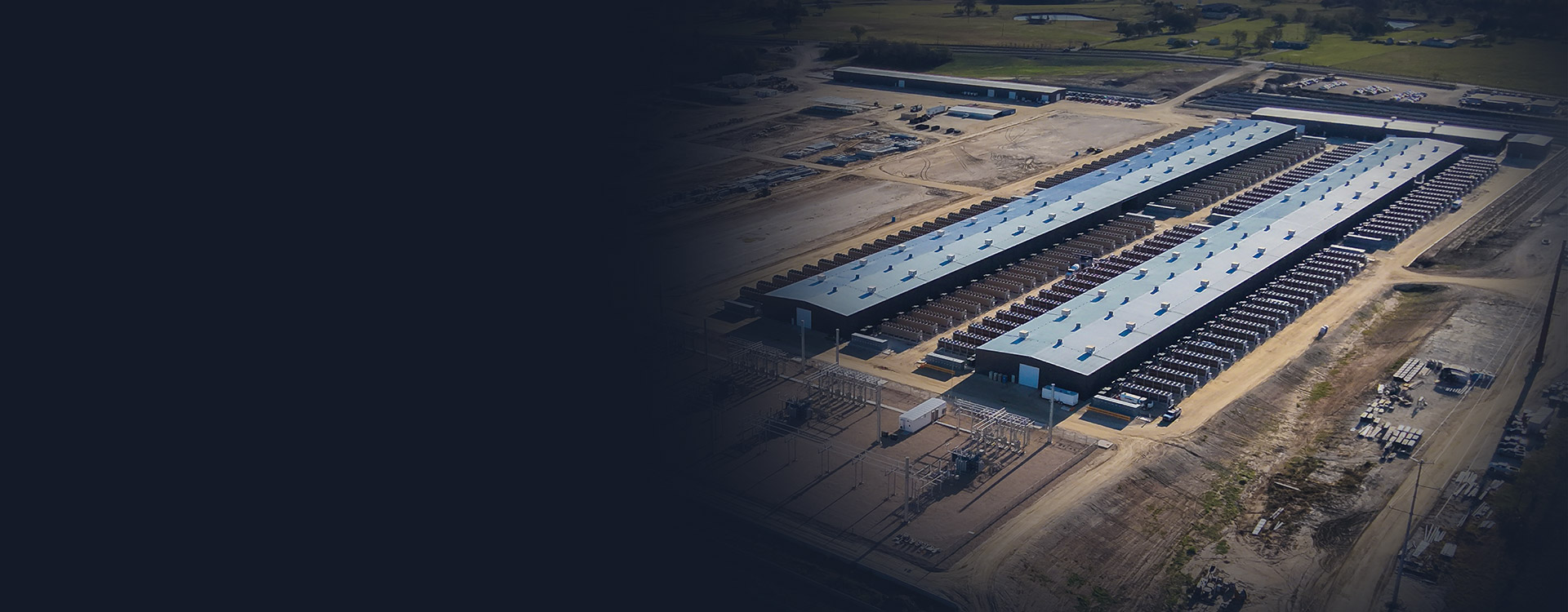
Riot’s existing Corsicana campus in Texas, pictured on its official location page. Credit: Riot Platforms. Source: Riot Platforms — Q3 2026 Results.
The agreement converts a preliminary proposal into a definitive lease and expands its scope. A report detailing the transaction says the August nonbinding letter of intent contemplated 756 MW of net critical IT capacity. The signed 910 MW agreement is about 20% larger, calculated from those two capacity figures. Corsicana’s initial 400 MW substation was energized in April 2024 for bitcoin mining.
Riot’s AI and high-performance-computing leasing record is comparatively recent. Its January 16 announcement identified the Rockdale agreement with Advanced Micro Devices (AMD), the computing-hardware manufacturer, as its first data-center lease, initially covering 25 MW. That announcement also said Riot had begun formally evaluating its assets for AI and high-performance computing use less than twelve months earlier.
The assets behind that transition predate the new leases. In January, Riot bought the 200 acres underlying Rockdale for $96 million, replacing a ground lease with outright ownership. Its announcement described a 700 MW grid interconnection, water and fiber connectivity at Rockdale, and a combined 1.7 GW of fully approved power capacity across its two Texas sites. Those are power-portfolio figures, distinct from critical IT capacity available to tenants.
In August, Riot added a 20-year, 191 MW Rockdale lease with the AI lab, valued by the company at $9.1 billion, according to a report on its leasing expansion. The quarterly filing puts AMD’s contracted deployment at 50 MW, up from the initial 25 MW. Including AMD and Corsicana, Riot now says it has contracted 1,151 MW and approximately $38 billion of long-term data-center revenue.
Those commitments are much larger than the business currently generating revenue. Riot reported in its quarterly results $18.4 million in third-quarter data-center revenue: $10.2 million of tenant fit-out reimbursement revenue, $7.7 million of base rent and $0.5 million of variable lease revenue. The quarter reflected the first full quarter of the stabilized 25 MW delivered to AMD. Contracted capacity should therefore be distinguished from capacity already earning rent.
Anthropic brings financing and a broader supply network to that relationship. In its May 28 funding announcement, the company said it had raised a $65 billion round, including $15 billion of previously committed investments. It said the funding would support research, additional compute and products serving demand for Claude. That funding announcement provides context for the customer’s scale, rather than a guarantee of Riot’s future receipts.
Anthropic also said it had expanded compute agreements with Amazon, Google and Broadcom, and SpaceX, and identified AWS as its primary cloud provider and training partner. Corsicana is consequently one part of a wider compute-sourcing strategy.
Corsicana is structured as a triple-net powered-land lease. Riot supplies land, powered pads and electrical infrastructure, retaining ownership and maintenance responsibility for the high- and medium-voltage infrastructure. The tenant procures, installs, owns and operates the modular compute deployment.
The tenant also bears substantially all operating costs. The detailed transaction report describes property taxes, insurance and lifecycle capital expenditure among those costs, with utility costs passed through without markup. It puts contracted rent under Riot’s project-debt case at $130 per kilowatt per month, escalating 3% annually. Riot says rent is payable on the full 910 MW regardless of utilization. This separates Riot’s rental entitlement from how intensively the lab uses its equipment, while concentrating the lease on one customer.
Riot estimates capital costs of $6 million per IT MW: $2 million for site work and electrical infrastructure and $4 million in reimbursements for tenant module costs. Reimbursements are payable in phases after delivery and the start of rent payments. At 910 MW, the reimbursement allowance totals $3.64 billion.
In its projected lease economics, Riot estimates approximately $1.8 billion in average annual rent and a 99% net operating income margin over the initial term, with an unlevered yield on cost of about 33%. The transaction report specifies that the average rent is before amortization of tenant reimbursements. These are projected lease economics, rather than profit after financing costs. Riot’s earlier lease announcement also explains that its projected net operating income excludes capital spending, material financial obligations, corporate overhead and depreciation.
Riot compares its capital requirement with roughly twice that amount for a typical Tier 3 build. The transaction report puts Riot’s own Rockdale build-to-suit Tier 3 facility at $11 million to $12 million per IT MW. Those projects have different responsibilities: Corsicana’s tenant owns and operates the modular compute deployment. The comparison measures Riot’s capital commitment, rather than proving that an equivalent operating data center costs half as much.
The initial AMD retrofit illustrates another distinction. Riot budgeted $89.8 million, or $3.6 million per IT MW, to reuse an existing Rockdale building and infrastructure. That smaller retrofit is a different construction scope from either the Corsicana powered-land development or a Tier 3 build.
Two optional five-year extensions would increase total contract value to about $54 billion; that larger figure depends on both options being exercised.
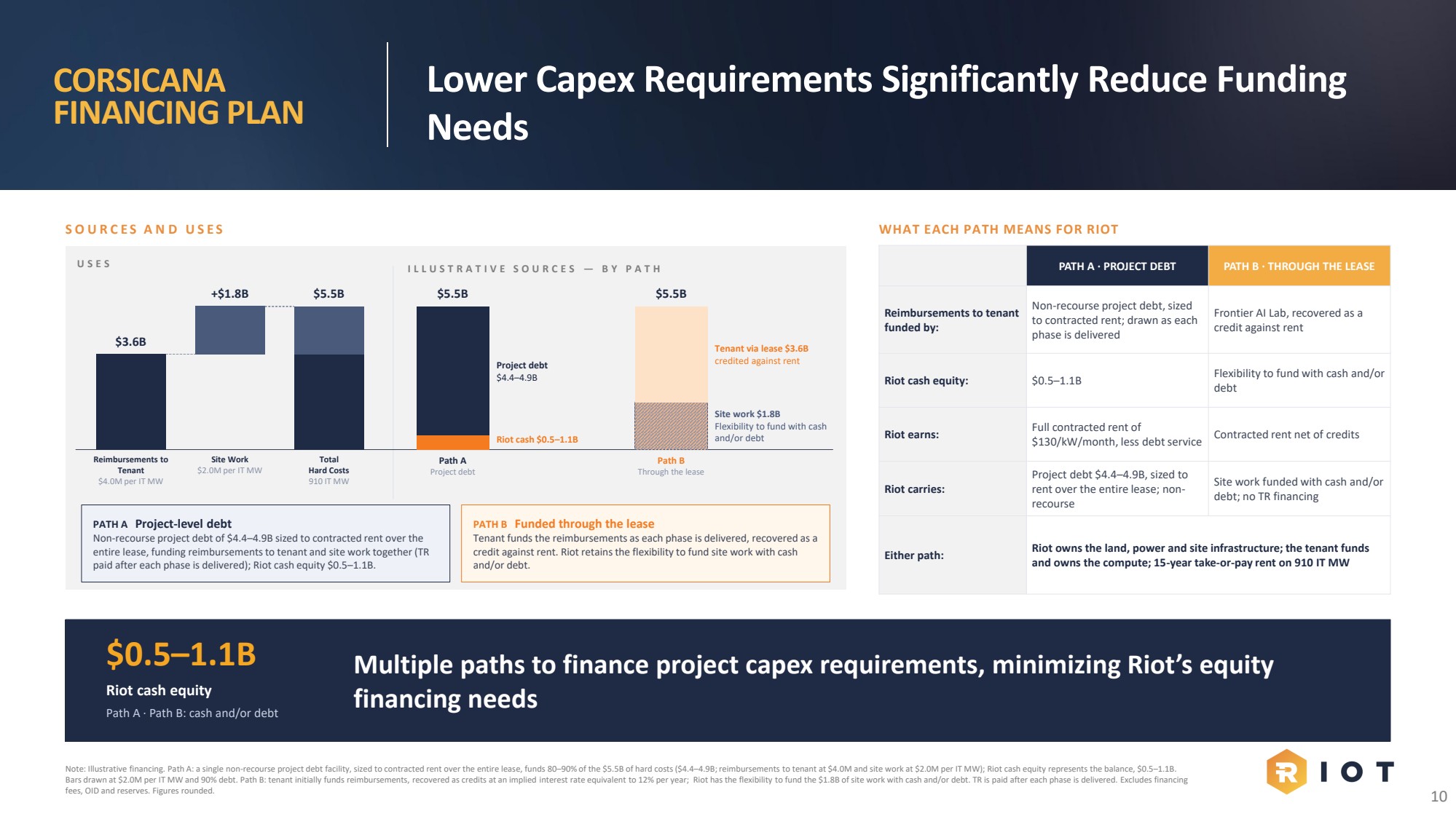
Company-reported illustrative financing paths for Corsicana, showing different debt obligations and effects on rental receipts. Source: Riot Platforms, Q3 2026 presentation, slide 10. Source: SEC — Q3 2026 Investor Presentation.
Riot expects to fund tenant reimbursements through non-recourse project debt sized against contracted rent. The detailed report describes illustrative borrowings of $4.4 billion to $4.9 billion, covering 80% to 90% of project cost and leaving $0.5 billion to $1.1 billion of Riot cash equity. Financing is expected to launch in 2027.
If financing on comparable market terms is unavailable, the tenant would fund reimbursements directly and recover them through credits against rent over the remaining term. The report describes an implied annual rate of 12% for that alternative. The fallback addresses the reimbursement funding requirement, but reduces the rent Riot receives. Neither route makes financing cost disappear.
Riot says it does not currently anticipate issuing equity for its announced projects. That is a funding expectation rather than completed financing. The report puts combined cash-equity needs for Corsicana and Rockdale at $0.8 billion to $1.5 billion over 2027–2029. The same report says Riot has a $573 million interim loan for Rockdale and is finalizing high-investment-grade credit support for that project.
Riot’s reported liquidity also needs qualification. At September 30, its $950.2 million in cash and bitcoin included $748.2 million of cash, of which $79.2 million was restricted, and approximately $202 million of bitcoin. It sold 20,264 bitcoin for about $1.5 billion in the first nine months of 2026, primarily to fund data-center development, without raising equity. Riot also repaid and terminated its $200 million Coinbase credit facility, releasing all bitcoin pledged to it.
Mining still supplied $116 million of Riot’s $181.4 million in third-quarter revenue, down from $160.8 million in mining revenue a year earlier despite higher production. Engineering generated another $47 million, up from $19.1 million, which Riot attributed to third-party data-center demand for custom electrical equipment.
Riot’s mining-cost table shows why the accounting basis matters. After power-curtailment credits, third-quarter cost per bitcoin was $39,265 excluding miner depreciation, below the $70,855 production value per bitcoin. Including miner depreciation raised the cost to $78,805. Riot says depreciation is a non-cash expense that does not determine whether temporarily operating a miner is economical. The figures show pressure on returns after equipment costs, without establishing that mining was consuming cash on that measure.
Riot’s engineering business adds a capability beyond owning mining sites. A report comparing the miners’ data-center transitions says its ESS Metron subsidiary makes switchgear and power distribution units, components the report identifies as constrained in the supply chain.
But signed AI leases are not unique to Riot. The same report describes rival bitcoin miner Cipher Digital as already receiving lease revenue at Black Pearl and holding an amended long-term lease at Barber Lake, while carrying a heavy debt load. It describes MARA Holdings as earlier in its conversion, without a signed AI lease. Their different stages of delivery and financing limit broad comparisons between miners pursuing AI customers.
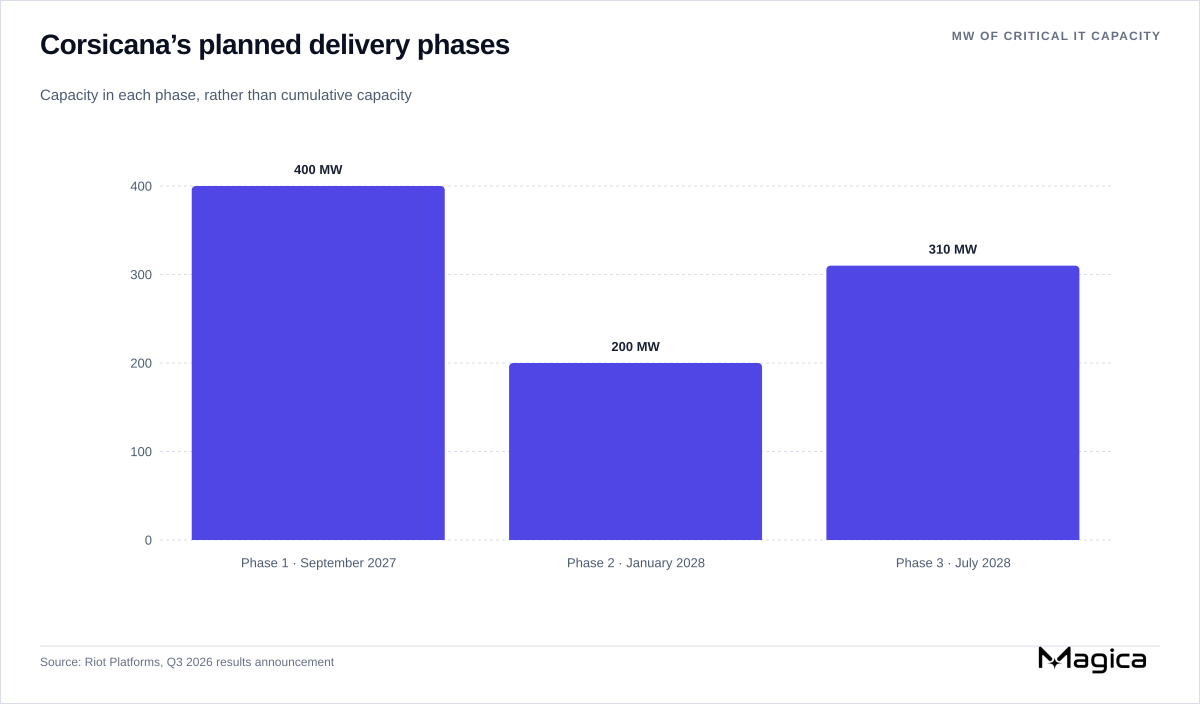
Company-reported Corsicana delivery targets by phase, rather than cumulative capacity. Source: Riot Platforms. Source: Riot Platforms — Q3 2026 Results.
Riot’s delivery plan calls for 400 MW in September 2027, 200 MW in January 2028 and 310 MW in July 2028. Rent on each phase must commence no later than 60 days after delivery of its powered pads.
The company must execute that schedule alongside Rockdale. A report on the concurrent projects places the AI lab’s first 96 MW there in December 2027 and the full 191 MW in June 2028. That report also relays Bloomberg’s account that Texas’s governor-elect called for an immediate data-center moratorium. It does not establish an enacted restriction or how a proposal would apply to Riot’s existing power approvals. Riot separately identifies permitting, construction delays, supply-chain issues and financing among its development risks.
The decisive evidence now will be financing terms, completed powered pads and the start of rental payments. The signed lease establishes a customer commitment. Turning its headline value into cash available to Riot still depends on delivering infrastructure and paying for it.
About two dozen restrictive data center measures appeared to pass in initial returns. Texas governor-elect Gina Hinojosa’s promised construction pause adds a state-level constraint, though the capacity ultimately delayed remains uncertain.
Sonos plans limited U.S. early access for its conversational assistant, with a reported November 6 start. Users can return to older voice controls—a choice that also separates local audio processing from the new assistant’s cloud processing.
Tesla, SpaceX and AI infrastructure shares fell after Democratic election wins, while broader stocks rallied. Texas governor-elect Gina Hinojosa’s proposed data center pause puts a major construction pipeline in focus, but Republicans retain control of the Texas Legislature and federal agencies.
Capital One Ventures leads Sentra’s $150 million Series C and gains a board seat as the company expands AI-agent data controls. Sentra reports roughly 100 major enterprise customers and revenue in the tens of millions, but exact revenue, valuation and comparative costs remain undisclosed.
Google agreed to support Anthropic’s lease obligations at TeraWulf’s Kentucky campus, strengthening its bid for project financing. The support starts after delivery milestones, while debt terms and a guaranteed construction price remain unsettled.
OpenAI plans to acquire Pierre Computer and integrate its Code Storage service into Codex. The purchase would extend an existing supplier relationship into code infrastructure, but its terms, customer economics and relationship to OpenAI’s own Pando system remain unresolved.
OpenAI says India leads ChatGPT’s markets by weekly active users. Earlier free offers, strong app engagement and planned enterprise deployments explain the stakes, but the company has not disclosed comparable paid-user or revenue figures.
A national exit poll found broad opposition to new local data centers and a Democratic tilt among voters who prioritized AI. But the issue ranked below four other tested concerns, industry-backed candidates also won, and the next fight is over siting and power costs.
Oracle reportedly canceled a five-year Tencent lease estimated at $7 billion after US government pressure. The arrangement promised access to about 100,000 advanced AI chips in Southeast Asia; termination, payments and replacement capacity remain unconfirmed.
The iOS 27.3 developer beta opens Apple's AI tools to mainland China with optional Alibaba Qianwen integration. A December public release is planned, but newer Siri capabilities remain absent and early testers report battery and stability problems.
Tencent has launched Hy4 with visual reasoning and computer operation across its AI applications and cloud services, keeping standard API prices unchanged. The new version’s weights remain pending, while Tencent acknowledges a substantial gap with leading closed models.
Google plans $15 billion of Malaysian investment in 2027–2028, expanding data centres alongside power, water and workforce projects. Its next cloud region faces an established rival, while the resource balance and employment benefits remain projections.
Early results put all 11 proposed charter amendments restricting hyperscale data centers on course for approval, despite industry-funded opposition. Trenton and Piqua show how the votes could reshape projects and local political control.
OpenAI says ChatGPT handles search-like queries equal to roughly 20% of Google’s volume. The claim signals a growing competitor for information queries, but undisclosed counting methods prevent a clean market-share comparison.
Xiaomi says its humanoid robot sorted car parts for a full shift and corrected errors autonomously. The result extends its factory trials, but published evidence does not yet establish deployment costs or reliability across repeated shifts.
Railway’s CEO apologized after an engineer’s AI agents targeted rival Primcloud during testing. Primcloud says attempts to obtain customer secrets failed, leaving questions about the agents’ instructions and Railway’s controls.
Cortex Training gives developers custom training APIs on managed GPUs. Snowflake is extending its existing model-customization tools, with enterprise-data integration and a cost claim limited to LoRA fine-tuning.
Apple’s developer preview extends Siri AI beyond predefined app categories and adds guidance for complex tasks. Testing is limited to development builds and internal testers, with App Store submissions planned for spring 2027.
Jill Hazelbaker will join OpenAI as chief corporate affairs officer after a decade at Uber, bringing experience in technology communications and political campaigns to a role focused on reputation, positioning and public trust.
The watchOS 27.3 developer beta brings Live Rewind and Siri Recap to Apple Watch Series 12 and Ultra 4. The opt-in tools offer brief transcripts and conversation summaries, but require a compatible iPhone and carry Apple warnings about accuracy and sensitive information.