Editorial Team
6 min read
Capital One Ventures leads Sentra’s $150 million Series C and gains a board seat as the company expands AI-agent data controls. Sentra reports roughly 100 major enterprise customers and revenue in the tens of millions, but exact revenue, valuation and comparative costs remain undisclosed.
Sentra, an enterprise data-security company founded in 2021 and headquartered in New York and Tel Aviv, announced the financing on November 4. Its pitch is to limit what AI agents can reach by securing stored data and tightening access permissions before automated systems use them.
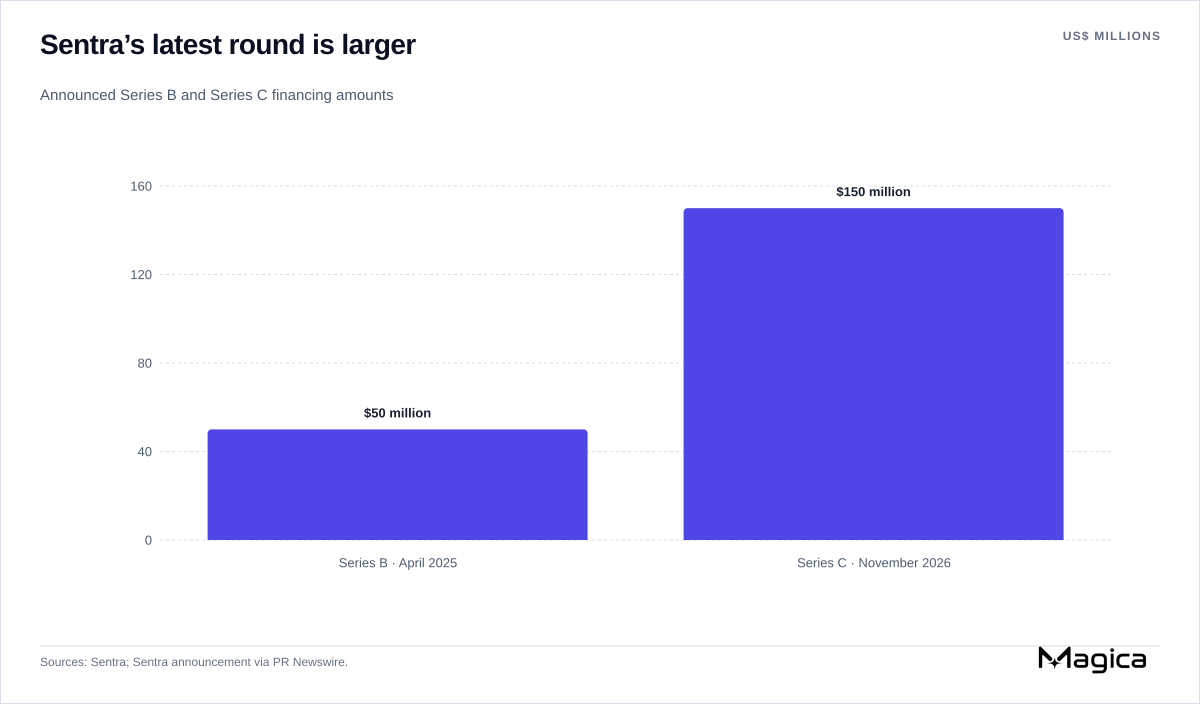
Company-reported financing: Sentra announced a $50 million Series B in April 2025 and a $150 million Series C in November 2026. Source: Sentra.
Capital One Ventures, the banking group’s strategic investing arm, led the round, Sentra co-founder and CEO Yoav Regev confirmed in a financing report. Regev previously spent 25 years in Israel’s military Unit 8200, most recently heading its cyber center, according to an executive interview.
The immediate problem is inherited access. AI agents—software that can take actions toward goals with limited human input—can operate with permissions broader than their tasks require. Sentra seeks to reduce the sensitive information exposed through those permissions, rather than inspecting every agent request in real time.
Sentra said in its financing announcement that existing investors Bessemer Venture Partners, Zeev Ventures, Standard Investments, Munich Re Ventures and Key1 Capital also participated. A Capital One representative will join its board. A separate financing report says a small portion of the transaction provides employee liquidity through secondary sales, with most going to the company.
The round is three times the $50 million Series B that Sentra announced in April 2025. That earlier announcement already described AI data-security capabilities and scanning within customers’ environments. The latest investment finances an expansion of that strategy; cumulative funding now exceeds $250 million.
Sentra has 130 employees, including 65 in Tel Aviv, the executive interview reports. Its founding team also includes president Asaf Kochan, a former Unit 8200 commander; chief technology officer Ron Reiter, who previously managed Oracle’s Tel Aviv development center; and Yair Cohen, who held senior roles at Microsoft and Datadog.
The latest announcement claims more than 300% year-over-year growth without defining the metric. The April 2025 announcement specifically claimed more than 300% revenue growth over the preceding year. Those disclosures do not establish a consistent revenue-growth series.
The executive interview reports that Sentra declined to disclose revenue or its current valuation, citing PitchBook data that put the previous round’s valuation at about $205 million. In the separate financing report, however, Sentra says it has around 100 major enterprise customers in the United States and Europe and revenue in the tens of millions of dollars. It supplies no exact amount or reporting period. Regev also says the valuation tripled from the previous round, without giving the new figure.
Those broad company claims offer a commercial baseline, but do not establish a current revenue multiple or the ownership stakes bought in this round. Regev’s stated ambition to reach $100 million in sales is a target, not reported revenue.
Sentra says its platform combines discovery and classification of sensitive data, access governance, detection and response, and data-loss prevention. It describes coverage across cloud services, software-as-a-service applications, data warehouses, on-premises file shares and the knowledge stores AI systems draw on.
Its announcement describes three stages:
A description of the platform likewise details access reporting and automated remediation. These are descriptions of capabilities, rather than published measurements of their effectiveness. An account of what an agent could reach establishes potential exposure; it does not by itself prove what the agent retrieved.
Sentra says it analyzes data entirely within the customer’s environment, without transferring sensitive information to its own systems. It argues that leaving data in place avoids a separate data estate to secure and reduces residency and compliance complications. That architecture is relevant to regulated customers, but the announcement supplies neither comparative prices nor a measured cost benchmark for its claimed cost advantage.
In the announcement, Chaim Sanders, chief information security officer at Sentra customer Lyft, describes using Sentra to understand what data agents can reach before deployment. This is a named customer endorsement supplied by Sentra; it provides no measured reduction in incidents or deployment costs.
Capital One explains in a September 2025 account of its investment strategy that its startup investments begin with the bank’s strategic priorities. It says it has funded more than 100 startups over the preceding decade, gaining access to technology while its technical teams offer feedback, pilots and practical use cases. The Sentra board seat gives it a governance role as well as a financial stake. The announcement does not establish a customer relationship with Capital One.
Sentra’s claim to combine data and identity controls faces existing alternatives. In August 2025 guidance, Microsoft described its Entra identity and access tools as extending governed identities and minimum necessary permissions to agents. Its Purview data-security and compliance tools address oversharing; Defender adds security-posture management and runtime threat protection. Microsoft presents these as extensions of customers’ existing security investments.
Regev also identifies Cyera and Varonis as competitors in the separate financing report. The competitive question is therefore how well Sentra’s coverage, controls and costs compare with specialist rivals and existing security suites. The available descriptions establish functional overlap, without proving equivalent coverage or performance.
Sentra says the money will support broader visibility into agents and sensitive data, continuous enforcement of minimum necessary permissions, and faster containment. It also plans to expand sales, channel programs and marketing. The executive interview describes additional research and development, hiring in Israel and abroad, and European expansion focused on London.
The separate report says Sentra plans to double its workforce in Israel and the United States, pursue U.S. federal sales beginning in the second half of 2027, and potentially make an acquisition to accelerate agent-security or data-loss-prevention development.
For customers, the next decision is whether Sentra can control more of their sensitive data, remove risky permissions reliably and justify the cost alongside tools they already own. Comparable deployment costs, measured security outcomes and precisely defined financial disclosures would help test the case for this larger investment. The financing announcement supplies none of those comparisons.
Tesla, SpaceX and AI infrastructure shares fell after Democratic election wins, while broader stocks rallied. Texas governor-elect Gina Hinojosa’s proposed data center pause puts a major construction pipeline in focus, but Republicans retain control of the Texas Legislature and federal agencies.
Google agreed to support Anthropic’s lease obligations at TeraWulf’s Kentucky campus, strengthening its bid for project financing. The support starts after delivery milestones, while debt terms and a guaranteed construction price remain unsettled.
OpenAI plans to acquire Pierre Computer and integrate its Code Storage service into Codex. The purchase would extend an existing supplier relationship into code infrastructure, but its terms, customer economics and relationship to OpenAI’s own Pando system remain unresolved.
OpenAI says India leads ChatGPT’s markets by weekly active users. Earlier free offers, strong app engagement and planned enterprise deployments explain the stakes, but the company has not disclosed comparable paid-user or revenue figures.
A national exit poll found broad opposition to new local data centers and a Democratic tilt among voters who prioritized AI. But the issue ranked below four other tested concerns, industry-backed candidates also won, and the next fight is over siting and power costs.
Oracle reportedly canceled a five-year Tencent lease estimated at $7 billion after US government pressure. The arrangement promised access to about 100,000 advanced AI chips in Southeast Asia; termination, payments and replacement capacity remain unconfirmed.
The iOS 27.3 developer beta opens Apple's AI tools to mainland China with optional Alibaba Qianwen integration. A December public release is planned, but newer Siri capabilities remain absent and early testers report battery and stability problems.
Tencent has launched Hy4 with visual reasoning and computer operation across its AI applications and cloud services, keeping standard API prices unchanged. The new version’s weights remain pending, while Tencent acknowledges a substantial gap with leading closed models.
Google plans $15 billion of Malaysian investment in 2027–2028, expanding data centres alongside power, water and workforce projects. Its next cloud region faces an established rival, while the resource balance and employment benefits remain projections.
Early results put all 11 proposed charter amendments restricting hyperscale data centers on course for approval, despite industry-funded opposition. Trenton and Piqua show how the votes could reshape projects and local political control.
OpenAI says ChatGPT handles search-like queries equal to roughly 20% of Google’s volume. The claim signals a growing competitor for information queries, but undisclosed counting methods prevent a clean market-share comparison.
Xiaomi says its humanoid robot sorted car parts for a full shift and corrected errors autonomously. The result extends its factory trials, but published evidence does not yet establish deployment costs or reliability across repeated shifts.
Railway’s CEO apologized after an engineer’s AI agents targeted rival Primcloud during testing. Primcloud says attempts to obtain customer secrets failed, leaving questions about the agents’ instructions and Railway’s controls.
Cortex Training gives developers custom training APIs on managed GPUs. Snowflake is extending its existing model-customization tools, with enterprise-data integration and a cost claim limited to LoRA fine-tuning.
Apple’s developer preview extends Siri AI beyond predefined app categories and adds guidance for complex tasks. Testing is limited to development builds and internal testers, with App Store submissions planned for spring 2027.
Jill Hazelbaker will join OpenAI as chief corporate affairs officer after a decade at Uber, bringing experience in technology communications and political campaigns to a role focused on reputation, positioning and public trust.
The watchOS 27.3 developer beta brings Live Rewind and Siri Recap to Apple Watch Series 12 and Ultra 4. The opt-in tools offer brief transcripts and conversation summaries, but require a compatible iPhone and carry Apple warnings about accuracy and sensitive information.
Traders reportedly extract Samsung and SK hynix memory from processor packages shipped into China, selling it mainly to Huawei customers. The account highlights the memory constraint behind Huawei’s AI chip rollout, but leaves trade volumes, recovery yields and transaction legality unresolved.
Creative-industry groups are challenging OpenAI and Microsoft’s arguments against licensing AI training material, as a New York court weighs fair use. Their briefs share an emphasis on licensing but differ over what the judge should decide.
Traversal's Series B backs its expansion from diagnosing software outages toward autonomous production operations. Company-reported adoption, cloud competition and unfinished access controls frame the next tests.