Editorial Team
7 min read
Tesla, SpaceX and AI infrastructure shares fell after Democratic election wins, while broader stocks rallied. Texas governor-elect Gina Hinojosa’s proposed data center pause puts a major construction pipeline in focus, but Republicans retain control of the Texas Legislature and federal agencies.
Carmaker Tesla, rocket operator SpaceX and several AI infrastructure stocks fell on November 4 after Democrats won both chambers of Congress and the Texas governorship. The wider market rallied, leaving investors to distinguish the relief of a settled election from new risks to particular companies and construction projects.
Elon Musk, chief executive of Tesla and SpaceX and a former head of the Department of Government Efficiency, backed Republicans heavily. Both companies are headquartered in Texas, where voters rejected his preferred candidates for governor and Senate. Their exposure combines facilities in the state with the prospect of congressional investigations into Musk’s government role and federal business ties, as described in the account of the election’s business implications.
Tesla fell about 5% and SpaceX 6.9% in premarket trading before narrowing their losses to about 2.5% and 1%, respectively, during the morning. Those changing intraday readings do not establish the lasting cost of the election result.
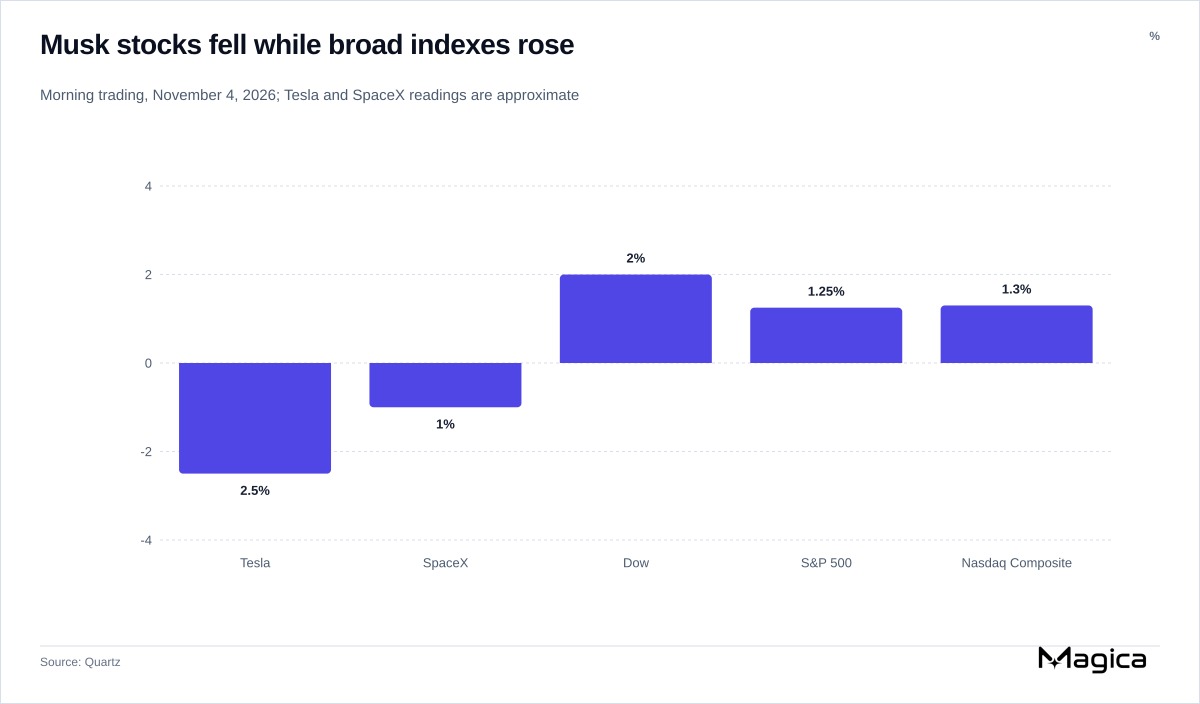
Tesla and SpaceX fell while broad indexes rose in November 4 morning trading. Company readings are approximate; these are intraday observations. Source: Quartz.
Democratic governor-elect Gina Hinojosa, an Austin state legislator since 2017, defeated Republican incumbent Greg Abbott to become Texas’s first Democratic governor in more than three decades. Her campaign challenged data center development and corruption, according to the election account.
Hinojosa campaigned against corporate subsidies and called for a halt to new data center approvals until lawmakers put stronger community protections in place. Her pledge, described in the account of her proposed moratorium, makes the terms of expansion a central business question. Republicans retain control of the state Legislature, constraining how much policy she can change.
Research firm SemiAnalysis estimates that Texas accounts for 41% of new U.S. data center capacity expected in 2028, according to the market analysis. That forecast concerns additions in a particular year; it is neither Texas’s share of existing capacity nor a tally of canceled projects.
The resistance extends beyond Texas. Initial returns suggested that about two dozen proposals intended to restrict or block data center development had passed, among 41 data center measures on ballots across 10 states. The results are preliminary, and they do not yet show how much construction will be delayed or prevented.
In the premarket account, AI-linked Oracle fell 3.5%, CoreWeave 6% and Nvidia 1% amid concerns about data center restrictions. The same account noted that major AI businesses were already facing investor concern about infrastructure spending. The election adds a policy question to that existing financial concern; the price changes alone cannot establish future revenue losses.
A December 2024 Department of Energy summary of research by Lawrence Berkeley National Laboratory estimated that U.S. data center electricity use would rise substantially by 2028:
| Measure | 2023 estimate | 2028 projection |
|---|---|---|
| Annual U.S. data center electricity use | 176 terawatt-hours | 325–580 terawatt-hours |
| Share of total U.S. electricity consumption | About 4.4% | Approximately 6.7%–12% |
These figures cover data centers generally, rather than AI facilities alone. They are a national estimate and projection published in 2024, not a measurement of Texas’s current power requirements. The projected range leaves substantial uncertainty about the scale of demand.
The federal summary also described responses: onsite generation and storage, reuse of infrastructure at retired coal facilities, and electricity rate structures intended to accommodate expansion while maintaining affordability. Those options matter because the policy choice includes how to supply power and distribute costs, as well as whether to approve construction. The report does not establish which measures would resolve the disputes facing individual Texas projects.
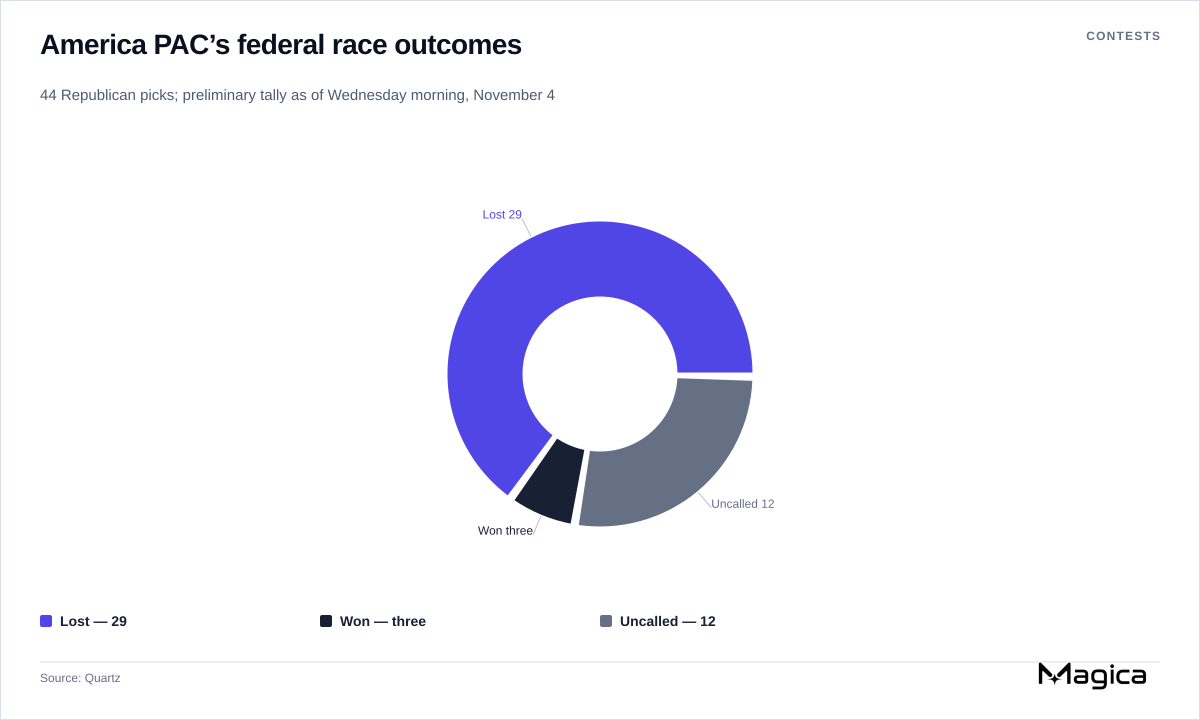
America PAC’s Republican picks in 44 federal contests, as of November 4 morning: 29 losses, three wins and 12 uncalled. These are contest counts, not spending shares. Source: Quartz.
A spending account citing CNBC’s tally put Musk’s contributions at at least $474 million, including $224 million in Texas. Other accounts used lower descriptions, including more than $445 million and nearly $450 million; the reports do not reconcile their tally dates or scope. The figures should not be treated as a single audited total.
Musk’s America PAC, the independent-expenditure political action committee he founded in 2024, spent close to $87 million across 44 federal contests. By Wednesday morning, its Republican candidates had lost 29 races and won three, with 12 still uncalled. About 93% of the PAC’s spending went to races Republicans lost, according to the spending account. That percentage measures dollars, rather than the share of contests lost.
His favored Texas Senate candidate, Republican Ken Paxton, lost to Democrat James Talarico, while Abbott lost the governorship. Tesla’s largest American car plant is just outside Austin, and SpaceX launches rockets from Starbase in South Texas. The facilities explain why the state’s decisions matter beyond the defeat of candidates Musk funded.
The potential congressional scrutiny extends beyond Musk: a briefing citing reported Democratic oversight plans identified Meta, Nvidia and Amazon as other technology companies of interest.
A possible Tesla-SpaceX combination adds a separate corporate decision. Musk said on SpaceX’s October third-quarter earnings call that both boards had established special committees of independent directors to examine a combination, according to the account of the discussions. He said a deal would require backing from 50% of all Tesla shareholders. The combination remains exploratory; the election is not evidence that a transaction has been blocked.
In morning trading, the Dow Jones Industrial Average rose 2%, the S&P 500 gained 1.25% and the Nasdaq Composite advanced 1.3%, according to the market report. Renewable energy stocks, health insurers and hospital operators had also gained in the premarket account.
Investor Bob Elliott attributed the futures rally to the administration’s acceptance of the result, which removed the threat of a prolonged dispute, in his assessment. Treasuries also rallied as investors bet that Democrats would constrain President Donald Trump’s ability to expand the deficit, according to the market briefing. These are market interpretations, rather than demonstrated long-term economic effects.
A Bloomberg Intelligence analysis examined 20 midterm cycles dating to 1946, excluding the current election year, and found average S&P 500 price gains of about 1.8% in the three months before the election and 7.5% in the three months afterward, excluding dividends. Post-election returns exceeded pre-election returns in 15 of those cycles. That historical comparison, described in the market analysis, does not isolate the effect of the winning party or guarantee a repeat.
Nor did the election uniformly strengthen restrictions on wealthy technology interests. A California proposal for a 5% wealth tax on individuals and trusts with more than $1 billion in assets appeared headed for defeat after Silicon Valley opposition, according to the same analysis.
Hinojosa’s moratorium proposal must now be judged by the authority used to implement it, the protections lawmakers consider and the projects affected. The evidence needed to assess business damage is specific: delayed approvals, changed subsidy terms, construction revisions or company disclosures of financial effects.
In Washington, Democratic oversight powers coexist with Trump’s control of executive agencies and his legislative veto. Goldman Sachs economists said Wednesday that they did not expect changes to national AI regulation, according to their policy outlook. That forecast limits the case for an immediate nationwide regulatory reversal. Congressional inquiries and any formal Tesla-SpaceX merger proposal will provide more concrete tests of the political risk investors were assessing on election morning.
About two dozen restrictive data center measures appeared to pass in initial returns. Texas governor-elect Gina Hinojosa’s promised construction pause adds a state-level constraint, though the capacity ultimately delayed remains uncertain.
Riot Platforms says its 15-year Corsicana lease with Anthropic will generate about $28 billion in revenue. The tenant owns and operates the compute, while Riot develops power infrastructure and funds module reimbursements through debt or credits against future rent.
Sonos plans limited U.S. early access for its conversational assistant, with a reported November 6 start. Users can return to older voice controls—a choice that also separates local audio processing from the new assistant’s cloud processing.
Capital One Ventures leads Sentra’s $150 million Series C and gains a board seat as the company expands AI-agent data controls. Sentra reports roughly 100 major enterprise customers and revenue in the tens of millions, but exact revenue, valuation and comparative costs remain undisclosed.
Google agreed to support Anthropic’s lease obligations at TeraWulf’s Kentucky campus, strengthening its bid for project financing. The support starts after delivery milestones, while debt terms and a guaranteed construction price remain unsettled.
OpenAI plans to acquire Pierre Computer and integrate its Code Storage service into Codex. The purchase would extend an existing supplier relationship into code infrastructure, but its terms, customer economics and relationship to OpenAI’s own Pando system remain unresolved.
OpenAI says India leads ChatGPT’s markets by weekly active users. Earlier free offers, strong app engagement and planned enterprise deployments explain the stakes, but the company has not disclosed comparable paid-user or revenue figures.
A national exit poll found broad opposition to new local data centers and a Democratic tilt among voters who prioritized AI. But the issue ranked below four other tested concerns, industry-backed candidates also won, and the next fight is over siting and power costs.
Oracle reportedly canceled a five-year Tencent lease estimated at $7 billion after US government pressure. The arrangement promised access to about 100,000 advanced AI chips in Southeast Asia; termination, payments and replacement capacity remain unconfirmed.
The iOS 27.3 developer beta opens Apple's AI tools to mainland China with optional Alibaba Qianwen integration. A December public release is planned, but newer Siri capabilities remain absent and early testers report battery and stability problems.
Tencent has launched Hy4 with visual reasoning and computer operation across its AI applications and cloud services, keeping standard API prices unchanged. The new version’s weights remain pending, while Tencent acknowledges a substantial gap with leading closed models.
Google plans $15 billion of Malaysian investment in 2027–2028, expanding data centres alongside power, water and workforce projects. Its next cloud region faces an established rival, while the resource balance and employment benefits remain projections.
Early results put all 11 proposed charter amendments restricting hyperscale data centers on course for approval, despite industry-funded opposition. Trenton and Piqua show how the votes could reshape projects and local political control.
OpenAI says ChatGPT handles search-like queries equal to roughly 20% of Google’s volume. The claim signals a growing competitor for information queries, but undisclosed counting methods prevent a clean market-share comparison.
Xiaomi says its humanoid robot sorted car parts for a full shift and corrected errors autonomously. The result extends its factory trials, but published evidence does not yet establish deployment costs or reliability across repeated shifts.
Railway’s CEO apologized after an engineer’s AI agents targeted rival Primcloud during testing. Primcloud says attempts to obtain customer secrets failed, leaving questions about the agents’ instructions and Railway’s controls.
Cortex Training gives developers custom training APIs on managed GPUs. Snowflake is extending its existing model-customization tools, with enterprise-data integration and a cost claim limited to LoRA fine-tuning.
Apple’s developer preview extends Siri AI beyond predefined app categories and adds guidance for complex tasks. Testing is limited to development builds and internal testers, with App Store submissions planned for spring 2027.
Jill Hazelbaker will join OpenAI as chief corporate affairs officer after a decade at Uber, bringing experience in technology communications and political campaigns to a role focused on reputation, positioning and public trust.
The watchOS 27.3 developer beta brings Live Rewind and Siri Recap to Apple Watch Series 12 and Ultra 4. The opt-in tools offer brief transcripts and conversation summaries, but require a compatible iPhone and carry Apple warnings about accuracy and sensitive information.