Editorial Team
8 min read
CoreWeave bonds fell after the election of candidates favoring data center restrictions. Texas governor-elect Gina Hinojosa wants to extend an existing approvals pause until lawmakers pass protections, adding delivery uncertainty for an industry whose expansion depends on power and financing.
CoreWeave, a cloud provider that sells computing capacity for building and running AI models, saw some of its bonds hit new lows on Nov. 4 after candidates favoring slower data center development won governorships, including in Texas. The election adds uncertainty over the infrastructure needed to turn customer commitments into revenue, though Texas already has an approvals pause and CoreWeave has faced delivery delays before.
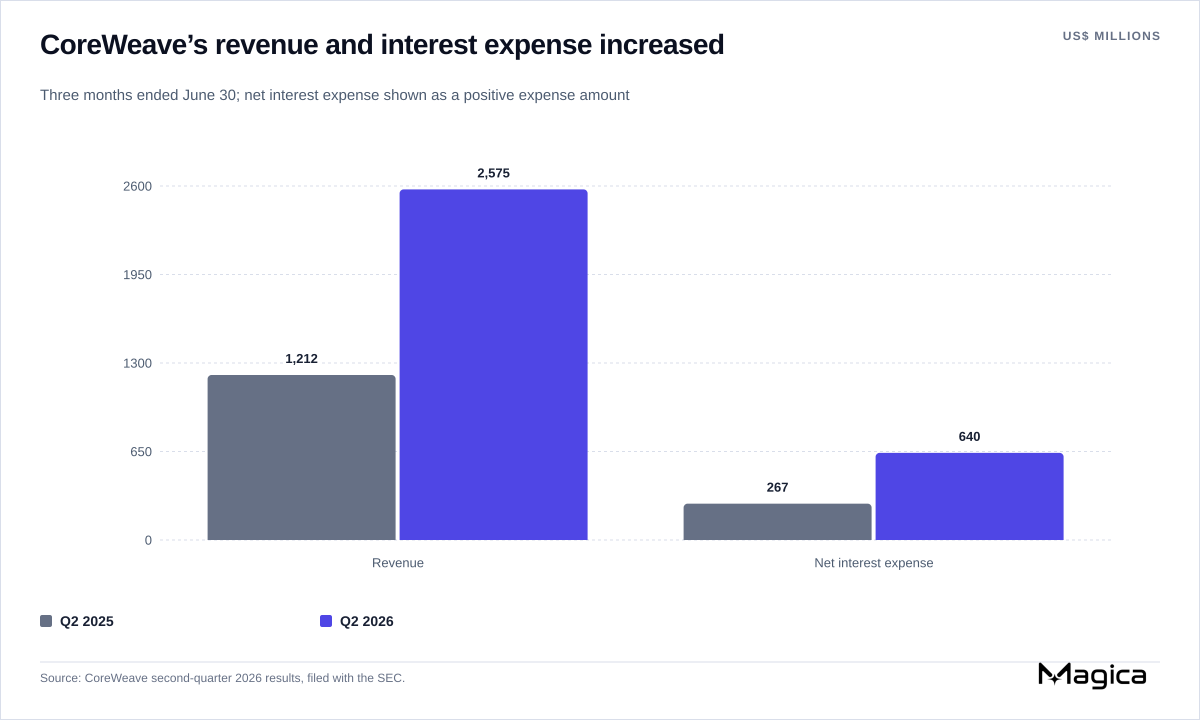
Company-reported revenue and net interest expense for the second quarters of 2025 and 2026, preceding the November bond selloff. Source: CoreWeave second-quarter results.
CoreWeave’s unsecured bonds due in 2031 were among Wednesday’s weakest high-yield performers, reaching 79.5 cents on the dollar, according to a pricing report citing Trace data. Its debt due in 2030 and 2032 also declined, trading around levels considered distressed, with yields above 15%.
Those are secondary-market prices and yields, rather than new borrowing terms or evidence that a particular project has been canceled. Their significance is the financial pressure accompanying uncertainty over future construction.
CoreWeave launched its cloud platform in 2020 and primarily finances infrastructure development through asset-level debt supported by committed customer contracts, supplemented by corporate debt and equity, according to its 2025 annual report. Customers generally reserve specified capacity through multiyear, take-or-pay contracts. That provides a contractual base for expansion, while making delivery of usable capacity critical.
The company’s second-quarter results show how quickly both the business and its financial demands have grown. These figures cover the three months ended June 30 in each year:
| Measure | 2025 | 2026 |
|---|---|---|
| Revenue | $1.212 billion | $2.575 billion |
| Net interest expense | $267 million | $640 million |
| Net loss | $290 million | $626 million |
| Cash from operating activities | −$251 million | $679 million |
| Cash purchases of property and equipment, including capitalized internal-use software | $2.453 billion | $6.422 billion |
Revenue more than doubled, but net interest expense rose faster, reaching about 25% of revenue from about 22% a year earlier, calculated from the table. Operating cash flow turned positive, yet remained far below equipment spending.
CoreWeave’s June 30 balance sheet listed approximately $35.1 billion in debt, adding current and non-current recourse and non-recourse borrowings and excluding lease liabilities. That compared with approximately $21.4 billion at Dec. 31, 2025. It also held $5.524 billion in cash and cash equivalents, separately from restricted cash.
The company had continued to obtain financing: its August results release said it had raised more than $10 billion in unsecured debt and convertible bonds and secured a $3.1 billion term loan. The November selloff follows substantial access to capital; it does not by itself establish that funding has stopped.
CoreWeave put its June 30 revenue backlog at approximately $104 billion. That company-defined measure includes remaining performance obligations and other estimated future revenue under committed contracts, subject to delivery and service availability. The release said the figure excluded more than $25 billion in net new customer commitments added in early third quarter. Neither figure is revenue already earned.
CoreWeave leases or licenses third-party data center space and says it does not control those facilities’ operations. Its annual report warns that it expects to commit substantial resources, including long-term power contracts, to potential sites before securing customer contracts.
The risk has already produced setbacks: the filing refers to delays announced in November 2025 in the delivery of certain facilities by a third-party provider. It also describes specialized networking, power and cooling requirements that can make retrofitting facilities expensive and time-consuming. A different building is not necessarily a ready substitute.
At the end of June 2026, CoreWeave reported 1.5 gigawatts of active power and approximately 3.7 gigawatts of total contracted power. Those are distinct measures: the contracted portfolio should not be read as capacity already operating.
CoreWeave’s annual report names general-purpose cloud providers Amazon Web Services, Google Cloud, Microsoft Azure and Oracle as competitors. It warns that rivals with greater resources may offer lower prices or bundle competing services at lower prices. Some competitors are also customers: Microsoft accounted for approximately 67% of CoreWeave’s 2025 revenue.

Gina Hinojosa at her gubernatorial campaign launch in Brownsville in October 2025. Photo: Gina Hinojosa campaign. Source: Gina Hinojosa campaign.
Texas governor-elect Gina Hinojosa, a Democratic state legislator and union lawyer, has promised to hold data center approvals until the Legislature passes protections. Her campaign announcement describes her earlier service on a school board before joining the Texas House. She takes office Jan. 19 and will work with a Democrat-dominated state House, according to reporting on her plans.
Her proposed restrictions concern who gets to approve projects and who bears their costs. She wants protections for community water supplies, union labor requirements, limits on nondisclosure agreements that obscure development, and an end to data center tax subsidies. She also wants to prevent facilities from raising Texans’ electricity costs.
The change would be in the duration and conditions of the pause. Outgoing Republican Gov. Greg Abbott had already frozen environmental permitting and grid connections while officials audited the industry. The grid audit was expected to run through December. Hinojosa wants the hold tied to legislation, rather than the completion of that information-gathering exercise.
Abbott’s own position had shifted from promoting Texas as an AI development hub to demanding information about electricity, water, incentives and neighborhood impacts. He also sought to make data centers pay for their electrical infrastructure and promised to pursue eliminating tax breaks. The dispute over subsidizing expansion therefore preceded the election and crossed party lines.
The transition reporting also says data-center-related donors gave Abbott about $9 million since July 2025.
Cost allocation also has a legislative precedent. The Texas Senate Research Center’s analysis of enrolled 2025 Senate Bill 6 describes requirements for the Public Utility Commission, the state utility regulator, to set interconnection standards and ensure covered large electricity users contribute to connection costs. The standards apply to new or expanded connections above a site-level threshold set at 75 megawatts unless the commission determines a lower threshold is necessary.
A separate provision requires a protocol and necessary equipment to allow certain transmission-voltage customers to be curtailed during emergency load shedding. It applies to loads connected after Dec. 31, 2025, with exceptions for specified critical facilities. New restrictions would enter a system already working through how large loads pay for and share the grid.
Texas accounts for 41% of new U.S. data center capacity expected in 2028, according to research firm SemiAnalysis figures cited in an election analysis. That is a forecast share of future additions, not Texas’s share of all existing American capacity or CoreWeave’s own footprint.
The timing matters. Most U.S. data centers expected in 2027 are already under construction, the analysis says, while a Texas hold lasting more than six months would cause extended delays. Democrats also won governorships in Ohio, Georgia and Arizona, the next three states after Texas for new capacity. The Ohio and Georgia winners favor restrictions, but their eventual policies remain unclear. Most political analysts cited in the report do not expect Democrats to block construction permanently.
The report estimates that nearly two-thirds of 2028 capacity could face delays. That is a potential exposure across states, rather than a count of projects with confirmed postponements.
Local votes added another constraint: initial returns suggested about two dozen proposals designed to restrict or block development had passed out of 41 data center measures on ballots across 10 states, according to Ballotpedia figures cited in the analysis. These preliminary results indicate opposition at several levels of government; they do not amount to a uniform national ban.
Industry representatives argue that development brings jobs, investment and tax receipts. Jess Heck, Texas government affairs director for the Data Center Coalition industry association, said the group wanted to work with state and local leadership on responsible growth, according to the reporting on Texas’s transition. The pending policy bargain is over the conditions under which those benefits justify demands on electricity, water and communities.
Texas’s legislative session starts in January and ends in mid-2027. Hinojosa’s pledge makes the passage of protections the key milestone, leaving the duration of a continued approvals hold unsettled.
Enforcement also matters. Environmental and community advocates identified permits they said had advanced despite Abbott’s pause, prompting the environmental agency to shut its online filing system, according to the Texas reporting. Some county officials had already complained that state law left them without enough authority to regulate data centers. An announcement alone does not resolve which approvals stop or how much control communities receive.
For CoreWeave creditors, the missing evidence is project-specific: which sites face restrictions, their capacity, any revised delivery dates, the customer-contract consequences and costs payable during a delay. Until those details emerge, the bond prices show financial-market stress, while the size of the proposed Texas policy’s effect on CoreWeave’s revenue and debt repayment remains unquantified.
Five technology groups have accumulated an estimated $3.2 trillion in future purchase and lease commitments. Filings show the funding pressure, but broad spending categories, long payment schedules and a methodology change limit what the total says about AI debt and growth.
PwC finds growth in a subset of AI-exposed junior job postings demanding senior skills, alongside pressure on entry-level opportunities. Workplace research suggests AI can support learning, but leaves employers to demonstrate how recruits acquire independent expertise.

Walmart plans new permissions and a gateway for outside shopping agents, while Amazon blocks unauthorized tools and sells ads through its own assistant. The stakes are product discovery, customer data and whether delegated purchases add sales or displace advertising opportunities.
Apple reportedly cut some engineers’ daily AI allowances from $300 to $200 in October and is weighing deeper restrictions. The limits tighten control over model use, but unused allowances make the savings uncertain.
Factory is acquiring coding-agent collaboration platform HumanLayer after raising $200 million in September. It plans to integrate shared tasks and planning tools, while HumanLayer promises open source, refunds and at least 30 days of continued service.
A minister identifies Google-commissioned research behind the action plan’s £400 billion AI claim. The government’s central estimate is £120 billion, but different methods and adoption assumptions prevent a straightforward forecast-cut comparison.
Research has separated language models’ detection of altered internal activity from their ability to identify its content. Mechanistic studies and skeptical controls leave the interpretation disputed—and one intervention that improved detection made other measures of self-knowledge worse.
The IEA maps 134 policies governing data-center integration, arguing that credible project queues, coordinated tariffs and flexible connections can protect consumers while accommodating AI growth. Many measures remain too new to judge.
Three watchdog groups seek to halt Project Meridian, alleging that its contractor-heavy membership and closed meetings violate federal advisory committee law. MITRE’s invitation for outside ideas complicates the dispute over public participation.
Meta is seeking up to €9 billion in its first euro bond sale, drawing record orders while offering wider spreads than Alphabet. Its advertising business and large liquid reserves cushion an AI investment push that has overtaken quarterly operating cash flow.
Pangram is expanding its text-detection business into images and video. Browser checks and developer access broaden its reach, while company benchmark scores leave real-world error rates and costs unresolved.
About two dozen restrictive data center measures appeared to pass in initial returns. Texas governor-elect Gina Hinojosa’s promised construction pause adds a state-level constraint, though the capacity ultimately delayed remains uncertain.
Riot Platforms says its 15-year Corsicana lease with Anthropic will generate about $28 billion in revenue. The tenant owns and operates the compute, while Riot develops power infrastructure and funds module reimbursements through debt or credits against future rent.
Sonos plans limited U.S. early access for its conversational assistant, with a reported November 6 start. Users can return to older voice controls—a choice that also separates local audio processing from the new assistant’s cloud processing.
Tesla, SpaceX and AI infrastructure shares fell after Democratic election wins, while broader stocks rallied. Texas governor-elect Gina Hinojosa’s proposed data center pause puts a major construction pipeline in focus, but Republicans retain control of the Texas Legislature and federal agencies.
Capital One Ventures leads Sentra’s $150 million Series C and gains a board seat as the company expands AI-agent data controls. Sentra reports roughly 100 major enterprise customers and revenue in the tens of millions, but exact revenue, valuation and comparative costs remain undisclosed.
Google agreed to support Anthropic’s lease obligations at TeraWulf’s Kentucky campus, strengthening its bid for project financing. The support starts after delivery milestones, while debt terms and a guaranteed construction price remain unsettled.
OpenAI plans to acquire Pierre Computer and integrate its Code Storage service into Codex. The purchase would extend an existing supplier relationship into code infrastructure, but its terms, customer economics and relationship to OpenAI’s own Pando system remain unresolved.
OpenAI says India leads ChatGPT’s markets by weekly active users. Earlier free offers, strong app engagement and planned enterprise deployments explain the stakes, but the company has not disclosed comparable paid-user or revenue figures.
A national exit poll found broad opposition to new local data centers and a Democratic tilt among voters who prioritized AI. But the issue ranked below four other tested concerns, industry-backed candidates also won, and the next fight is over siting and power costs.