Editorial Team
10 min read
The IEA maps 134 policies governing data-center integration, arguing that credible project queues, coordinated tariffs and flexible connections can protect consumers while accommodating AI growth. Many measures remain too new to judge.
The International Energy Agency (IEA), the energy-policy agency whose analysis supports decisions across 32 member countries and beyond, is urging governments to screen data-center connection requests more rigorously and allocate the costs and risks of grid expansion explicitly. Its new policy survey identifies a problem that building more infrastructure alone cannot settle: electricity networks may commit money before developers establish that they will need the capacity.
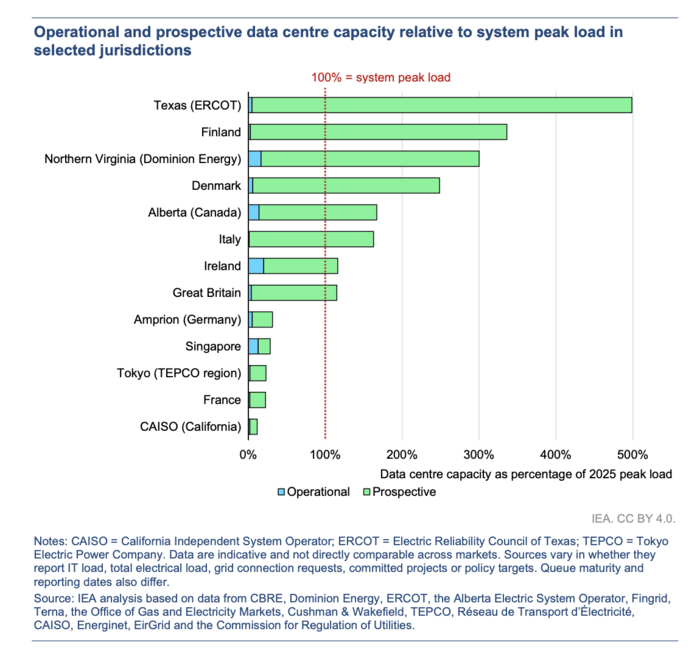
Data-center pipelines relative to 2025 system peak load. Definitions, project maturity and reporting dates differ across jurisdictions; these figures are indicative and not directly comparable. Source: IEA, Powering Artificial Intelligence (2026), p. 18, CC BY 4.0. Source: Maeil Business Newspaper.
Published on October 14, 2026, as noted in coverage of its release, <em>Powering Artificial Intelligence</em> was prepared at the request of France’s presidency of the Group of Seven major economies. The IEA surveyed 34 policy jurisdictions covering about 90% of global data-center capacity. Its recommendations express the IEA Secretariat’s views, rather than a binding G7 agreement or the position of every member government. The analysis follows its 2025 Energy and AI report and a 2026 update, moving from the demand outlook to the practical rules governing connections, power supply and operations.
The agency identified 134 policies and regulations, nearly 40% announced or implemented in the preceding 12 months. The largest area of activity concerns making future demand visible—its size, timing and location—rather than managing data centers once they are operating, according to the executive summary.
The stakes are substantial. The IEA estimates that the largest operators, known as hyperscalers and typically major cloud or digital-service providers, will spend more than $700 billion in capital expenditure in 2026, mostly on new data centers. Governments seeking AI infrastructure for innovation and digital sovereignty must weigh those investments against pressure on electricity bills, equipment supplies, water and local communities.
The agency’s earlier 2026 demand outlook projected global data-center electricity consumption rising from 485 terawatt-hours in 2025 to 950 TWh in 2030, about 3% of global electricity demand by then. The 2030 figure is a central projection, distinct from the capacity developers have requested permission to connect. It covers all data centers, including conventional cloud computing, rather than AI alone. The outlook also says investments have become too large to fund from company balance sheets alone: dependence on capital markets makes the pace of expansion sensitive to financing conditions and expectations of AI returns.
Connection pipelines in Texas, Northern Virginia, Finland and Great Britain illustrate the planning problem. The IEA estimates that at least 180 GW of data-center projects at advanced stages of development were waiting in connection queues globally as of May 2026. That excludes early-stage requests and projects deemed unlikely to materialize. But the full report cautions against directly comparing its jurisdictional figures: the underlying sources variously measure IT load, total electrical load, connection requests, committed projects or policy targets, with different reporting dates and project maturity.
A gigawatt (GW) measures power capacity; terawatt-hours measure electricity consumed over time. Neither a requested connection nor an announced campus establishes how much electricity a completed facility will use.
Developers can seek several possible connections before choosing a site. Even completed buildings take time to fill with servers and customer workloads. Treating every request as immediate, permanent demand can therefore overstate what networks need to build; dismissing the pipeline can leave genuine projects waiting. The IEA says projects can move from announcement to operation in two to three years, while network upgrades can take much longer.
Australia provides a concrete example. The Australian Energy Market Operator, which prepares electricity demand forecasts used in system planning, screened 44 GW of data-center connection requests for its demand forecast and judged 7.9 GW likely to proceed, using project status, connection progress, supporting evidence and checks for duplication. That is approximately 18% of requested capacity, calculated as 7.9 divided by 44. It is a screening result for that pipeline, not a global cancellation rate.
The policy response includes deposits, evidence of financial backing, progress milestones and rules that release unused capacity. Some jurisdictions are moving beyond first-come, first-served allocation toward project readiness and system or strategic value. These changes redistribute access to a scarce resource among data centers and other electricity users. The report also identifies a tension: demanding advanced permits before accepting a grid application can move the bottleneck elsewhere and deprive planners of early warning of future demand. The IEA warns that criteria must remain transparent and predictable, while stronger entry requirements should avoid unnecessarily excluding viable smaller developers.
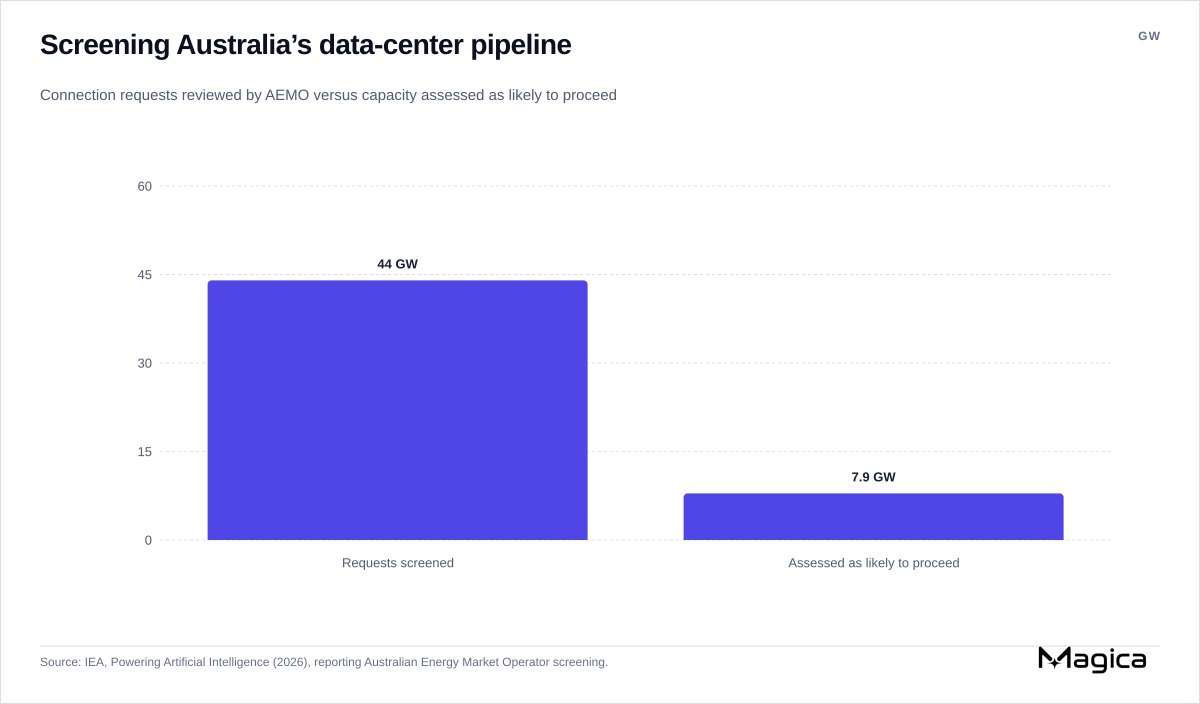
AEMO assessed 7.9 GW as likely to proceed from 44 GW of requests screened for its demand forecast. This assessment concerns that pipeline, not a global cancellation rate. Source: IEA. Source: IEA full report.
A data center’s effect on other customers’ bills depends on where it connects and what must be built. A facility using spare infrastructure and paying its share can spread fixed costs over more consumption. A facility requiring new lines, substations or generation can increase costs recovered from other users. A steady electricity load does not automatically confer a saving: it can still add to the system’s peak.
The distinction between dedicated assets and shared upgrades matters. A line serving one customer can usually be charged to that customer. Reinforcement benefiting several users requires a judgment about which costs the new connection caused and which investments would have been needed anyway.
In the United States, the IEA counted 24 states that had approved or were considering a large-load tariff as of August 2026, with proposals pending in six more. Such dedicated tariff classes remain less common elsewhere, where commitments are often attached to connection permissions instead.
Virginia offers one model for allocating the uncertainty. The GS-5 rate class for customers of electricity utility Dominion Energy Virginia, approved in November 2025 and effective in 2027, combines a 14-year contract with minimum charges based on 85% of contracted transmission and distribution capacity and 60% of generation capacity, plus exit fees and collateral. Its scope covers customers of at least 25 MW with a load factor of at least 75%, according to the IEA’s tariff comparison. A 75% load factor means average demand is three-quarters of peak demand. Paying against reserved capacity helps protect other users when actual consumption ramps up slowly.
These protections require joint calibration. A minimum payment may already recover costs that an exit fee or collateral requirement also covers. The report argues that existing consumers should be protected without making a large load pay substantially more than the costs and risks attributable to it. A tariff package can shift risk without reducing the underlying construction cost. Nor does allocating network costs settle the entire bill: additional demand can increase wholesale energy prices and payments for reliable generation capacity before any new grid construction occurs. Tax incentives and public subsidies can further change who ultimately pays.
Siting is one alternative to reinforcing a congested location. Capacity maps and prepared sites can direct projects toward available infrastructure, but workloads differ: large-scale AI training and batch inference—running trained models on jobs that do not need an immediate response—are generally easier to locate far from users than latency-sensitive customer services.
Network upgrades short of new lines also matter. The IEA estimates that measures including reconductoring, dynamic line ratings and power-flow control could enable 450–700 GW of projects already at advanced stages in global connection queues. That potential spans different kinds of grid users and should not be added mechanically to estimates for flexible connections.
Conditional or non-firm connections allow the grid operator to limit consumption under defined circumstances, potentially connecting projects sooner. Phased access increases capacity as demand grows or network upgrades become available. The IEA estimates that non-firm agreements could unlock 750–900 GW of grid hosting capacity globally; that is a broader grid potential, not a forecast of additional AI facilities.
The commercial obstacle is control over expensive computing assets. Colocation providers may operate a building while tenants control the workloads, leaving the provider unable to promise reductions. The report estimates annual rental costs for AI-optimized compute capacity at as much as $20 billion–$30 billion per GW, around 100 times the equivalent capacity cost of a battery. That comparison concerns capacity costs, rather than a measured loss from each hour of curtailment, but explains why cheaper electricity alone may offer an inadequate incentive. Earlier grid access can be more valuable.
Flexibility can also come from batteries, backup supply or other resources without stopping all computing. It needs enforceable terms specifying when reductions occur, their duration, measurement and consequences for nonperformance.
Operational behavior also matters independently of flexibility. The IEA says a transmission fault in Northern Virginia in July 2026 caused 3.8 GW of data-center demand to transfer to backup supply, requiring immediate corrective action by the grid operator. Outages were avoided, but such simultaneous demand losses can worsen grid disturbances. Several jurisdictions are developing technical requirements for facilities to remain connected through short disturbances and restore demand in a controlled way.
On-site generation offers another route, with limitations. The report puts the global pipeline of natural-gas generation intended for data centers at around 210 GW, including roughly 190 GW at the proposal stage and 17 GW under construction. Most of that pipeline is in the United States, and it is not a forecast of completed capacity. Turbine shortages, reliability requirements and eventual connections to the wider grid complicate claims of independence. The IEA estimates that reliably serving a continuous 1 GW data-center load with gas turbines could require 1.3–1.7 GW or more of generation. Fully isolated sites remain exceptionally rare. Greater use of on-site gas also contributes to the IEA’s central scenario in which electricity-related data-center emissions rise from around 150 million tonnes of CO2 currently to about 350 million tonnes in 2035.
Gas is only one procurement route. Operators also signed 45 TWh of power purchase agreements in the first half of 2026, nearly 20% more than a year earlier, according to the IEA’s executive summary. Such contracts link customers financially to generation; they usually do not physically isolate a facility from the wider grid. Interest in advanced geothermal, storage and small modular nuclear reactors is growing, though the report does not expect commercial operation of those reactors until the 2030s.
Efficiency remains a complementary tool. Better equipment and appropriate model selection can moderate demand growth, while cooling choices must account for both electricity and water use. Concentrated, costly campuses also face physical hazards and insurance gaps, adding another reason to assess location before committing infrastructure.
The report maps emerging approaches rather than establishing that they work. Many measures are too recent for outcomes to be assessed. Governments still need evidence of which projects connect, how their demand ramps up, whether flexibility performs during actual grid stress and how much infrastructure cost falls on each customer group.
That requires information from both sides: developers must disclose credible schedules and load profiles, while network operators must make capacity constraints and connection terms clearer. Regulators then need to assess deposits, tariffs, contracts and exit provisions together. A near-term test is the audit of data-center requests at the Electric Reliability Council of Texas, the operator of most of the state’s grid. It expects to finish checking roughly 300 projects by December 10, according to reporting on the audit. That will provide a concrete check on the queue’s credibility. The broader test is whether commitments survive construction delays and slower demand ramp-up without leaving other users to fund idle assets—or blocking viable projects with excessive safeguards.
Five technology groups have accumulated an estimated $3.2 trillion in future purchase and lease commitments. Filings show the funding pressure, but broad spending categories, long payment schedules and a methodology change limit what the total says about AI debt and growth.
PwC finds growth in a subset of AI-exposed junior job postings demanding senior skills, alongside pressure on entry-level opportunities. Workplace research suggests AI can support learning, but leaves employers to demonstrate how recruits acquire independent expertise.
CoreWeave bonds fell after the election of candidates favoring data center restrictions. Texas governor-elect Gina Hinojosa wants to extend an existing approvals pause until lawmakers pass protections, adding delivery uncertainty for an industry whose expansion depends on power and financing.

Walmart plans new permissions and a gateway for outside shopping agents, while Amazon blocks unauthorized tools and sells ads through its own assistant. The stakes are product discovery, customer data and whether delegated purchases add sales or displace advertising opportunities.
Apple reportedly cut some engineers’ daily AI allowances from $300 to $200 in October and is weighing deeper restrictions. The limits tighten control over model use, but unused allowances make the savings uncertain.
Factory is acquiring coding-agent collaboration platform HumanLayer after raising $200 million in September. It plans to integrate shared tasks and planning tools, while HumanLayer promises open source, refunds and at least 30 days of continued service.
A minister identifies Google-commissioned research behind the action plan’s £400 billion AI claim. The government’s central estimate is £120 billion, but different methods and adoption assumptions prevent a straightforward forecast-cut comparison.
Research has separated language models’ detection of altered internal activity from their ability to identify its content. Mechanistic studies and skeptical controls leave the interpretation disputed—and one intervention that improved detection made other measures of self-knowledge worse.
Three watchdog groups seek to halt Project Meridian, alleging that its contractor-heavy membership and closed meetings violate federal advisory committee law. MITRE’s invitation for outside ideas complicates the dispute over public participation.
Meta is seeking up to €9 billion in its first euro bond sale, drawing record orders while offering wider spreads than Alphabet. Its advertising business and large liquid reserves cushion an AI investment push that has overtaken quarterly operating cash flow.
Pangram is expanding its text-detection business into images and video. Browser checks and developer access broaden its reach, while company benchmark scores leave real-world error rates and costs unresolved.
About two dozen restrictive data center measures appeared to pass in initial returns. Texas governor-elect Gina Hinojosa’s promised construction pause adds a state-level constraint, though the capacity ultimately delayed remains uncertain.
Riot Platforms says its 15-year Corsicana lease with Anthropic will generate about $28 billion in revenue. The tenant owns and operates the compute, while Riot develops power infrastructure and funds module reimbursements through debt or credits against future rent.
Sonos plans limited U.S. early access for its conversational assistant, with a reported November 6 start. Users can return to older voice controls—a choice that also separates local audio processing from the new assistant’s cloud processing.
Tesla, SpaceX and AI infrastructure shares fell after Democratic election wins, while broader stocks rallied. Texas governor-elect Gina Hinojosa’s proposed data center pause puts a major construction pipeline in focus, but Republicans retain control of the Texas Legislature and federal agencies.
Capital One Ventures leads Sentra’s $150 million Series C and gains a board seat as the company expands AI-agent data controls. Sentra reports roughly 100 major enterprise customers and revenue in the tens of millions, but exact revenue, valuation and comparative costs remain undisclosed.
Google agreed to support Anthropic’s lease obligations at TeraWulf’s Kentucky campus, strengthening its bid for project financing. The support starts after delivery milestones, while debt terms and a guaranteed construction price remain unsettled.
OpenAI plans to acquire Pierre Computer and integrate its Code Storage service into Codex. The purchase would extend an existing supplier relationship into code infrastructure, but its terms, customer economics and relationship to OpenAI’s own Pando system remain unresolved.
OpenAI says India leads ChatGPT’s markets by weekly active users. Earlier free offers, strong app engagement and planned enterprise deployments explain the stakes, but the company has not disclosed comparable paid-user or revenue figures.
A national exit poll found broad opposition to new local data centers and a Democratic tilt among voters who prioritized AI. But the issue ranked below four other tested concerns, industry-backed candidates also won, and the next fight is over siting and power costs.