Editorial Team
8 min read
Alibaba targets 30%–45% cloud revenue growth next fiscal year and may reduce its long-term capacity plan. Domestic chips underpin its unchanged 2030 revenue ambition, but production, funding and customer allocation remain critical tests.
Alibaba, the Chinese e-commerce and cloud computing group, may reduce its long-term computing-capacity target and capital spending plan as new export controls constrain its infrastructure options. On its November 19 earnings call, management put its cloud revenue growth target for the next fiscal year at 30%–45%, while retaining its calendar 2030 ambition of $100 billion in external cloud revenue.
The company is betting that its own chip supply chain can sustain that longer-term growth with a potentially smaller infrastructure buildout. The immediate question is how quickly those chips can reach customers: Alibaba says its own model development gets first call on its flagship chips, and its heaviest investment period still lies ahead.
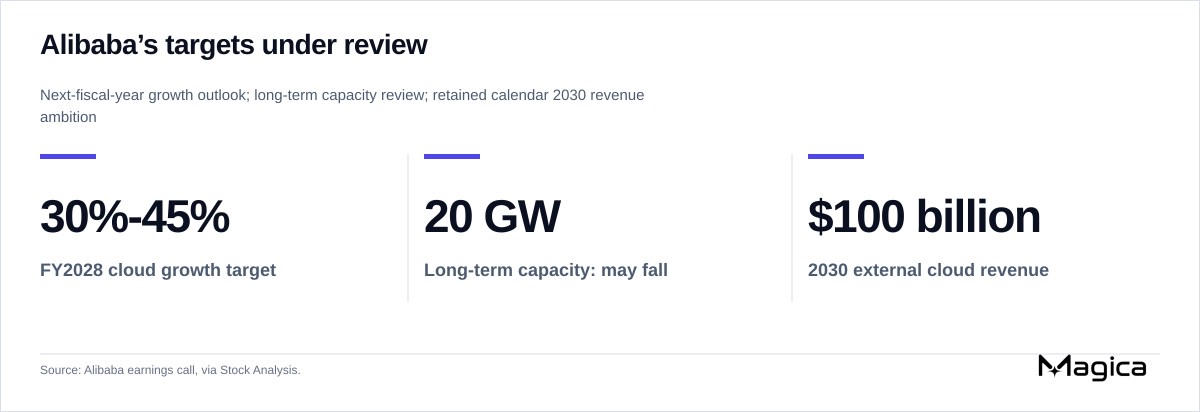
Company-reported targets: Alibaba may reduce its long-term capacity goal while retaining its 2030 external cloud revenue ambition. Source: Stock Analysis.
Management said in the September-quarter earnings call transcript that new compute export-control rules would affect next year's products and services and introduce substantial supply-chain uncertainty. Its Chinese-language response specifies the next fiscal year for the 30%–45% growth range; the question identifies that period as fiscal 2028. Alibaba said its operating plan was still being evaluated.
The policy change reaches beyond physical chip shipments. The U.S. Commerce Department's Bureau of Industry and Security said in its November 16 announcement that a new interim final rule addresses remote access to advanced chips and servers. Its stated purpose is to prevent existing technology restrictions from being circumvented through computing arrangements involving data centers in third countries. Alibaba said it needed more information to assess the full product and financial effects of the new rules.
The outlook follows accelerating growth in the September 2026 quarter, Alibaba's second quarter of fiscal 2027. The company reported three distinct measures:
| Cloud revenue measure | September 2026 quarter | Year-over-year growth |
|---|---|---|
| AI Cloud and compute services, total | CNY 61 billion | 53% |
| Revenue from external customers | CNY 47 billion | 64% |
| External recurring revenue, excluding compute equipment solutions | CNY 37 billion | 67% |
These categories overlap and should not be added together. Management's 30%–45% outlook referred broadly to cloud revenue, rather than providing separate forecasts for each measure.
AI-related product revenue reached CNY 17.9 billion, with triple-digit growth for the 13th consecutive quarter, according to the company. But management also said recent model releases from Alibaba and its partners had lagged expectations, affecting model-as-a-service revenue development. Hardware supply is therefore only part of its account of the near-term outlook.
Alibaba said domestic-compute development was ahead of its original expectations. As those products expand, it expects cloud revenue growth to return to at least 50% in calendar 2028. It also retained its calendar 2030 target of $100 billion in external cloud revenue and an EBITDA margin above 20%. Those remain company forecasts, not demonstrated returns from the chip transition.
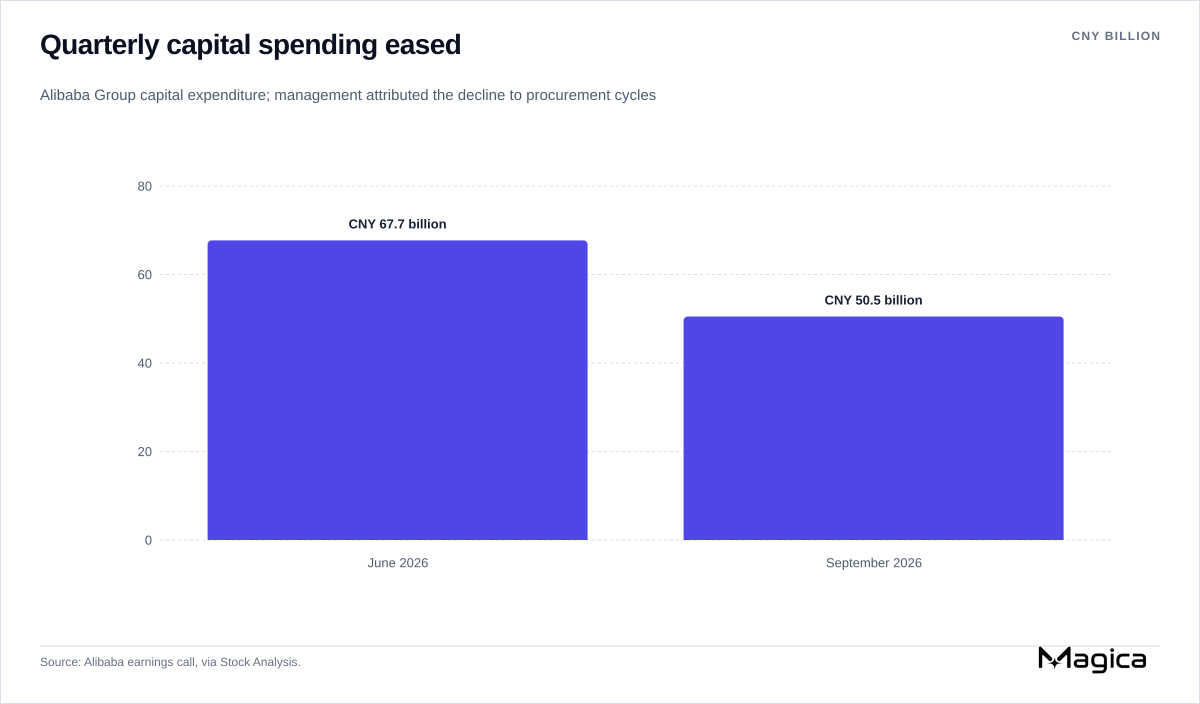
Company-reported quarterly capital expenditure. Alibaba attributed the sequential decline to procurement cycles. Source: Stock Analysis.
Alibaba's preliminary assessment pointed to a possible reduction in its long-term 20 GW computing-capacity target, with an associated reduction in overall capital expenditure. It did not disclose a replacement capacity target or quantify the spending change.
That review follows its February 2025 commitment to invest at least RMB 380 billion over three years in cloud and AI infrastructure. Alibaba said that exceeded its spending in those areas over the preceding decade. The latest call did not establish a revised figure for that particular pledge.
For the September 2026 quarter, group capital expenditure was CNY 50.5 billion, down from CNY 67.7 billion in the preceding quarter. Alibaba attributed the sequential decline to procurement cycles, rather than a newly implemented cut to its long-term plan. It said higher chip-component prices and additional CPU capacity for anticipated AI-agent demand contributed to the year-over-year increase in spending.
Group free cash flow was negative CNY 34.5 billion, compared with negative CNY 21.8 billion a year earlier, though the outflow narrowed from CNY 44.7 billion in the preceding quarter. The company attributed the annual deterioration mainly to cloud infrastructure investment, partly offset by reduced quick-commerce losses and higher cloud customer prepayments.
There is a financial cushion: Alibaba reported a net cash position of $32.9 billion at September 30, up from $30.7 billion in the preceding quarter. That does not remove the investment burden. Management expects its heaviest sustained investment period to run through 2027 and the first half of 2028, with positive overall cash flow targeted for the second half of calendar 2028. It did not promise an earlier turnaround following a capacity reduction.
Central to the plan is T-Head, Alibaba's wholly owned data-center chip subsidiary, whose portfolio spans graphics processors, CPUs, storage and networking chips. Alibaba said supernode instances powered by T-Head's Zhenwu M890 had been launched in August and were now being commercialized at scale.
The next production milestones are still prospective. Alibaba expects mass production of the next-generation Zhenwu V900 in the first quarter of calendar 2027, followed by commercial-scale supernode clusters in the second quarter. Its Qwen family of AI models is already using T-Head chips to train its next generation, the company said.
That creates an allocation choice. Management said its flagship chips would first support its own foundation-model training and iteration, followed by important partners and customers. It also plans to buy chips from other domestic suppliers for inference—the execution of trained models. Owning the chip business gives Alibaba influence over allocation, but does not establish how much training capacity external customers will receive.
A proposed listing could broaden T-Head's financing options. Alibaba's November 10 filing disclosed a confidential Hong Kong listing application submitted on September 11, 2026. Alibaba expects T-Head to remain a subsidiary after the proposed offering.
Alibaba said a separate listing could help investors value T-Head independently and give the chip business direct access to equity and debt markets. But the offering's size, structure and resulting reduction in Alibaba's ownership were not finalized. The transaction still requires approvals and company decisions; the filing gives no assurance that it will happen or when. It is therefore a potential financing route, rather than a quantified source of funding for the capacity ramp-up.
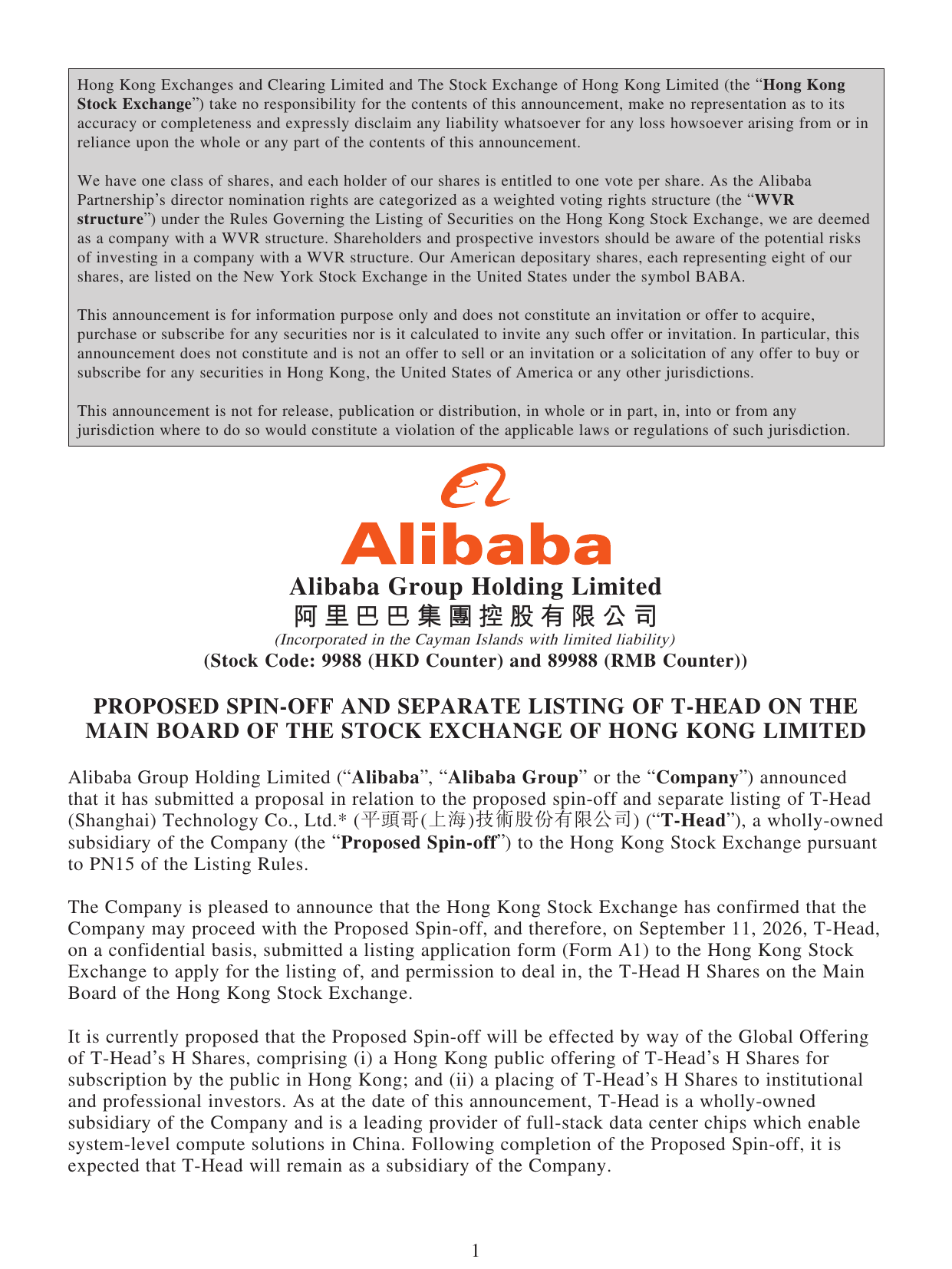
Alibaba’s November 10 filing disclosed T-Head’s confidential listing application. The proposed offering remains subject to approvals and company decisions. Source: Alibaba Group T-Head listing filing.
Management sees a commercial benefit in tight supply: it said scarcity strengthens its bargaining position on prices. It also argued that customers using more Alibaba products face higher switching costs, while integrated chips, models and cloud services make direct price comparisons harder. These are Alibaba's explanations for better margins and its competitive position; the call supplied no like-for-like customer cost comparison proving those advantages.
Alibaba enters the transition from an established position. Research firm Omdia estimated that it held 34% of mainland China's cloud infrastructure services market in the second quarter of 2025, compared with Huawei Cloud's 17% and Tencent Cloud's 10%. Those are historical market estimates, not current shares or measures of available AI training capacity.
The same research describes Huawei Cloud's CloudMatrix computing architecture and enterprise agent platform, and Tencent Cloud's model and agent-development offerings. Integration is consequently a competitive strategy pursued by several providers. The research does not establish whether those services can replace particular Alibaba workloads or offer lower deployment costs.
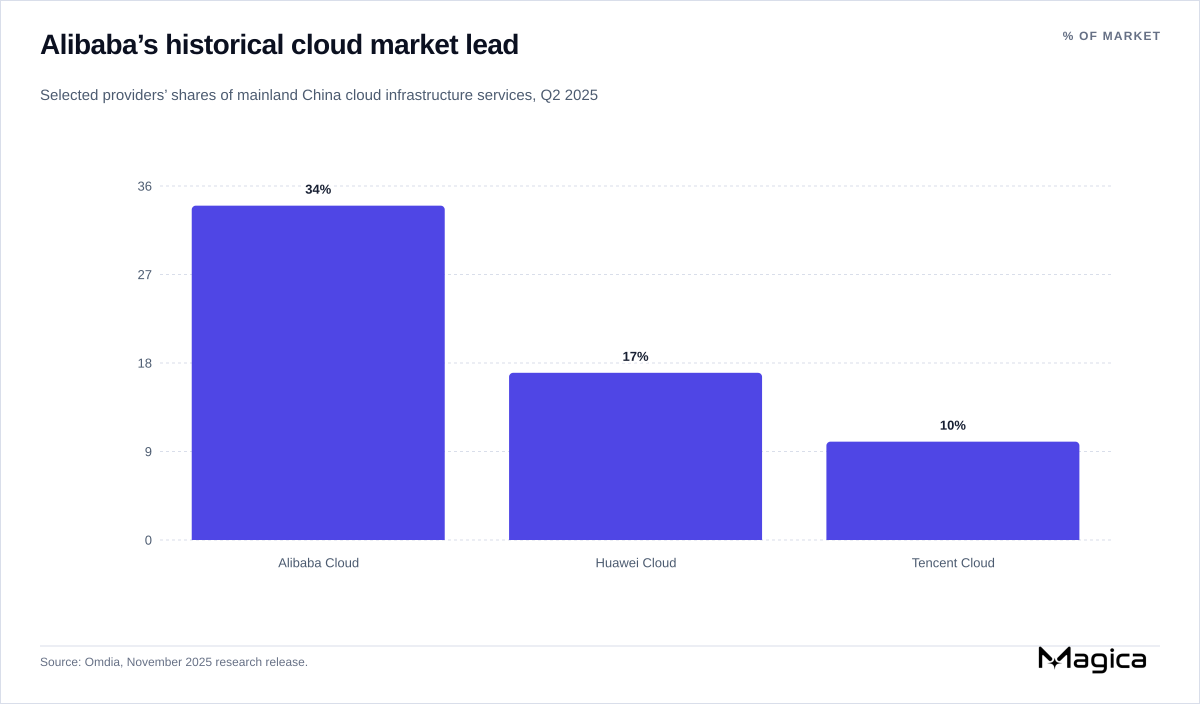
Omdia’s historical Q2 2025 estimates for selected providers; these shares do not measure available AI training capacity. Source: Omdia market research.
Alibaba's roadmap now needs to become production capacity, customer deployments and cash returns. The call provided chip launch milestones, but no revised gigawatt target, quantified capital budget reduction or production volumes that would establish the scale of the replacement supply.
Overseas growth adds another allocation decision. Alibaba said it operates 109 availability zones across 32 regions and is evaluating partnerships and, eventually, exports of its own chips to support overseas AI services. It said chip exports would follow satisfaction of domestic demand.
The next evidence that matters is how much compute reaches paying customers after Alibaba's own training needs, on what schedule and at what cost. That will test whether a reduced capacity plan can still support the revenue targets management has retained—and whether the investment cycle eases on its projected 2028 timetable.
Anthropic raised $81.3 billion in a record IPO and opened 34% above its offer price before retreating. Rapid revenue growth and adjusted operating profits sit alongside vast computing commitments and limited investor control.
The Kimi developer reportedly abandoned planned Nvidia B300 capacity for 2027 after new US restrictions. The deal exposes financing risks for overseas AI clouds, but neither a model delay nor a $150 million cash loss is established.
Kong is expanding from API management into hosting AI agents and applications. Volcano bundles backend services with a LavaFlow repair preview, but human review, plan restrictions and deployment controls narrow its autonomous-software pitch.
Anthropic's pre-debut price indications reached $105, about 26.5% above its offer price, after an $81.3 billion IPO. Strong demand for the Claude maker confronts enormous computing commitments and a governance structure that limits ordinary shareholders' influence.
Google has booked New Glenn for a dedicated Project Suncatcher launch in early 2029. Laboratory tests support parts of its orbital AI design, but deployment, launch reliability and commercial economics remain unproven.
Canva is rolling out free controls for Free and Pro accounts to disable supported generative AI tools and reduce AI-made assets in search. The settings extend individual choice while leaving AI enabled by default and preserving the company's investment in generation.
Singapore’s central bank plans a common protocol for financial institutions to assess customer AI agents, alongside a sandbox for treasury and payments. Its digital settlement network has completed a S$100 million bill issuance, but wider adoption, cost savings and agent accountability remain unresolved.
Jeff Bezos says Prometheus tools are in private trials, including two Blue Origin projects. Its claims of faster design now face the harder test of manufacturing gains, as rivals automate existing engineering workflows.
The IEA projects data-center electricity demand reaching 1,000 terawatt-hours annually by 2030, but connection queues, equipment shortages and local opposition could limit how much of the investment boom gets built.
European individuals secured about $1.1 billion of Anthropic shares, roughly 1.4% of the public offering’s value. The UK offer combines broad participation with rationing, while the AI lab’s governance and compute commitments define what investors are buying.
Federal prosecutors accuse Igor D’iu of acting for Russia to surveil employees of a Silicon Valley defense technology company identified in reports as Palantir. An FBI affidavit describes screen photographs, employee dossiers and $45,000 in reported payments, but leaves the handlers’ identities and the success of attempted electronic collection unresolved.
Alibaba’s September-quarter profit more than tripled as investment gains and a commerce recovery amplified stronger cloud earnings. Cloud revenue rose 53%, but AI application losses widened and infrastructure spending left free cash flow negative. A large share placement bolstered liquidity.
President Donald Trump rejected international restrictions on advanced AI at APEC. His administration has already outlined voluntary cybersecurity cooperation, alongside deregulation and support for American AI exports and infrastructure.
London-based LATO has raised $4.7 million to expand AI agents that interview customers and experts for investment research. Its early traction claims come as rivals offer similar research workflows and Salesforce absorbs Listen Labs; comparative cost and quality remain unproven.
Snap’s free Easy Lens CLI connects AI coding assistants to Snapchat’s AR creation and publishing workflow. It builds on earlier prompt-based tools as TikTok offers a competing approach.
Nvidia’s first earnings report since Jensen Huang’s departure showed revenue more than doubling, but shares fell 2.9%. Interim CEO Colette Kress faces a permanent leadership search, lower forecast margins and expanding infrastructure commitments, including conditional guarantees.
Needham’s $150 target stands about 81% above Anthropic’s $83 IPO price, versus Morningstar’s $92 fair-value estimate. Rapid enterprise growth and fresh financing support the business, but pricing power, compute commitments and shareholder control complicate the investment case.
A cyberattack disrupted access to European Commission payslips, leave management and medical reimbursements. The HR platform is back online, while the health insurance system remains unavailable and the extent of any staff data theft is unknown.
Waymo suspended Bay Area service during the November 18 storm after reports of robotaxis obstructing flooded streets, raising questions about how it withdraws its fleet when road conditions deteriorate.
Lenovo reported record quarterly revenue of $30.2 billion as its infrastructure business swung into profit. A $1.91 billion noncash warrant charge drove a reported loss, while expanding inventories and overdue receivables raised the stakes for cash collection.