Editorial Team
4 min read
President Donald Trump rejected international restrictions on advanced AI at APEC. His administration has already outlined voluntary cybersecurity cooperation, alongside deregulation and support for American AI exports and infrastructure.
U.S. President Donald Trump rejected what he called “globalist regulation” of advanced artificial intelligence at the Asia-Pacific Economic Cooperation summit in Shenzhen, China, on November 19. The president, whose administration had already launched an AI deregulation and export agenda in July 2025, said the technology's risks required care but opposed measures that would “control or stifle” its development, according to an account of the plenary session.
His remarks reinforce a preference for limiting regulatory barriers, rather than announce a new AI rule. They also need to be read alongside a more recent policy: in June, the White House described an executive order directing voluntary cooperation with developers on frontier-model cybersecurity and enforcement against AI-enabled crimes.
APEC is a regional economic cooperation forum whose members reaffirmed its voluntary, nonbinding and consensus-building principles in their 2025 ministerial statement. A speech there signals the U.S. negotiating position; it does not itself change an international legal obligation.
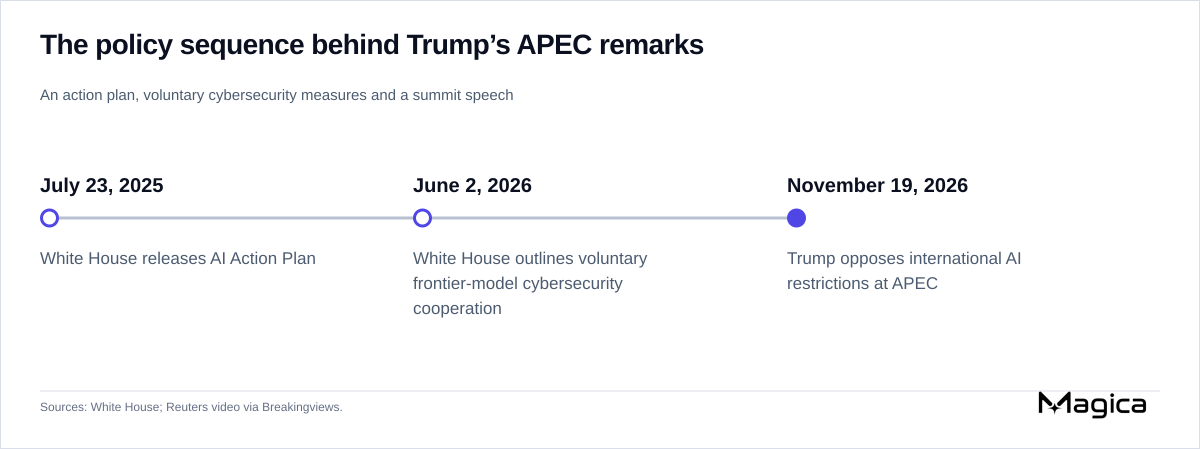
The administration’s AI action plan and voluntary cybersecurity approach preceded Trump’s rejection of international AI restrictions at APEC. Source: White House.
A video transcript of the speech records Trump opposing “any form of globalist regulation.” That transcript was generated with AI and carries an error warning, but the separate plenary account also describes his rejection of restrictions on frontier AI models.
The plenary account supplies relevant history: Trump has repeatedly opposed official regulation of those models, arguing that existing U.S. laws go far enough. His acknowledgment of risks therefore does not necessarily imply support for a new regulatory regime.
Anthropic raised $81.3 billion in a record IPO and opened 34% above its offer price before retreating. Rapid revenue growth and adjusted operating profits sit alongside vast computing commitments and limited investor control.
Calling the technology “superintelligence,” Trump said:
“It's almost completely good, but it's got some bad elements, and we have to be very careful in managing those bad elements.”
That wording is recorded in the plenary account. It is a political characterization, not evidence that the models have reached a particular technical capability. The reported remarks do not identify a specific international proposal being rejected or define the harms he wants managed.
In its June 2, 2026 fact sheet, the White House said Trump had signed an executive order calling for classified benchmarks of advanced AI cyber capabilities and a voluntary framework giving trusted partners secure early access to covered frontier models for cybersecurity.
The order also directed the attorney general to prioritize enforcement against AI-enabled computer crimes and other criminal activity. The White House said the order did not authorize mandatory government licensing, preclearance or permitting of AI models.
These directions establish a proposed approach, rather than demonstrate participation or effectiveness. They also make the question more specific: how much risk can voluntary cooperation and existing law address?
The earlier America's AI Action Plan announcement, issued on July 23, 2025, paired the removal of federal regulatory barriers with faster permitting for data centers and semiconductor fabrication plants. It also proposed workforce initiatives for occupations including electricians and heating, ventilation and air-conditioning technicians—recognition that expansion requires physical infrastructure and skilled workers.
The White House said the Commerce and State departments would partner with industry to deliver AI export packages to American friends and allies, encompassing hardware, models, software, applications and standards. It also proposed procurement guidelines requiring government suppliers of frontier large language models to satisfy its criteria for objectivity and freedom from ideological bias.
That is an active government role in overseas deployment and purchasing, alongside the effort to reduce regulation. The announcement establishes the administration's intended instruments; it does not establish delivered export packages, additional computing capacity, deployment costs or a competitive advantage over foreign alternatives.
The infrastructure agenda also faces domestic concerns. A separate account of the summit speech describes voter unease about AI's effects on jobs amid data-center expansion. That reported concern complicates the president's overwhelmingly positive presentation of the technology, without establishing the scale of employment effects.
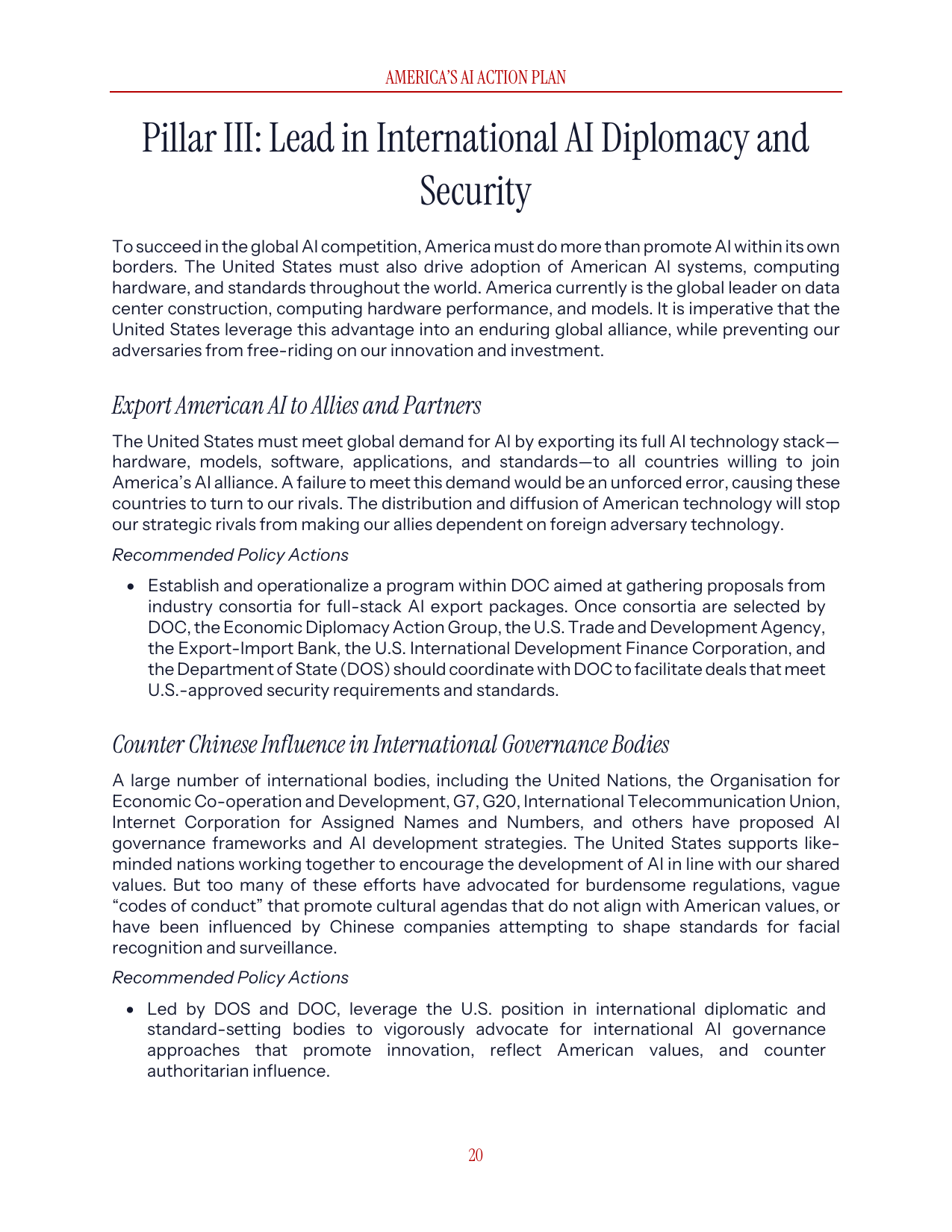
The White House’s July 2025 AI Action Plan recommends federal coordination for full-stack AI export packages; it does not document completed deployments. Source: White House.
The speech adds no detailed replacement for international restrictions. The sharper test is how the administration applies the tools it has already described: voluntary access to covered frontier models, criminal enforcement, procurement conditions and support for AI exports.
For developers, overseas customers and people exposed to AI harms, the evidence that matters next is whether those mechanisms secure participation, identify and reduce risks, and leave room for cooperation across borders. Trump's rejection of international curbs is clear. The scope and effectiveness of the safeguards he will accept remain to be demonstrated.
The Kimi developer reportedly abandoned planned Nvidia B300 capacity for 2027 after new US restrictions. The deal exposes financing risks for overseas AI clouds, but neither a model delay nor a $150 million cash loss is established.
Kong is expanding from API management into hosting AI agents and applications. Volcano bundles backend services with a LavaFlow repair preview, but human review, plan restrictions and deployment controls narrow its autonomous-software pitch.
Anthropic's pre-debut price indications reached $105, about 26.5% above its offer price, after an $81.3 billion IPO. Strong demand for the Claude maker confronts enormous computing commitments and a governance structure that limits ordinary shareholders' influence.
Google has booked New Glenn for a dedicated Project Suncatcher launch in early 2029. Laboratory tests support parts of its orbital AI design, but deployment, launch reliability and commercial economics remain unproven.
Canva is rolling out free controls for Free and Pro accounts to disable supported generative AI tools and reduce AI-made assets in search. The settings extend individual choice while leaving AI enabled by default and preserving the company's investment in generation.
Alibaba targets 30%–45% cloud revenue growth next fiscal year and may reduce its long-term capacity plan. Domestic chips underpin its unchanged 2030 revenue ambition, but production, funding and customer allocation remain critical tests.
Singapore’s central bank plans a common protocol for financial institutions to assess customer AI agents, alongside a sandbox for treasury and payments. Its digital settlement network has completed a S$100 million bill issuance, but wider adoption, cost savings and agent accountability remain unresolved.
Jeff Bezos says Prometheus tools are in private trials, including two Blue Origin projects. Its claims of faster design now face the harder test of manufacturing gains, as rivals automate existing engineering workflows.
The IEA projects data-center electricity demand reaching 1,000 terawatt-hours annually by 2030, but connection queues, equipment shortages and local opposition could limit how much of the investment boom gets built.
European individuals secured about $1.1 billion of Anthropic shares, roughly 1.4% of the public offering’s value. The UK offer combines broad participation with rationing, while the AI lab’s governance and compute commitments define what investors are buying.
Federal prosecutors accuse Igor D’iu of acting for Russia to surveil employees of a Silicon Valley defense technology company identified in reports as Palantir. An FBI affidavit describes screen photographs, employee dossiers and $45,000 in reported payments, but leaves the handlers’ identities and the success of attempted electronic collection unresolved.
Alibaba’s September-quarter profit more than tripled as investment gains and a commerce recovery amplified stronger cloud earnings. Cloud revenue rose 53%, but AI application losses widened and infrastructure spending left free cash flow negative. A large share placement bolstered liquidity.
London-based LATO has raised $4.7 million to expand AI agents that interview customers and experts for investment research. Its early traction claims come as rivals offer similar research workflows and Salesforce absorbs Listen Labs; comparative cost and quality remain unproven.
Snap’s free Easy Lens CLI connects AI coding assistants to Snapchat’s AR creation and publishing workflow. It builds on earlier prompt-based tools as TikTok offers a competing approach.
Nvidia’s first earnings report since Jensen Huang’s departure showed revenue more than doubling, but shares fell 2.9%. Interim CEO Colette Kress faces a permanent leadership search, lower forecast margins and expanding infrastructure commitments, including conditional guarantees.
Needham’s $150 target stands about 81% above Anthropic’s $83 IPO price, versus Morningstar’s $92 fair-value estimate. Rapid enterprise growth and fresh financing support the business, but pricing power, compute commitments and shareholder control complicate the investment case.
A cyberattack disrupted access to European Commission payslips, leave management and medical reimbursements. The HR platform is back online, while the health insurance system remains unavailable and the extent of any staff data theft is unknown.
Waymo suspended Bay Area service during the November 18 storm after reports of robotaxis obstructing flooded streets, raising questions about how it withdraws its fleet when road conditions deteriorate.
Lenovo reported record quarterly revenue of $30.2 billion as its infrastructure business swung into profit. A $1.91 billion noncash warrant charge drove a reported loss, while expanding inventories and overdue receivables raised the stakes for cash collection.