Editorial Team
9 min read
Needham’s $150 target stands about 81% above Anthropic’s $83 IPO price, versus Morningstar’s $92 fair-value estimate. Rapid enterprise growth and fresh financing support the business, but pricing power, compute commitments and shareholder control complicate the investment case.
Anthropic, the developer of the Claude AI models and applications, heads toward its scheduled November 19 Nasdaq debut with a new $150 Buy target from brokerage Needham—about 81% above its $83 offer price. Other published valuations leave considerably less room, despite also anticipating strong growth.
The offering puts Anthropic at roughly $1.5 trillion on a fully diluted basis. Founded in 2021, according to its IPO prospectus, the company has built a rapidly expanding enterprise business around selling access to its models. The investment question is whether that business can sustain premium prices while financing the next generation of AI and the infrastructure to deliver it.
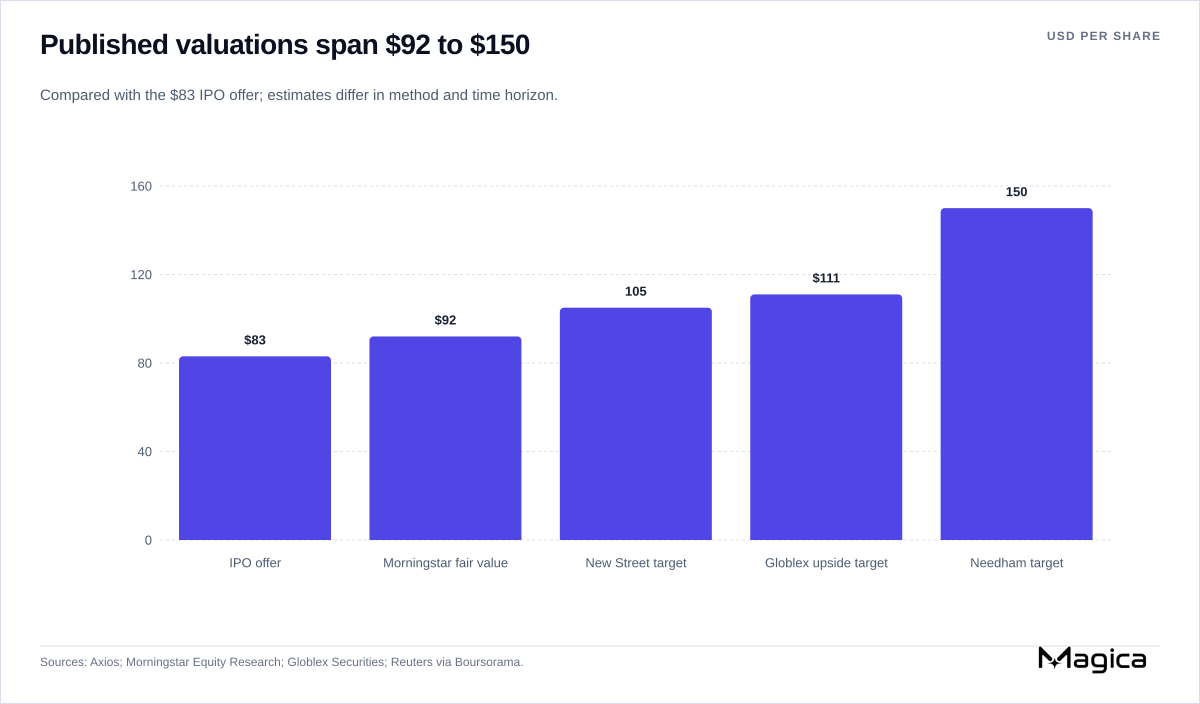
Magica comparison of published assessments and the IPO offer. Methods and horizons differ: Morningstar estimates fair value, New Street specifies 12 months, and Globlex uses its upside case before final pricing. Source: Axios.
Needham based its recommendation on economies of scale and premium brand strength in a competitive industry. Fellow research firm New Street Research had earlier initiated with a Buy and a 12-month $105 target, according to the pre-debut report. New Street forecasts revenue rising from $53 billion in 2026 to $505 billion in 2030; those are analyst projections, not reported sales.
Securities firm Globlex recommends buying at a $111 target, but explicitly bases that figure on stronger growth and cash generation than its base case. Independent investment research provider Morningstar’s November 12 analysis puts fair value at $92, with a narrow competitive moat and a Very High uncertainty rating. Its valuation uses discounted future cash flows; it is not a Buy rating or a promise of a near-term trading price.
| Research provider | Published assessment | Difference from $83 offer price |
|---|---|---|
| New Street Research | $105, 12-month target; Buy | About 27% higher |
| Globlex Securities | $111 target; Buy, using its upside case | About 34% higher |
| Needham | $150 target; Buy | About 81% higher |
| Morningstar | $92 fair-value estimate | About 11% higher |
The percentages are calculated as each published figure divided by $83, minus one. They compare assessments with the offer price, rather than an opening trading price, and do not make the estimates equivalent in method or time horizon.
Timing matters. The November 18 Globlex analysis still assumed pricing within a $70–$78 indicative range. Its advertised upside of about 42% used $78, not the eventual $83 price. Its base discounted-cash-flow valuation is about $90 a share, and it says it would wait for a better entry if shares traded materially above the IPO range.
Anthropic develops the underlying Claude models, sells access through an application programming interface and cloud platforms, and offers applications including Claude Code for software development and Cowork for delegated business tasks. Its commercial record has expanded rapidly: Globlex reports revenue of $386 million in 2024, $4.6 billion in 2025 and $33.2 billion in the first nine months of 2026.
The analysis, drawing on Anthropic’s figures, says customers generating at least $100,000 in trailing annual revenue rose from 1,500 at the end of 2025 to 11,900 in the third quarter of 2026. Of those customers, 1,900 generated more than $1 million and 250 more than $10 million. The top five customers’ share of revenue fell from 36% in the first quarter to 21% in the third, indicating a broader revenue base alongside its expansion.
Growth has nevertheless shown sensitivity to capacity and pricing. Third-quarter revenue reached about $17 billion, up 47% from the preceding quarter, after 144% sequential growth in the second quarter. The report says Anthropic attributed the slowdown to limited compute capacity, summer buying patterns, price cuts and tighter usage-rule enforcement. Customers subsequently found to have violated usage rules or commercial terms accounted for 5%–7% of nine-month revenue.
There is also evidence against treating that slowdown as a lasting trend. The same analysis says Anthropic’s revenue run rate rose from $71 billion on September 30 to $81 billion on October 31. That measure annualizes recent usage and subscription fees; it is not revenue already earned over a year.
Morningstar assumes 47% compound annual revenue growth over five years. Its bear- and bull-case fair values are $25 and $188 per share, respectively, reflecting different paths for adoption, model progress and available compute. Those are scenarios, not additional price targets. The analysis warns that the historical relationship between more resources and better AI capabilities could weaken. It also sees AI-assisted model research as a possible accelerator, while warning that safety failures could prompt pauses or regulation.
The competitive advantage remains contested even within the positive research. Morningstar credits research expertise and compute economics, but does not yet recognize switching costs as an established moat source. Customers with simple deployments can change providers relatively easily; consumption can fall quickly. Globlex similarly notes that enterprises using multiple models can route work to rival developers OpenAI or Google without moving their underlying data. Cheaper and open-weight models can handle routine tasks, while Cowork competes with tools bundled into Google and Microsoft products.
There are defenses beyond model quality. Morningstar says more than half of large customers use both the Claude platform and a first-party application. Long-running agents can also require model-specific tools and error handling that are costly to rebuild. Globlex reports Anthropic’s claim that Opus 5.5 reduced customers’ cost per task by about 40% against Opus 5 while preserving margins. That is a company claim about task economics, not evidence that every customer will keep paying a premium.
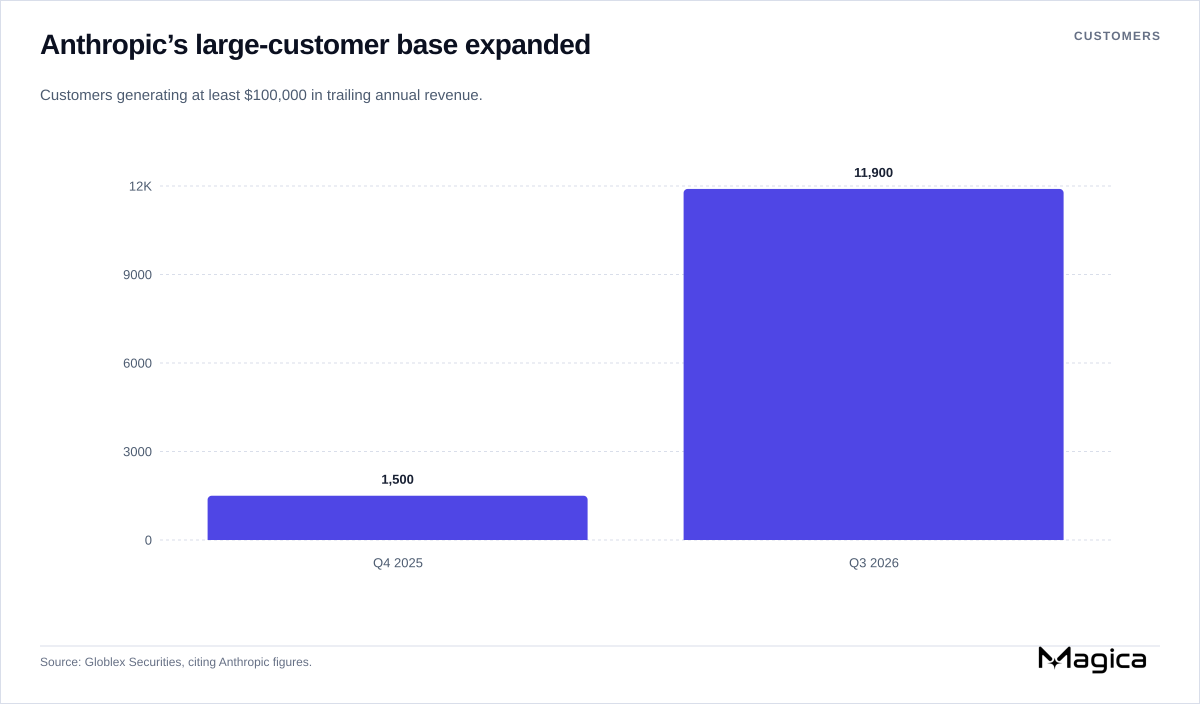
Company-reported customer counts, charted by Magica from Globlex’s analysis. Each customer generated at least $100,000 in trailing annual revenue for Anthropic. Source: Globlex Securities.
Usage generated 79% of revenue in the first nine months of 2026, while cloud marketplaces accounted for 44%, the Globlex analysis says. These describe different dimensions—billing model and distribution channel—and overlap. Cloud distribution brings customers but also fees. Morningstar highlights the structural conflict: cloud providers supply capacity while competing for the value created by AI. Variable customer consumption must support a largely fixed cost base.
Morningstar also identifies a potential cost advantage: Anthropic can route workloads across different suppliers’ chips, negotiate multiyear capacity deals at scale and improve training and inference efficiency. Through Anthropic Direct, the company plans to lease chips for dedicated facilities, potentially replacing expensive short-term capacity. The risk runs both ways: delayed capacity can constrain sales, while capacity arriving ahead of demand can depress margins.
The distinction between serving models and developing them is crucial. Globlex estimates an 85% gross margin for the first nine months, but says training and research sit outside that measure. It estimates that only 27% of first-half compute spending served paying customers; the remainder included model development, research and internal workloads.
Third-quarter compute and infrastructure costs reached $9.9 billion, including $5 billion of expensive short-term capacity. Adjusted operating margin fell from 19% to 15% even as adjusted operating income increased. Anthropic still recorded a $1.3 billion GAAP operating loss over the first nine months, alongside $6.6 billion of operating cash flow, according to Globlex.
The much larger nine-month GAAP net loss of $104 billion included $94.3 billion of noncash fair-value charges, mainly from convertible notes becoming more valuable as Anthropic’s valuation rose. It should not be read as equivalent cash consumption. The report also says Anthropic expected a separate $14.2 billion stock-based compensation charge at listing, calculated at the old $74 indicative midpoint. The adjusted profit figures exclude stock-based compensation and certain other charges.
The same report puts cash and short-term investments at about $132 billion on September 30, against $900.9 billion of purchase and lease commitments, mainly for compute and infrastructure. Of those commitments, $70.7 billion falls due in the following 12 months. The total spans many years, and some commitments are conditional or cancelable; it is not an immediately payable bill.
The IPO raised over $81 billion, according to the pricing report. Globlex also describes a concurrent $26 billion private placement involving strategic investors including Nvidia, Google and Microsoft. Fresh financing matters alongside operating cash flow: the company is funding a buildout before knowing how quickly demand will absorb it. Morningstar’s earlier analysis judges the balance sheet healthy and estimates that existing cash plus expected IPO proceeds could cover noncancelable compute commitments for about three years even if revenue growth stalled in 2027. That is its assessment, based on financing assumptions made before final pricing.
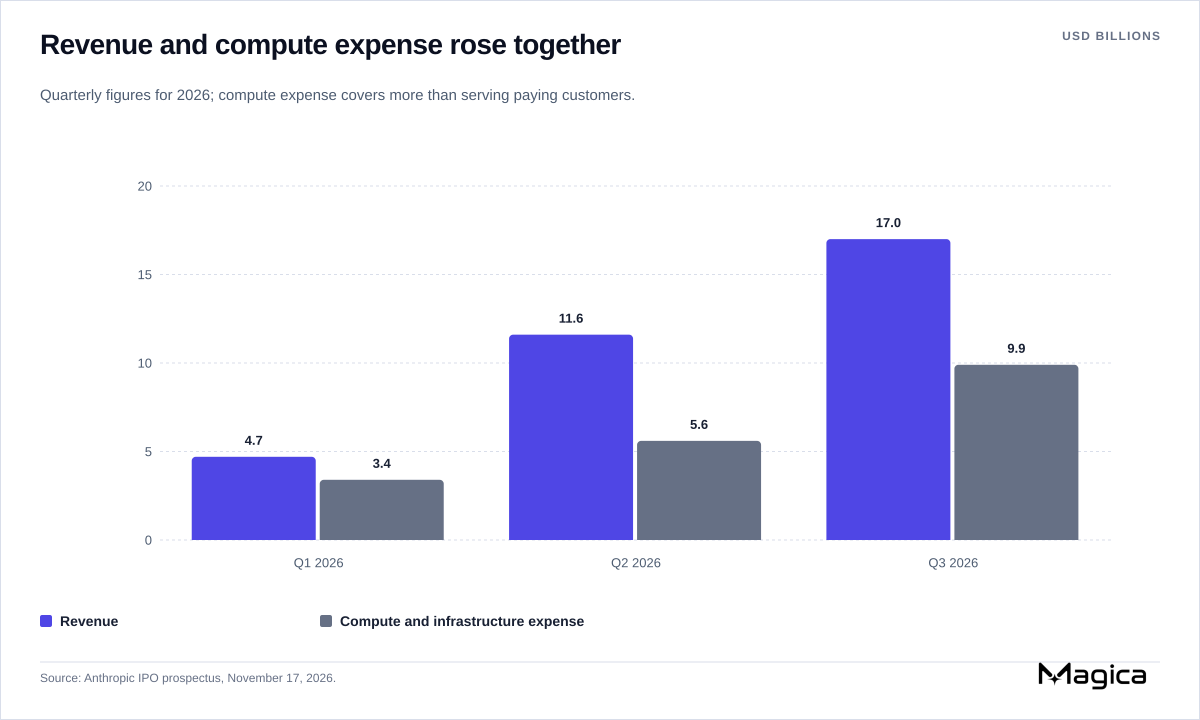
Company-reported quarterly revenue and compute and infrastructure expense, charted by Magica from Anthropic’s prospectus. Compute includes research, model development, serving customers and internal usage; the gap is not operating profit. Source: Anthropic IPO Prospectus.
The prospectus says the founders’ special share will carry 50.1% of voting power on matters submitted to shareholders generally, including elections of directors outside the trust’s remit. Separately, the Long-Term Benefit Trust can elect and remove directors constituting a majority of the board. General voting control and board appointment rights therefore need to be assessed separately.
Anthropic’s governance explanation describes the trust as an independent body designed to insulate trustees from financial interests in the company. Its purpose is to balance shareholder interests with the public consequences of advanced AI. Anthropic’s public benefit corporation structure gives directors latitude to consider those consequences alongside shareholder returns. The company says it does not expect the trust to intervene in ordinary commercial strategy; it also describes provisions allowing sufficiently large shareholder supermajorities to change the trust’s powers without trustee consent.
The next meaningful evidence is whether paid usage and cash generation grow fast enough to support the capacity buildout. Globlex’s upside case projects $256.7 billion of revenue and $21.2 billion of unlevered free cash flow in 2028, including investment in leased equipment. Its base case projects $200.6 billion of revenue that year and still-negative free cash flow.
That gap explains why a bullish view of Claude can coexist with caution about the shares. Investors need evidence that new capacity lowers delivery costs, customers keep expanding usage and model improvements retain pricing power. A strong debut alone would settle none of those questions.
Anthropic raised $81.3 billion in a record IPO and opened 34% above its offer price before retreating. Rapid revenue growth and adjusted operating profits sit alongside vast computing commitments and limited investor control.
The Kimi developer reportedly abandoned planned Nvidia B300 capacity for 2027 after new US restrictions. The deal exposes financing risks for overseas AI clouds, but neither a model delay nor a $150 million cash loss is established.
Kong is expanding from API management into hosting AI agents and applications. Volcano bundles backend services with a LavaFlow repair preview, but human review, plan restrictions and deployment controls narrow its autonomous-software pitch.
Anthropic's pre-debut price indications reached $105, about 26.5% above its offer price, after an $81.3 billion IPO. Strong demand for the Claude maker confronts enormous computing commitments and a governance structure that limits ordinary shareholders' influence.
Google has booked New Glenn for a dedicated Project Suncatcher launch in early 2029. Laboratory tests support parts of its orbital AI design, but deployment, launch reliability and commercial economics remain unproven.
Canva is rolling out free controls for Free and Pro accounts to disable supported generative AI tools and reduce AI-made assets in search. The settings extend individual choice while leaving AI enabled by default and preserving the company's investment in generation.
Alibaba targets 30%–45% cloud revenue growth next fiscal year and may reduce its long-term capacity plan. Domestic chips underpin its unchanged 2030 revenue ambition, but production, funding and customer allocation remain critical tests.
Singapore’s central bank plans a common protocol for financial institutions to assess customer AI agents, alongside a sandbox for treasury and payments. Its digital settlement network has completed a S$100 million bill issuance, but wider adoption, cost savings and agent accountability remain unresolved.
Jeff Bezos says Prometheus tools are in private trials, including two Blue Origin projects. Its claims of faster design now face the harder test of manufacturing gains, as rivals automate existing engineering workflows.
The IEA projects data-center electricity demand reaching 1,000 terawatt-hours annually by 2030, but connection queues, equipment shortages and local opposition could limit how much of the investment boom gets built.
European individuals secured about $1.1 billion of Anthropic shares, roughly 1.4% of the public offering’s value. The UK offer combines broad participation with rationing, while the AI lab’s governance and compute commitments define what investors are buying.
Federal prosecutors accuse Igor D’iu of acting for Russia to surveil employees of a Silicon Valley defense technology company identified in reports as Palantir. An FBI affidavit describes screen photographs, employee dossiers and $45,000 in reported payments, but leaves the handlers’ identities and the success of attempted electronic collection unresolved.
Alibaba’s September-quarter profit more than tripled as investment gains and a commerce recovery amplified stronger cloud earnings. Cloud revenue rose 53%, but AI application losses widened and infrastructure spending left free cash flow negative. A large share placement bolstered liquidity.
President Donald Trump rejected international restrictions on advanced AI at APEC. His administration has already outlined voluntary cybersecurity cooperation, alongside deregulation and support for American AI exports and infrastructure.
London-based LATO has raised $4.7 million to expand AI agents that interview customers and experts for investment research. Its early traction claims come as rivals offer similar research workflows and Salesforce absorbs Listen Labs; comparative cost and quality remain unproven.
Snap’s free Easy Lens CLI connects AI coding assistants to Snapchat’s AR creation and publishing workflow. It builds on earlier prompt-based tools as TikTok offers a competing approach.
Nvidia’s first earnings report since Jensen Huang’s departure showed revenue more than doubling, but shares fell 2.9%. Interim CEO Colette Kress faces a permanent leadership search, lower forecast margins and expanding infrastructure commitments, including conditional guarantees.
A cyberattack disrupted access to European Commission payslips, leave management and medical reimbursements. The HR platform is back online, while the health insurance system remains unavailable and the extent of any staff data theft is unknown.
Waymo suspended Bay Area service during the November 18 storm after reports of robotaxis obstructing flooded streets, raising questions about how it withdraws its fleet when road conditions deteriorate.
Lenovo reported record quarterly revenue of $30.2 billion as its infrastructure business swung into profit. A $1.91 billion noncash warrant charge drove a reported loss, while expanding inventories and overdue receivables raised the stakes for cash collection.