Editorial Team
7 min read
Singapore’s central bank plans a common protocol for financial institutions to assess customer AI agents, alongside a sandbox for treasury and payments. Its digital settlement network has completed a S$100 million bill issuance, but wider adoption, cost savings and agent accountability remain unresolved.
Singapore’s central bank plans a common access protocol for AI agents, software that can act on a user’s behalf. It also plans to turn its digital-currency test network into an operational settlement utility. The initiatives address permission to act for a customer and the infrastructure for settling digital money and securities between institutions.
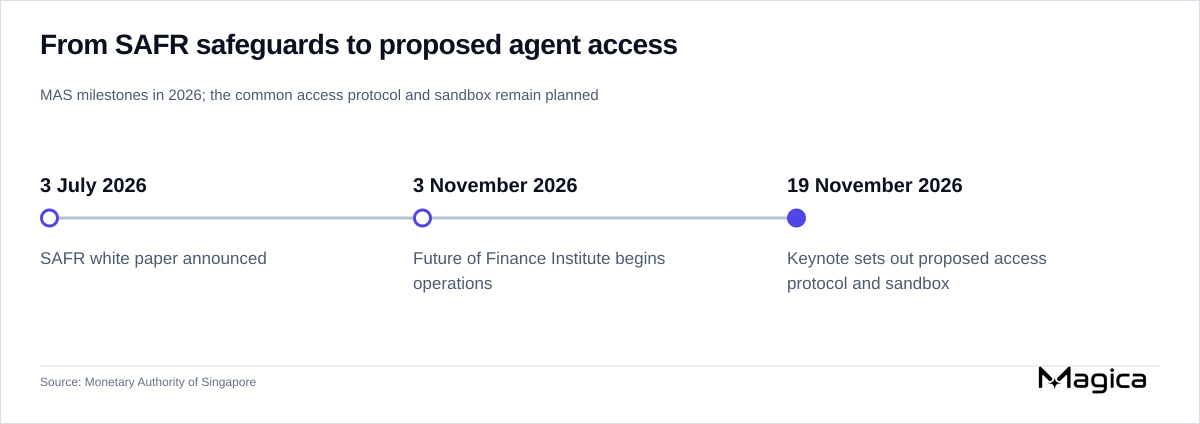
MAS’s November proposals build on earlier SAFR work and the start of the Future of Finance Institute’s operations. Dates mark milestones; spacing does not represent elapsed time. Source: Monetary Authority of Singapore.
The Monetary Authority of Singapore (MAS), Singapore’s central bank, announced the plans on November 19 at the Singapore FinTech Festival. Managing director Chia Der Jiun—who took the role in January 2024, having previously served as MAS’s deputy managing director for corporate development—said many financial institutions still lack terms or channels for agents to access their services. His public-service record shows he first joined MAS in 2004.
The immediate problem is delegated control. Chia said in his keynote that some providers are already building agent interfaces. But sharing account credentials does not tell an institution whether an agent is fully authorised, whether it is following its mandate or who bears responsibility if it exceeds instructions.
Chia warned users against giving personal agents financial-account login details, saying safety assurances were insufficient. The proposal would create a way to assess permission before accepting an instruction, rather than treating possession of credentials as sufficient.
MAS will facilitate the development of a common “know your agent” protocol under the next phase of Safeguards for Agentic Finance at Runtime (SAFR), its industry collaboration on financial-agent safeguards. It would exchange information about an agent’s identity, whom it represents, delegated authority, mandate, provenance and reliability. Institutions could then determine permitted access and establish a dedicated secure channel. This is a development commitment, not an announcement that the common protocol is operating.
There is prior work beneath that proposal. In a July 3 white-paper announcement, MAS described SAFR checkpoints that verify and record proposed agent actions before execution. It said industry members had already applied the framework to payments and treasury operations, among other workflows. The new announcement extends that work towards customer agents’ access to institutions and tests involving programmable money.
Agent identification also has commercial precedents. Payments-network operator Visa introduced its Trusted Agent Protocol in October 2025, developed with Cloudflare. Visa said it uses agent-specific cryptographic signatures to help merchants recognise trusted agents, consumer relationships and payment information. Its initial specifications applied to the Visa network. MAS’s proposed scope concerns access to financial institutions and the mandates and controls governing what agents may do there; trusted agent identification itself is not a new category.
MAS will set up the sandbox with the Future of Finance Institute, a Singapore public-private collaboration involving MAS, financial institutions, technology firms and researchers. The institute began operations on November 3, initially focusing on AI adoption, agent deployment practices and risk management.
The two proposed use cases divide authority between customers and institutions:
The proposed controls follow SAFR’s earlier principles: bounded autonomy, specific mandates and safeguards proportionate to the discretion and financial impact of an agent’s actions. Customer instructions alone would not determine what an institution accepts.
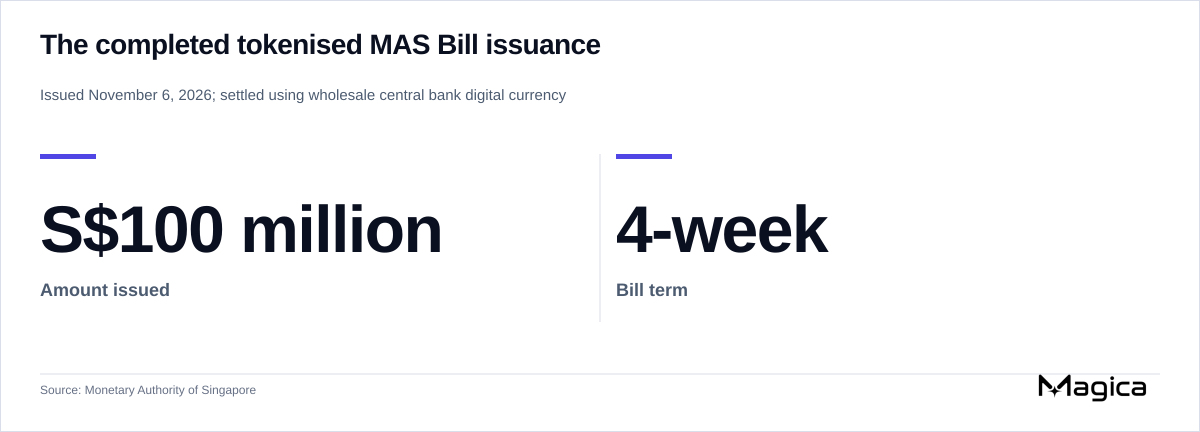
MAS reported a completed S$100 million issuance of four-week bills, settled using wholesale central bank digital currency. Its release did not quantify cost savings. Source: Monetary Authority of Singapore.
The settlement initiative has a completed transaction behind it. MAS said it issued S$100 million of four-week tokenised MAS Bills on November 6, settling them using wholesale central bank digital currency (CBDC). The short-term central-bank securities mature on December 4.
Five primary dealers—banks approved by MAS to make markets and deal in Singapore government and MAS securities—participated: DBS, HSBC’s Singapore branch, OCBC, Standard Chartered and UOB. Applications exceeded twice the issuance size. That establishes demand for this auction, but does not quantify the infrastructure’s cost advantage or wider market acceptance.
The bills were issued natively: ownership was recorded directly and solely on the distributed ledger. MAS says this eliminates reconciliation and intermediaries needed when conventionally issued instruments are subsequently tokenised. Its release supplies no measured saving in fees, processing time or operating costs.
MAS is the securities issuer and operates the Singapore Dollar Test Network on which they settled using central-bank money. Chia said it will reposition the network as an operational utility called SG Digital Ledger, supporting settlement across institutions, tokenised assets, digital money and ledgers. He explicitly left the scope of take-up to market demand.
The network supported live interbank overnight lending settled through wholesale CBDC in 2025. The bills add an asset that could back secured lending. A report on the transaction describes both their potential use as collateral for interbank borrowing and a network designed to settle the cash and securities legs of a trade simultaneously.
Chia acknowledged that tokenised assets remain small relative to conventional markets. Tokenisation changes how ownership is recorded and transferred, not the economic substance of the underlying cash, bond or fund. Large banks already offer tokenised deposits for corporate treasury, he said. The challenge is to make particular uses commercially compelling.
For collateral, that requires assets counterparties will accept, legal clarity and operational capabilities across banks, brokers, dealers, clearing houses and custodians. MAS and industry partners published the Guardian Tokenised Collateral Framework on November 19, covering eligibility, custody, valuation, return and enforcement. MAS is also updating its capital-markets tokenisation guide and working with the legal profession on private-law issues.
MAS wants to bring other commonly used collateral onto the infrastructure, potentially including foreign government securities and money market funds. Chia said the pace would depend on industry adoption.
The central bank also sees roles for tokenised deposits, regulated stablecoins and wholesale CBDC. Its BLOOM digital-money collaboration brings together 24 industry members and regional policymakers; MAS published a field guide on practical deployment considerations.
Separate networks must also connect. Chia said Global Layer One, MAS’s collaboration on interoperable digital-asset infrastructure, had produced standards, with five global financial institutions establishing an independent industry-led organisation in Singapore to carry the work forward.
For cross-border settlement, he said MAS had tested a synchronised mechanism across separate central-bank systems with the Bank of England and Bank of Thailand. With Deutsche Bundesbank, it had considered how separate systems could verify settlement conditions before releasing funds. Those are specific stages of connectivity work, alongside the broader task of getting institutions to accept and manage tokenised assets.
MAS intends to expand bill issuance, participation and collateral use in further live trials in 2027. Chia described tokenised MAS Bills as potentially complementary to conventional bills. The next evidence needed is whether more institutions use them in mainstream transactions and whether the resulting settlement efficiencies justify deployment.
For agents, the keynote supplied neither a completed allocation of liability nor a deployment timetable for the common protocol. The planned sandbox must test whether institutions can accept useful delegated actions while enforcing customers’ mandates and their own controls.
Chia also flagged possible financial-stability consequences as agents move money and allocate assets faster. He cited emerging studies in simulated environments suggesting risks of collusion and unequal outcomes between agents of differing capability. Those are research warnings, not observed outcomes of this sandbox. Access checks are therefore one part of the unresolved question: who can stop an agent, and who is accountable when an accepted instruction produces the wrong result?
Anthropic raised $81.3 billion in a record IPO and opened 34% above its offer price before retreating. Rapid revenue growth and adjusted operating profits sit alongside vast computing commitments and limited investor control.
The Kimi developer reportedly abandoned planned Nvidia B300 capacity for 2027 after new US restrictions. The deal exposes financing risks for overseas AI clouds, but neither a model delay nor a $150 million cash loss is established.
Kong is expanding from API management into hosting AI agents and applications. Volcano bundles backend services with a LavaFlow repair preview, but human review, plan restrictions and deployment controls narrow its autonomous-software pitch.
Anthropic's pre-debut price indications reached $105, about 26.5% above its offer price, after an $81.3 billion IPO. Strong demand for the Claude maker confronts enormous computing commitments and a governance structure that limits ordinary shareholders' influence.
Google has booked New Glenn for a dedicated Project Suncatcher launch in early 2029. Laboratory tests support parts of its orbital AI design, but deployment, launch reliability and commercial economics remain unproven.
Canva is rolling out free controls for Free and Pro accounts to disable supported generative AI tools and reduce AI-made assets in search. The settings extend individual choice while leaving AI enabled by default and preserving the company's investment in generation.
Alibaba targets 30%–45% cloud revenue growth next fiscal year and may reduce its long-term capacity plan. Domestic chips underpin its unchanged 2030 revenue ambition, but production, funding and customer allocation remain critical tests.
Jeff Bezos says Prometheus tools are in private trials, including two Blue Origin projects. Its claims of faster design now face the harder test of manufacturing gains, as rivals automate existing engineering workflows.
The IEA projects data-center electricity demand reaching 1,000 terawatt-hours annually by 2030, but connection queues, equipment shortages and local opposition could limit how much of the investment boom gets built.
European individuals secured about $1.1 billion of Anthropic shares, roughly 1.4% of the public offering’s value. The UK offer combines broad participation with rationing, while the AI lab’s governance and compute commitments define what investors are buying.
Federal prosecutors accuse Igor D’iu of acting for Russia to surveil employees of a Silicon Valley defense technology company identified in reports as Palantir. An FBI affidavit describes screen photographs, employee dossiers and $45,000 in reported payments, but leaves the handlers’ identities and the success of attempted electronic collection unresolved.
Alibaba’s September-quarter profit more than tripled as investment gains and a commerce recovery amplified stronger cloud earnings. Cloud revenue rose 53%, but AI application losses widened and infrastructure spending left free cash flow negative. A large share placement bolstered liquidity.
President Donald Trump rejected international restrictions on advanced AI at APEC. His administration has already outlined voluntary cybersecurity cooperation, alongside deregulation and support for American AI exports and infrastructure.
London-based LATO has raised $4.7 million to expand AI agents that interview customers and experts for investment research. Its early traction claims come as rivals offer similar research workflows and Salesforce absorbs Listen Labs; comparative cost and quality remain unproven.
Snap’s free Easy Lens CLI connects AI coding assistants to Snapchat’s AR creation and publishing workflow. It builds on earlier prompt-based tools as TikTok offers a competing approach.
Nvidia’s first earnings report since Jensen Huang’s departure showed revenue more than doubling, but shares fell 2.9%. Interim CEO Colette Kress faces a permanent leadership search, lower forecast margins and expanding infrastructure commitments, including conditional guarantees.
Needham’s $150 target stands about 81% above Anthropic’s $83 IPO price, versus Morningstar’s $92 fair-value estimate. Rapid enterprise growth and fresh financing support the business, but pricing power, compute commitments and shareholder control complicate the investment case.
A cyberattack disrupted access to European Commission payslips, leave management and medical reimbursements. The HR platform is back online, while the health insurance system remains unavailable and the extent of any staff data theft is unknown.
Waymo suspended Bay Area service during the November 18 storm after reports of robotaxis obstructing flooded streets, raising questions about how it withdraws its fleet when road conditions deteriorate.
Lenovo reported record quarterly revenue of $30.2 billion as its infrastructure business swung into profit. A $1.91 billion noncash warrant charge drove a reported loss, while expanding inventories and overdue receivables raised the stakes for cash collection.