Editorial Team
7 min read
Nvidia’s first earnings report since Jensen Huang’s departure showed revenue more than doubling, but shares fell 2.9%. Interim CEO Colette Kress faces a permanent leadership search, lower forecast margins and expanding infrastructure commitments, including conditional guarantees.
Nvidia, the chipmaker supplying AI computing infrastructure, closed lower on November 18 after its first earnings report since the departure of Jensen Huang, its co-founder and former chief executive. The results showed continued rapid growth; they left a leadership transition and expanding financial exposure for investors to assess.
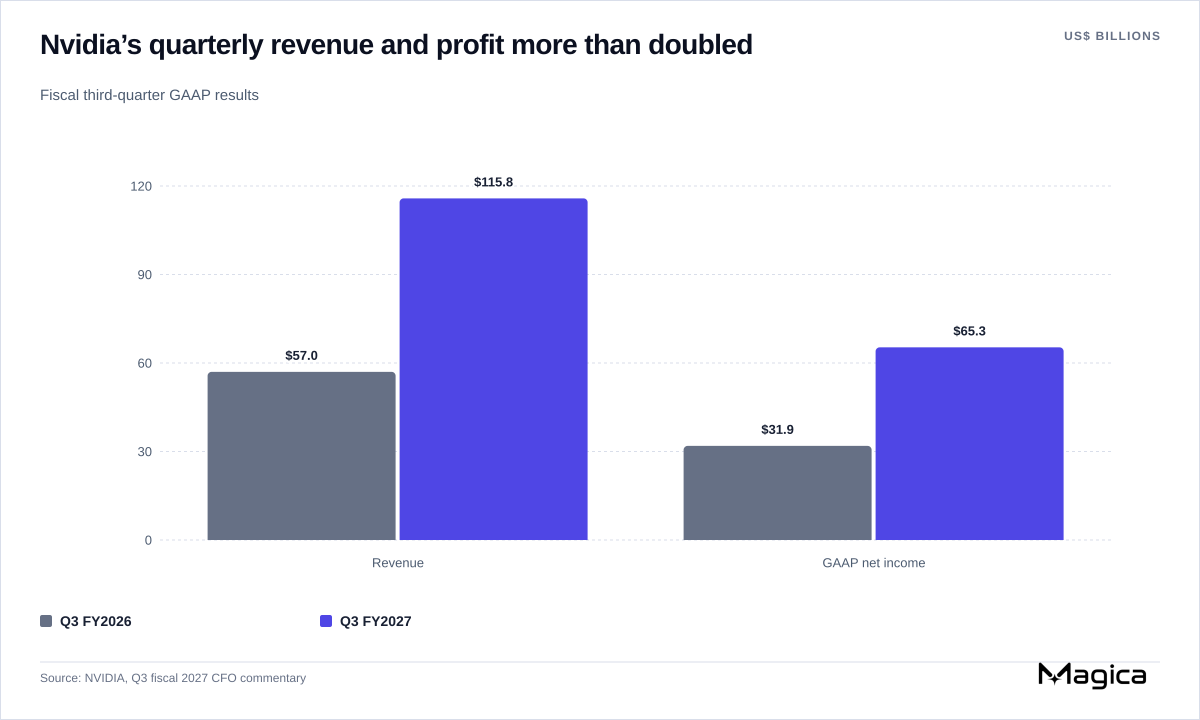
Nvidia’s company-reported revenue and GAAP net income for fiscal Q3 2026 and fiscal Q3 2027. Source: NVIDIA.
Nvidia’s results released late Tuesday beat analyst expectations, and its revenue forecast also topped estimates, according to the closing market report. The shares nevertheless finished Wednesday down 2.9%.
The company’s fiscal third-quarter commentary gives the scale of the business behind that reaction. For the quarter ended October 25, Nvidia reported:
| Measure | Q3 fiscal 2027 | Q3 fiscal 2026 |
|---|---|---|
| Revenue | $115.8 billion | $57.0 billion |
| Data-center revenue | $107.6 billion | $51.2 billion |
| GAAP net income | $65.3 billion | $31.9 billion |
| GAAP gross margin | 74.8% | 73.4% |
S&P Capital IQ analyst estimates cited in the earnings account had put expected revenue at $108.7 billion and net income at $60.5 billion. That report put the stock up 2% in Tuesday’s after-hours trading, a different trading window from Wednesday’s closing decline.
Data centers accounted for about 93% of quarterly revenue, calculated by dividing $107.6 billion by $115.8 billion. Within that business, Nvidia’s combined AI Clouds, Industrial, and Enterprise category grew 195% year over year to $47.5 billion, faster than its hyperscale category’s 71% growth to $60.1 billion. The expansion therefore extended beyond the largest cloud operators.
Nvidia attributed growth to its newly introduced Rubin computing architecture, standalone Vera central processors and continued Blackwell Ultra growth. It described Rubin as its fastest architecture ramp, but said the initial ramp slightly reduced gross margins from the previous quarter.
For fiscal Q4, Nvidia forecast revenue of $130 billion, plus or minus 3%, with an additional week in the quarter. It assumed no data-center compute revenue from China, after shipping $2.4 billion of data-center Hopper products there in Q3. The extra week and China assumption matter when comparing the forecast with the just-completed quarter.
The company forecast GAAP and non-GAAP gross margins of 71%–72%, below Q3’s 74.8% GAAP margin. A higher sales forecast thus comes alongside a lower expected share of revenue remaining after cost of revenue.
Interim CEO Colette Kress, who remains chief financial officer, has held Nvidia’s CFO role since 2013. She brings a long record overseeing the company’s finances to a transition that now requires both operating continuity and scrutiny of its infrastructure obligations.
Huang was ousted the previous week following an extramarital affair that raised U.S. national-security concerns, according to the subsequent market account. The loss of a co-founder who had also been chief executive makes the permanent succession decision consequential beyond a routine quarterly earnings comparison.
Tuesday’s earnings account put the cumulative loss in Nvidia’s market capitalization since the scandal broke at more than $1 trillion, showing that Wednesday’s decline followed a much larger repricing.
In the earnings announcement, Kress said the company’s roadmap remained on track, according to that account. Huang separately wrote that he would be willing to return as CEO, while the account cited reports that the board had ruled out bringing him back.
The same account cited a Wall Street Journal report that the Securities and Exchange Commission had opened a civil probe. An SEC spokesperson declined to comment, and Nvidia representatives had not immediately responded to a request for comment. Nvidia’s own quarterly commentary refers to an ongoing investigation by an independent board committee and a search for a new CEO.
Wednesday’s chip-stock moves were mixed: the Philadelphia SE Semiconductor Index gained 0.1%, Advanced Micro Devices rose 5.3%, Intel fell 0.9% and Micron declined 1%, according to the closing market report. Nvidia underperformed that sector benchmark, but share-price divergence does not demonstrate a shift in customers or product competitiveness.
The wider market offered another source of uncertainty. The S&P 500 fell 0.23%, reversing earlier gains after Federal Reserve minutes emphasized inflation risks and possible further rate increases. The Nasdaq Composite still gained 0.42%. One session cannot isolate the contribution of Nvidia’s leadership troubles, financial outlook or broader market pressures to its closing price.
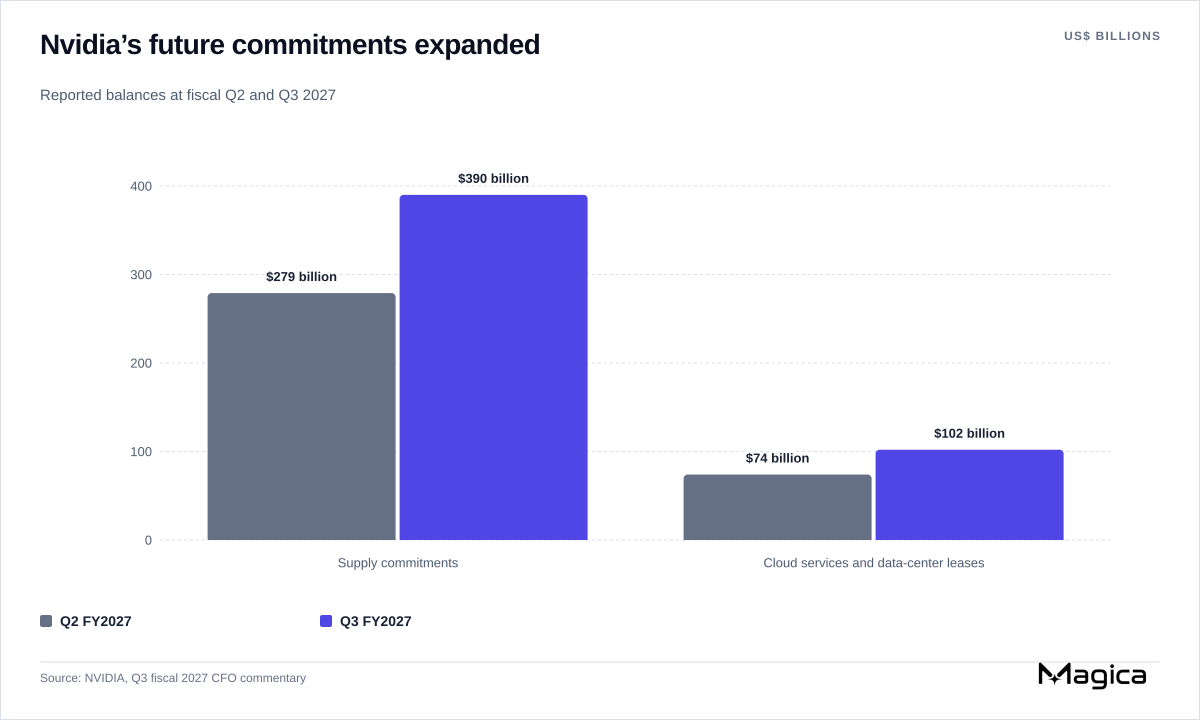
Nvidia’s company-reported future commitments rose between fiscal Q2 and Q3 2027. These multiyear balances exclude separately disclosed neocloud agreements and guarantees. Source: NVIDIA.
Nvidia’s quarterly commentary shows why revenue alone cannot settle questions about its expansion. The company said supply commitments rose to $390 billion from $279 billion a quarter earlier, primarily for multiyear memory procurement. Its schedule puts $203 billion of supply and capacity commitments in fiscal 2028. These are future procurement obligations across several years, rather than expenses incurred in Q3.
Cloud-service agreements and data-center lease commitments together rose to $102 billion from $74 billion. Nvidia said this infrastructure supports research and development. The uncommenced leases have terms of up to 20 years and are expected to begin between fiscal Q4 2027 and fiscal 2033; some may be assigned to third parties.
Including $20 billion in equity investments and $6 billion in capital expenditures, Nvidia’s schedule totals $518 billion in future commitments as of October 25, spread across the remainder of fiscal 2027 and later years. The following customer agreements and guarantees are disclosed separately.
Customer support creates a separate exposure. Nvidia said specialized AI cloud providers and frontier model developers are expanding faster than their balance sheets and long-term credit profiles can support. Its $32 billion maximum in neocloud agreements depends on those providers obtaining financing and the computing capacity being deployed, operational and accepted by Nvidia. Commitments could shrink or disappear if conditions are not met. Nvidia said it will book upfront infrastructure sales and, if criteria are satisfied, participate in revenue from those providers’ customers.
The company also disclosed $118 billion of maximum gross guarantee exposure, under which partner defaults could require payments to third parties. Of that, $105 billion concerns credit support for approximately 4.25 gigawatts across nine buildings at SB Energy’s Ohio campus, to host Nvidia infrastructure under 20-year leases to AI developer OpenAI, subject to limited exceptions.
That $105 billion exposure takes effect building by building as construction is completed and facilities are ready for service, with the first expected in fiscal 2029. It then declines as OpenAI makes lease payments. Nvidia also has an option to support approximately 3.8 additional gigawatts. It said it had made no payments under its guarantees to date. The maximum exposure is therefore neither a current cash outflow nor an estimate of expected losses.
Nvidia has substantial cash generation against those obligations: quarterly operating cash flow was $48.3 billion, compared with $23.8 billion a year earlier. But cash, cash equivalents and marketable debt securities fell to $53.5 billion from $56.6 billion a quarter earlier, as the company returned $28.1 billion to shareholders through buybacks and dividends. It also has $227.3 billion in remaining repurchase authorization that it plans to use through fiscal 2028; authorization does not itself require those purchases.
Receivables reached $81 billion, with days sales outstanding rising to 64 from 60 in the previous quarter; Nvidia attributed that change to Rubin shipment timing and extended terms for certain investment-grade customers. Inventory rose to $39.7 billion from $31.6 billion a quarter earlier, which the company said supported the Rubin ramp.
The company says its 10-Q will follow in the coming weeks. That filing is the next disclosure to examine for the timing and terms of these exposures. The evidence that matters next is whether customers secure financing, facilities become operational and payments arrive as obligations take effect—alongside the board’s choice of a permanent chief executive.
Anthropic raised $81.3 billion in a record IPO and opened 34% above its offer price before retreating. Rapid revenue growth and adjusted operating profits sit alongside vast computing commitments and limited investor control.
The Kimi developer reportedly abandoned planned Nvidia B300 capacity for 2027 after new US restrictions. The deal exposes financing risks for overseas AI clouds, but neither a model delay nor a $150 million cash loss is established.
Kong is expanding from API management into hosting AI agents and applications. Volcano bundles backend services with a LavaFlow repair preview, but human review, plan restrictions and deployment controls narrow its autonomous-software pitch.
Anthropic's pre-debut price indications reached $105, about 26.5% above its offer price, after an $81.3 billion IPO. Strong demand for the Claude maker confronts enormous computing commitments and a governance structure that limits ordinary shareholders' influence.
Google has booked New Glenn for a dedicated Project Suncatcher launch in early 2029. Laboratory tests support parts of its orbital AI design, but deployment, launch reliability and commercial economics remain unproven.
Canva is rolling out free controls for Free and Pro accounts to disable supported generative AI tools and reduce AI-made assets in search. The settings extend individual choice while leaving AI enabled by default and preserving the company's investment in generation.
Alibaba targets 30%–45% cloud revenue growth next fiscal year and may reduce its long-term capacity plan. Domestic chips underpin its unchanged 2030 revenue ambition, but production, funding and customer allocation remain critical tests.
Singapore’s central bank plans a common protocol for financial institutions to assess customer AI agents, alongside a sandbox for treasury and payments. Its digital settlement network has completed a S$100 million bill issuance, but wider adoption, cost savings and agent accountability remain unresolved.
Jeff Bezos says Prometheus tools are in private trials, including two Blue Origin projects. Its claims of faster design now face the harder test of manufacturing gains, as rivals automate existing engineering workflows.
The IEA projects data-center electricity demand reaching 1,000 terawatt-hours annually by 2030, but connection queues, equipment shortages and local opposition could limit how much of the investment boom gets built.
European individuals secured about $1.1 billion of Anthropic shares, roughly 1.4% of the public offering’s value. The UK offer combines broad participation with rationing, while the AI lab’s governance and compute commitments define what investors are buying.
Federal prosecutors accuse Igor D’iu of acting for Russia to surveil employees of a Silicon Valley defense technology company identified in reports as Palantir. An FBI affidavit describes screen photographs, employee dossiers and $45,000 in reported payments, but leaves the handlers’ identities and the success of attempted electronic collection unresolved.
Alibaba’s September-quarter profit more than tripled as investment gains and a commerce recovery amplified stronger cloud earnings. Cloud revenue rose 53%, but AI application losses widened and infrastructure spending left free cash flow negative. A large share placement bolstered liquidity.
President Donald Trump rejected international restrictions on advanced AI at APEC. His administration has already outlined voluntary cybersecurity cooperation, alongside deregulation and support for American AI exports and infrastructure.
London-based LATO has raised $4.7 million to expand AI agents that interview customers and experts for investment research. Its early traction claims come as rivals offer similar research workflows and Salesforce absorbs Listen Labs; comparative cost and quality remain unproven.
Snap’s free Easy Lens CLI connects AI coding assistants to Snapchat’s AR creation and publishing workflow. It builds on earlier prompt-based tools as TikTok offers a competing approach.
Needham’s $150 target stands about 81% above Anthropic’s $83 IPO price, versus Morningstar’s $92 fair-value estimate. Rapid enterprise growth and fresh financing support the business, but pricing power, compute commitments and shareholder control complicate the investment case.
A cyberattack disrupted access to European Commission payslips, leave management and medical reimbursements. The HR platform is back online, while the health insurance system remains unavailable and the extent of any staff data theft is unknown.
Waymo suspended Bay Area service during the November 18 storm after reports of robotaxis obstructing flooded streets, raising questions about how it withdraws its fleet when road conditions deteriorate.
Lenovo reported record quarterly revenue of $30.2 billion as its infrastructure business swung into profit. A $1.91 billion noncash warrant charge drove a reported loss, while expanding inventories and overdue receivables raised the stakes for cash collection.