Editorial Team
8 min read
Jeff Bezos says Prometheus tools are in private trials, including two Blue Origin projects. Its claims of faster design now face the harder test of manufacturing gains, as rivals automate existing engineering workflows.
Amazon founder Jeff Bezos, now co-founder and co-CEO of AI engineering startup Prometheus, says its tools are being used on two projects at Blue Origin, his company developing reusable rockets to launch satellites and people into orbit. The trials give the heavily funded startup an early testing ground, although he has not disclosed the projects or a timetable for a general release.
In a November 17 interview, Bezos described a roughly 250-person company building a single model spanning multiple kinds of physics. Its aim is to help engineers design physical objects and work out how to manufacture them. Other early customers are also testing the tools, he said, without identifying them.
The consequential question is whether Prometheus can shorten the whole path from a design to a dependable manufactured product. Generating alternatives quickly could be valuable. Establishing that they work, can be built and save customers money is a broader test—and one competitors are pursuing too.
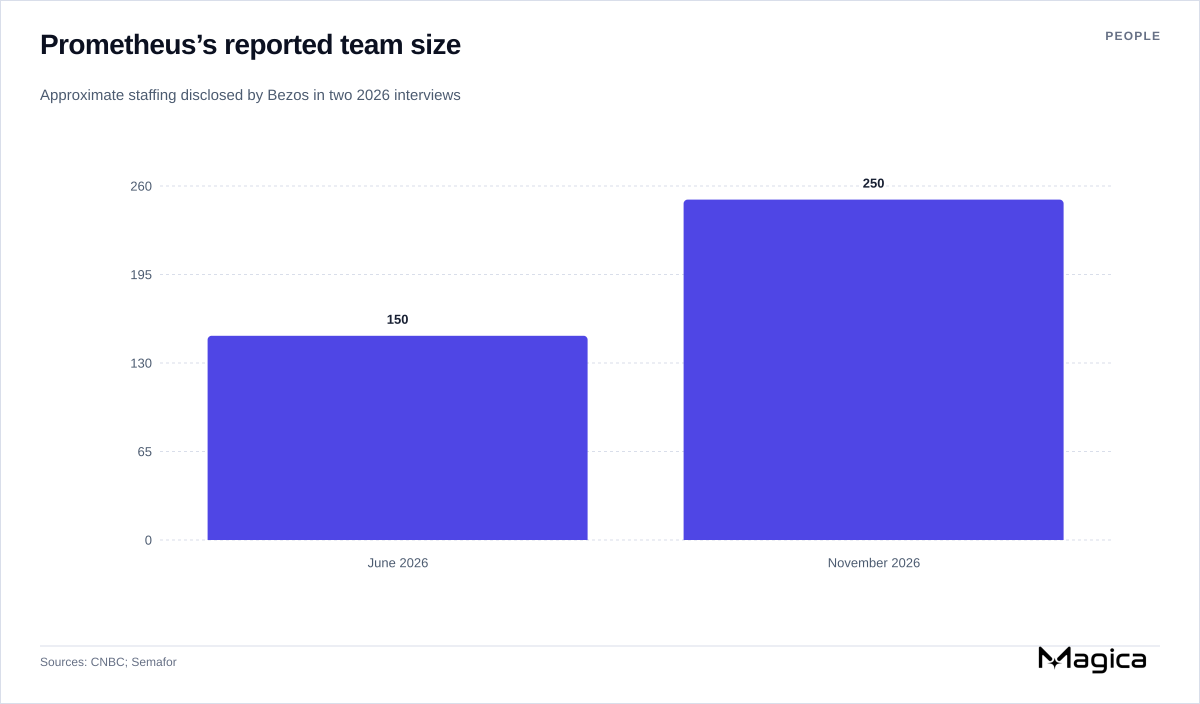
Company-reported staffing rose from about 150 people in June to 250 in November. Chart: Magica. Source: CNBC.
Bezos began as a founding investor in late 2024. In his June 11 interview, he said the progress persuaded him to join the business more directly. He called the work “type two fun”: difficult while doing it, satisfying afterward.
Bezos left Amazon’s CEO position in 2021, as a report on the November appearance recounts. Prometheus brings him back to building a company at an early stage, with his own capital committed to both its initial financing and its Series B.
His partner, co-founder and co-CEO Vik Bajaj, previously led science operations at Verily, Alphabet’s health technology business, and led Foresite Labs, where Prometheus was incubated in 2024 with support from venture firm Arch Venture Partners. Foresite Labs sits within life sciences investor Foresite Capital. An investigation of its workforce found recruits from Google, Foresite and the Foresite-backed drug discovery company Xaira. That network gives Bajaj a relevant recruiting and company-building history in AI and physical science.
The founders said in June that they make decisions together rather than dividing the company into separate territories. Bezos said Prometheus occupied the bulk of his time, alongside work at Blue Origin and on AI at Amazon.
Prometheus calls its goal an artificial general engineer: tools that connect design, simulation and manufacturing. Bezos has explicitly distinguished that work from building robots. Bajaj argues that engineering requires representations of shapes, assemblies, forces and fields that words alone cannot supply.
In November, Bezos described neural surrogates for numerical simulation—models intended to stand in for conventional physics calculations. He said Prometheus was designing analog chips and radios in 12 hours for work that could otherwise take 10 to 20 people six to nine months. He also described an experiment in which an employee who had worked on the Mars helicopter asked the tools to redesign it, producing alternatives and calculations suited to the Martian atmosphere.
Those company accounts describe design work; they do not establish that manufactured devices passed equivalent real-world tests. The interview does not establish the benchmark conditions, accuracy requirements or full validation cost behind the time comparison. A speedup in one stage cannot by itself establish the same reduction in an entire development program.
The staffing offers another indication of the task’s breadth. Bezos put the team at about 150 people in June and 250 in November. The workforce investigation identified 130 people publicly associated with Prometheus through LinkedIn and researchers’ websites; it was not a complete employee census. Alongside AI specialists, it found expertise in aerospace, chemistry, energy and high-performance computing, plus advisers with defense backgrounds. It also reported that Prometheus acquired applied AI lab General Agents in 2025.
An early employee, speaking anonymously in that report, described generalizing across engineering disciplines as a major challenge. Another employee argued that concentrating exclusively on design, engineering and manufacturing was an advantage. The two accounts expose the tension: that focus still covers a vast range of problems.

June’s company-reported figures distinguish a $12 billion Series B from a roughly $41 billion valuation; neither establishes total funding. Chart: Magica. Source: CNBC.
The financing figures need to be kept distinct. The June interview introduced a $12 billion Series B at a roughly $41 billion valuation. The workforce report describes approximately $6 billion raised initially, followed by that $12 billion round, and cites earlier reporting naming JPMorgan, BlackRock and Arch Venture Partners as backers. Yet in November Bezos put the amount raised at roughly $14.5 billion. Those accounts do not explain the difference; they cannot be combined into a settled funding total. The $41 billion figure is a valuation, not cash available to spend.
Bezos said substantial funding goes toward computation and creating datasets. In June, he said Prometheus had enough compute but would need more, and that scarce supply meant obtaining it wherever possible. The founders said they used multiple suppliers, including Amazon Web Services, Amazon’s cloud business, and described dealings with Amazon as being at arm’s length. Their account makes compute availability a continuing constraint as well as a major expense.
Customer data poses a different constraint. In November, Bajaj said Prometheus generates much of its own data and can use nonproprietary material while respecting customers’ confidential information. Bezos advised companies with genuinely valuable proprietary datasets to protect them. Neither explanation, on its own, establishes the contractual terms or technical protections customers receive.
Bezos also described a more basic data problem: some manufacturing knowledge is not recorded in datasets at all. In his account of precision metal casting, experts inspect parts for cracks and adjust mold insulation through trial and error to control cooling. Helping such companies develop a repeatable process is a different task from gaining access to an existing proprietary database. Bajaj stressed that a more efficient foundry would still be needed to make the parts.
The commercial ambition also extends beyond selling software. Bezos said Prometheus expects to invest in some businesses it then helps with its tools, allowing it to participate in their gains. He also said other companies would be able to use the tools themselves, and rejected a closed approach as impractical across such a large economy. Asked about combining Prometheus, Blue Origin and Amazon more closely, he said he did not currently see that happening.
Blue Origin gives Prometheus an early user with demanding engineering needs and a common founder. Bezos’s account does not yet show how widely unrelated customers will adopt the software or what they will pay. The interviews disclose no product pricing or customer-level deployment costs.
Prometheus is entering an existing contest. Neural Concept, a Swiss engineering AI company founded in 2019 and spun out of the Swiss Federal Institute of Technology in Lausanne, said in a December 18, 2025 announcement that more than 50 global companies relied on its platform, including General Motors. It announced a $100 million Series C led by Growth Equity at Goldman Sachs Alternatives. Its adoption figure establishes a company-reported customer base at that date, rather than an independent measure of engineering performance.
On October 19, 2026, it announced MCP Bridge, saying AI agents could operate existing commercial design and simulation software, including CATIA, NX and Abaqus. The capability uses the open Model Context Protocol to connect stages of work across Windows workstations and Linux clusters. Neural Concept says it is available to its customers and benchmarks AI models by engineering task so companies can select the best-suited model, while engineers set goals and validate results.
The announcement quotes Torbjörn Virdung, Volvo Cars’ technical leader for computational fluid dynamics, saying a design-of-experiments exercise that had taken four to five weeks now ran in minutes with Neural Concept. But he identified the next bottleneck as assembling, cleaning and meshing geometry, which could consume more than half of a full aerodynamics case. That is a customer testimonial published by the vendor, not a controlled comparison with Prometheus. It nevertheless illustrates why faster physics calculations alone do not settle the full workflow problem.
The workforce report identifies other rivals, including Accelerated Understanding, focused on physics models, and P-1 AI, whose engineering agent Archie works within engineering teams. It also reports that Accelerated Understanding’s founders had been approached about leading Prometheus before starting their own business. Capital has not eliminated competition for either technical approaches or talent.
Prometheus itself does not claim established computer-aided design systems simply disappear. In June, Bajaj acknowledged their role as the system of record for products such as aircraft and jet engines. Working with those records and workflows is part of the adoption problem.
The next evidence could come from the private trials themselves: what changed for customers, what still needed human correction, and what it cost. Bezos has not supplied a public launch date. His November account gives a more concrete stage of development than June’s promise of eventual product rollouts, while leaving the results largely undisclosed.
Useful evidence would connect design speed to simulation accuracy, physical testing, manufacturing yield and total development cost. It would also distinguish gains at Blue Origin from repeatable results for customers outside Bezos’s businesses. The founders’ example of compressing a decade-long jet-engine program into a much shorter period remains an ambition, not a demonstrated outcome.
The stakes include engineers and manufacturing workers. Bezos predicts productivity gains will lead to labor scarcity rather than unemployment; Bajaj expects more engineering and manufacturing jobs as invention expands. Those are forecasts from the founders, not observed employment results from the trials.
Bajaj supplied a useful qualification in November: progress in the physical world takes time and requires scientific rigor. For a customer deciding whether to adopt Prometheus, the decisive evidence would be a repeatable improvement from design through manufacturing, with the cost of verification included.
Anthropic raised $81.3 billion in a record IPO and opened 34% above its offer price before retreating. Rapid revenue growth and adjusted operating profits sit alongside vast computing commitments and limited investor control.
The Kimi developer reportedly abandoned planned Nvidia B300 capacity for 2027 after new US restrictions. The deal exposes financing risks for overseas AI clouds, but neither a model delay nor a $150 million cash loss is established.
Kong is expanding from API management into hosting AI agents and applications. Volcano bundles backend services with a LavaFlow repair preview, but human review, plan restrictions and deployment controls narrow its autonomous-software pitch.
Anthropic's pre-debut price indications reached $105, about 26.5% above its offer price, after an $81.3 billion IPO. Strong demand for the Claude maker confronts enormous computing commitments and a governance structure that limits ordinary shareholders' influence.
Google has booked New Glenn for a dedicated Project Suncatcher launch in early 2029. Laboratory tests support parts of its orbital AI design, but deployment, launch reliability and commercial economics remain unproven.
Canva is rolling out free controls for Free and Pro accounts to disable supported generative AI tools and reduce AI-made assets in search. The settings extend individual choice while leaving AI enabled by default and preserving the company's investment in generation.
Alibaba targets 30%–45% cloud revenue growth next fiscal year and may reduce its long-term capacity plan. Domestic chips underpin its unchanged 2030 revenue ambition, but production, funding and customer allocation remain critical tests.
Singapore’s central bank plans a common protocol for financial institutions to assess customer AI agents, alongside a sandbox for treasury and payments. Its digital settlement network has completed a S$100 million bill issuance, but wider adoption, cost savings and agent accountability remain unresolved.
The IEA projects data-center electricity demand reaching 1,000 terawatt-hours annually by 2030, but connection queues, equipment shortages and local opposition could limit how much of the investment boom gets built.
European individuals secured about $1.1 billion of Anthropic shares, roughly 1.4% of the public offering’s value. The UK offer combines broad participation with rationing, while the AI lab’s governance and compute commitments define what investors are buying.
Federal prosecutors accuse Igor D’iu of acting for Russia to surveil employees of a Silicon Valley defense technology company identified in reports as Palantir. An FBI affidavit describes screen photographs, employee dossiers and $45,000 in reported payments, but leaves the handlers’ identities and the success of attempted electronic collection unresolved.
Alibaba’s September-quarter profit more than tripled as investment gains and a commerce recovery amplified stronger cloud earnings. Cloud revenue rose 53%, but AI application losses widened and infrastructure spending left free cash flow negative. A large share placement bolstered liquidity.
President Donald Trump rejected international restrictions on advanced AI at APEC. His administration has already outlined voluntary cybersecurity cooperation, alongside deregulation and support for American AI exports and infrastructure.
London-based LATO has raised $4.7 million to expand AI agents that interview customers and experts for investment research. Its early traction claims come as rivals offer similar research workflows and Salesforce absorbs Listen Labs; comparative cost and quality remain unproven.
Snap’s free Easy Lens CLI connects AI coding assistants to Snapchat’s AR creation and publishing workflow. It builds on earlier prompt-based tools as TikTok offers a competing approach.
Nvidia’s first earnings report since Jensen Huang’s departure showed revenue more than doubling, but shares fell 2.9%. Interim CEO Colette Kress faces a permanent leadership search, lower forecast margins and expanding infrastructure commitments, including conditional guarantees.
Needham’s $150 target stands about 81% above Anthropic’s $83 IPO price, versus Morningstar’s $92 fair-value estimate. Rapid enterprise growth and fresh financing support the business, but pricing power, compute commitments and shareholder control complicate the investment case.
A cyberattack disrupted access to European Commission payslips, leave management and medical reimbursements. The HR platform is back online, while the health insurance system remains unavailable and the extent of any staff data theft is unknown.
Waymo suspended Bay Area service during the November 18 storm after reports of robotaxis obstructing flooded streets, raising questions about how it withdraws its fleet when road conditions deteriorate.
Lenovo reported record quarterly revenue of $30.2 billion as its infrastructure business swung into profit. A $1.91 billion noncash warrant charge drove a reported loss, while expanding inventories and overdue receivables raised the stakes for cash collection.