Editorial Team
5 min read
Waymo suspended Bay Area service during the November 18 storm after reports of robotaxis obstructing flooded streets, raising questions about how it withdraws its fleet when road conditions deteriorate.
Waymo, the Alphabet-backed operator of the driverless Waymo One ride-hailing service, suspended Bay Area rides during the storm on Wednesday, November 18, 2026, after reports of its vehicles blocking flooded San Francisco streets. The company said it had reduced its fleet before stopping service, but riders and street videos described cars obstructing traffic before the pause.
The operator grew out of Google's self-driving technology project and became an Alphabet business in 2016. This disruption tests an operational requirement for its commercial service: withdrawing vehicles safely when the roads they use become hazardous.

A Waymo Jaguar I-PACE in San Francisco, from the company’s December 2025 blackout-response post. Archival image. Source: Waymo. Source: Waymo blackout response.
At Oak and Cole streets near the Panhandle, video showed a stopped Waymo blocking one of the remaining passable lanes as water flooded the roadway. The incident occurred around 10:20 a.m., according to the account accompanying the video. Other drivers had to move into deeper water to get around it, according to a separate report.
Waymo’s app displayed a weather-related pause shortly after 11 a.m. The latter report described a shutdown covering its regional service area through San Francisco, the Peninsula and the South Bay. Although some coverage described a city-only interruption, the company announced a Bay Area suspension, according to the reported statement.
Anthropic raised $81.3 billion in a record IPO and opened 34% above its offer price before retreating. Rapid revenue growth and adjusted operating profits sit alongside vast computing commitments and limited investor control.
Another disabled Waymo was seen blocking traffic at Bayshore Boulevard and Industrial Street. A company spokesperson said Waymo had tracked the storm hours beforehand and reduced its operating fleet before halting service. It was communicating with local emergency-management officials about resuming operations, according to the report carrying its response. Service remained paused at 3 p.m. Wednesday.
Rider accounts show how the disruption developed inside individual cars. One passenger at Fell Street and Masonic Avenue said she was transferred among three support specialists and waited half an hour before the vehicle was moved to the right lane, according to the report from that intersection. Another rider, Edward Frazer, said a North Beach-to-Mission Bay journey had lasted an hour and a half, with more than 10 pullovers and an eventual inability to connect to support, according to the account carrying his post.
Those accounts establish difficult individual trips, not the proportion of Waymo’s fleet affected. The available reporting gives no fleet-wide count of stranded vehicles or technical explanation for Wednesday’s stops.
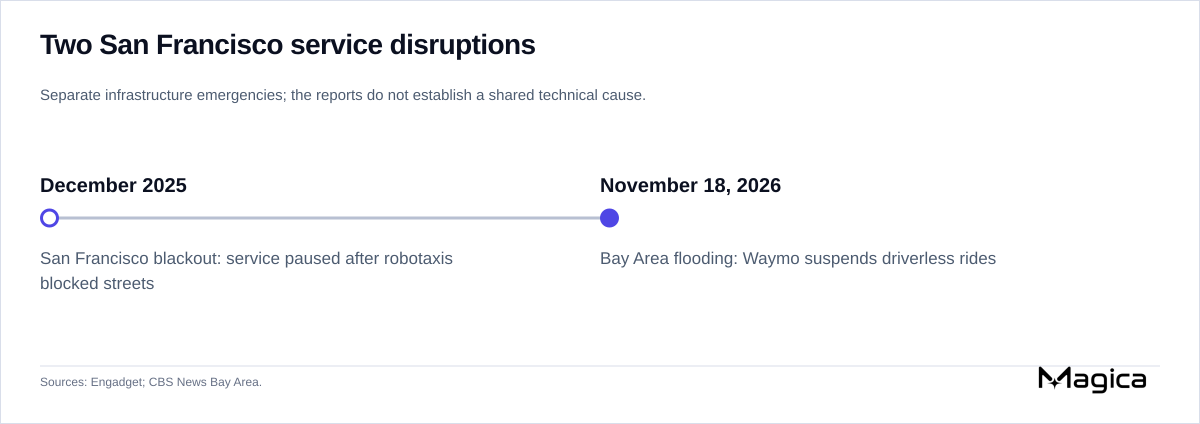
Waymo paused service during both emergencies. The reporting does not establish that the same mechanism caused the vehicle stops. Source: Engadget.
Flooding disrupted transportation far beyond Waymo. The California Highway Patrol reported freeway closures and BART warned of systemwide weather delays, according to the storm updates. Stopping service during unsafe conditions does not by itself establish a failure of autonomous driving. The more specific question is whether cars can reach safe stopping places as conditions worsen.
Waymo has encountered flooding before. In May, it recalled nearly 4,000 vehicles and issued a software update after a robotaxi entered a flooded road in San Antonio; another flooded-road incident later prompted a pause in Atlanta, according to the account of the earlier disruptions. Those episodes involved entering flooded roads. Wednesday’s reports of stopped cars do not establish that the same software issue recurred.
A different infrastructure failure exposed an operational constraint in December 2025. During a San Francisco blackout, Waymos stalled 1,600 times, largely because they needed human confirmation before proceeding through dark signals, according to the account of that disruption. That figure counts stalls, not necessarily distinct vehicles.
In its own December 23, 2025 account, Waymo said its system was designed to treat dark signals as four-way stops and had successfully crossed more than 7,000 dark signals during the blackout. But a concentrated surge in requests for confirmation created a backlog and response delays that contributed to congestion. The successful crossings and reported stalls are different measures, not a basis for calculating a failure rate.
Waymo said it was updating the fleet with additional outage context and improving emergency-response protocols. It also said it had directed vehicles to park and then returned them to depots in waves during the blackout. That account describes an earlier withdrawal procedure; it does not establish how Wednesday's fleet was cleared or whether a support backlog recurred.
Waymo's commercial expansion has substantial backing. The company said it raised $5.6 billion in an Alphabet-led round in October 2024 to expand its ride-hailing service and advance the Waymo Driver, its autonomous driving system. In that funding announcement, it said it was providing more than 100,000 paid trips a week, ten times the prior year's level. Those are historical company figures, not a measure of its November 2026 ridership or revenue lost during this shutdown.
The storm pause also followed news of a separate California Department of Motor Vehicles restriction barring Waymo from state freeways after incidents involving construction zones and a Highway Patrol traffic break, according to the report on the suspension. Waymo subsequently pulled its robotaxis off freeways across all its markets, according to the account of its wider response. The freeway withdrawal and weather suspension were separate restrictions on where and when riders could use the service.
Waymo told riders service would return when road conditions improved and the forecast looked clear. Its reported discussions with emergency-management officials supplied no fixed reopening time.
The unanswered operational questions are how many vehicles needed assistance, how long they obstructed roads, and when Waymo began clearing vulnerable locations relative to the flooding. A reopening announcement would settle availability for riders. A timeline of fleet reduction and vehicle recovery would be needed to assess whether Waymo could have limited the obstructions that preceded the shutdown.
The Kimi developer reportedly abandoned planned Nvidia B300 capacity for 2027 after new US restrictions. The deal exposes financing risks for overseas AI clouds, but neither a model delay nor a $150 million cash loss is established.
Kong is expanding from API management into hosting AI agents and applications. Volcano bundles backend services with a LavaFlow repair preview, but human review, plan restrictions and deployment controls narrow its autonomous-software pitch.
Anthropic's pre-debut price indications reached $105, about 26.5% above its offer price, after an $81.3 billion IPO. Strong demand for the Claude maker confronts enormous computing commitments and a governance structure that limits ordinary shareholders' influence.
Google has booked New Glenn for a dedicated Project Suncatcher launch in early 2029. Laboratory tests support parts of its orbital AI design, but deployment, launch reliability and commercial economics remain unproven.
Canva is rolling out free controls for Free and Pro accounts to disable supported generative AI tools and reduce AI-made assets in search. The settings extend individual choice while leaving AI enabled by default and preserving the company's investment in generation.
Alibaba targets 30%–45% cloud revenue growth next fiscal year and may reduce its long-term capacity plan. Domestic chips underpin its unchanged 2030 revenue ambition, but production, funding and customer allocation remain critical tests.
Singapore’s central bank plans a common protocol for financial institutions to assess customer AI agents, alongside a sandbox for treasury and payments. Its digital settlement network has completed a S$100 million bill issuance, but wider adoption, cost savings and agent accountability remain unresolved.
Jeff Bezos says Prometheus tools are in private trials, including two Blue Origin projects. Its claims of faster design now face the harder test of manufacturing gains, as rivals automate existing engineering workflows.
The IEA projects data-center electricity demand reaching 1,000 terawatt-hours annually by 2030, but connection queues, equipment shortages and local opposition could limit how much of the investment boom gets built.
European individuals secured about $1.1 billion of Anthropic shares, roughly 1.4% of the public offering’s value. The UK offer combines broad participation with rationing, while the AI lab’s governance and compute commitments define what investors are buying.
Federal prosecutors accuse Igor D’iu of acting for Russia to surveil employees of a Silicon Valley defense technology company identified in reports as Palantir. An FBI affidavit describes screen photographs, employee dossiers and $45,000 in reported payments, but leaves the handlers’ identities and the success of attempted electronic collection unresolved.
Alibaba’s September-quarter profit more than tripled as investment gains and a commerce recovery amplified stronger cloud earnings. Cloud revenue rose 53%, but AI application losses widened and infrastructure spending left free cash flow negative. A large share placement bolstered liquidity.
President Donald Trump rejected international restrictions on advanced AI at APEC. His administration has already outlined voluntary cybersecurity cooperation, alongside deregulation and support for American AI exports and infrastructure.
London-based LATO has raised $4.7 million to expand AI agents that interview customers and experts for investment research. Its early traction claims come as rivals offer similar research workflows and Salesforce absorbs Listen Labs; comparative cost and quality remain unproven.
Snap’s free Easy Lens CLI connects AI coding assistants to Snapchat’s AR creation and publishing workflow. It builds on earlier prompt-based tools as TikTok offers a competing approach.
Nvidia’s first earnings report since Jensen Huang’s departure showed revenue more than doubling, but shares fell 2.9%. Interim CEO Colette Kress faces a permanent leadership search, lower forecast margins and expanding infrastructure commitments, including conditional guarantees.
Needham’s $150 target stands about 81% above Anthropic’s $83 IPO price, versus Morningstar’s $92 fair-value estimate. Rapid enterprise growth and fresh financing support the business, but pricing power, compute commitments and shareholder control complicate the investment case.
A cyberattack disrupted access to European Commission payslips, leave management and medical reimbursements. The HR platform is back online, while the health insurance system remains unavailable and the extent of any staff data theft is unknown.
Lenovo reported record quarterly revenue of $30.2 billion as its infrastructure business swung into profit. A $1.91 billion noncash warrant charge drove a reported loss, while expanding inventories and overdue receivables raised the stakes for cash collection.